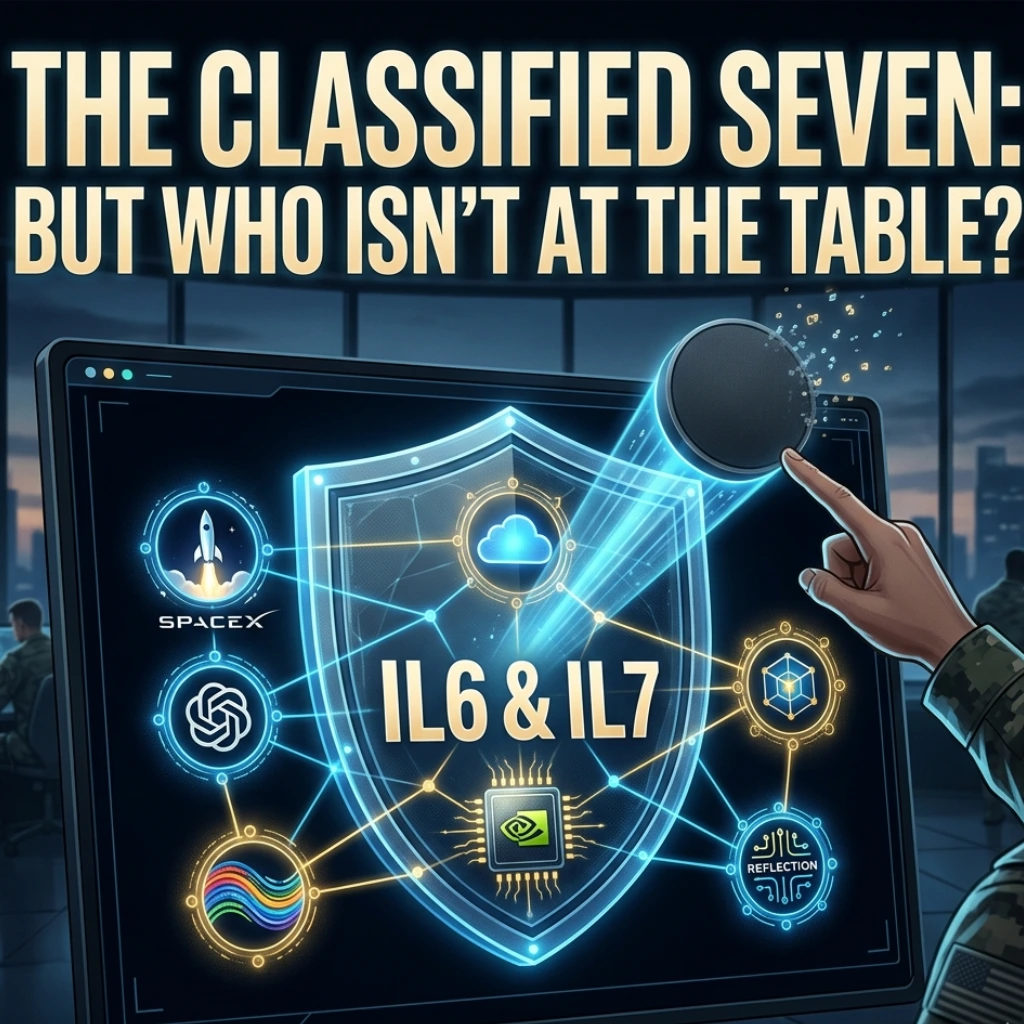
Is the future of warfare being written in lines of code? It certainly looks that way. In a move that feels like it’s ripped straight from a Tom Clancy novel, the U.S. Department of Defense (DoD) recently inked landmark agreements with seven of the world’s most powerful tech giants.
The goal? To deploy cutting-edge artificial intelligence across their most sensitive, “top-secret” classified networks. We are talking about Impact Level 6 (IL6) and beyond-the kind of digital fortresses where the nation’s most guarded secrets live.
But as the ink dries on these massive contracts, the industry is buzzing about one name that didn’t make the cut. According to a report by NDTV World News, while names like OpenAI and SpaceX are in, Anthropic is noticeably absent.
The “Magnificent Seven” of Defense AI
The Pentagon isn’t just “trying out” AI anymore; they are embedding it into the nervous system of national security. The list of partners includes a “who’s who” of Silicon Valley:
- OpenAI & Microsoft: Bringing the power of Large Language Models (LLMs) to intelligence analysis.
- Google & Amazon Web Services (AWS): Providing the massive cloud backbone required for global data processing.
- Nvidia: Supplying the raw GPU horsepower that makes modern AI possible.
- SpaceX: Bridging the gap between orbital satellite data and real-time AI decision-making.
- Reflection: The specialized player focusing on high-tier infrastructure.
By integrating these platforms into classified networks, the Pentagon aims to automate everything from logistics and predictive maintenance to real-time battlefield analysis. But why now? And why these specific players?
The Anthropic Mystery: A Strategic Snub?
Perhaps the biggest shockwave in the tech community is the omission of Anthropic. Known for its “Claude” AI and a heavy emphasis on “AI Safety,” Anthropic was previously seen as a darling of the Washington circuit. They held cleared status and were often touted as the “responsible” alternative to more aggressive firms.
So, what happened?
Was it a matter of technical compatibility with IL6 security protocols? Or perhaps a disagreement over the ethical boundaries of lethal autonomous systems? While the Pentagon remains tight-lipped, the exclusion suggests that when it comes to the highest stakes of national defense, “safety-first” branding might not be enough to secure a seat at the table.
Why Impact Level 6 (IL6) Matters
To understand the weight of these deals, you have to understand the environment. In the world of government data, not all clouds are created equal.
- IL2 & IL4: General public and sensitive unclassified info.
- IL5: Higher-level unclassified and some tactical data.
- IL6: The “Secret” tier. This requires physical separation from the internet and rigorous encryption.
By bringing OpenAI and Nvidia into this space, the U.S. is essentially building a “Sovereign AI.” They are creating a version of the tools we use every day-like ChatGPT-but contained within a vacuum where no data can leak to foreign adversaries. It’s about speed of decision-making. In a modern conflict, the side that processes data the fastest usually wins.
Final Thoughts: A New Era of Algorithmic Warfare
We are witnessing a fundamental shift in how global power is maintained. The Pentagon is no longer just buying tanks and jets; it is buying compute and reasoning.
The inclusion of companies like SpaceX and Reflection alongside traditional software giants shows that the U.S. wants a seamless pipeline from space-based sensors to the commander’s desk. However, the exclusion of Anthropic serves as a reminder that the defense sector is a cutthroat arena where “cleared status” doesn’t always guarantee a contract.
Will this move trigger a new “AI arms race” among private tech firms vying for government favor? Only time will tell. But for now, the digital front lines have been drawn, and the players have been chosen.
What do you think? Does the Pentagon’s reliance on private AI companies make the country safer, or does it hand too much power to Silicon Valley?
FAQs
Find answers to common questions below.
Why is the Pentagon moving AI to Impact Level 6 (IL6) networks?
IL6 is a "Secret" level classification that requires hardware to be physically disconnected from the public internet. Moving AI here allows the military to analyze sensitive combat data without the risk of external leaks or hacking.
Is OpenAI allowed to be used for military purposes now?
Yes. While OpenAI previously had restrictions on "warfare" applications, their policy was updated to allow for national security missions that align with democratic values, such as cybersecurity and logistics.
What does "Reflection" contribute to these defense deals?
Reflection specializes in high-tier infrastructure and data integrity, ensuring that the AI models running on classified networks don't "hallucinate" or provide corrupted data during critical missions.
Will Anthropic be added to the list later?
While they were omitted from this specific landmark deal, Anthropic still holds various government clearances. Their absence here may be a temporary technical hurdle rather than a permanent ban.