If you’ve spent any time tracking the stock market lately, you’ve likely noticed a recurring theme. The “Magnificent Seven” aren’t just surviving; they are thriving in a way that feels almost gravity-defying. But what is actually fueling this engine? Is it just hype, or are we seeing a fundamental shift in how the world’s most powerful companies make their bread?
According to recent Big Tech Profitability reports, the answer is clear: Generative AI has moved from a laboratory experiment to a primary revenue driver.
From Experiments to Essentials: Google’s Cloud Dominance
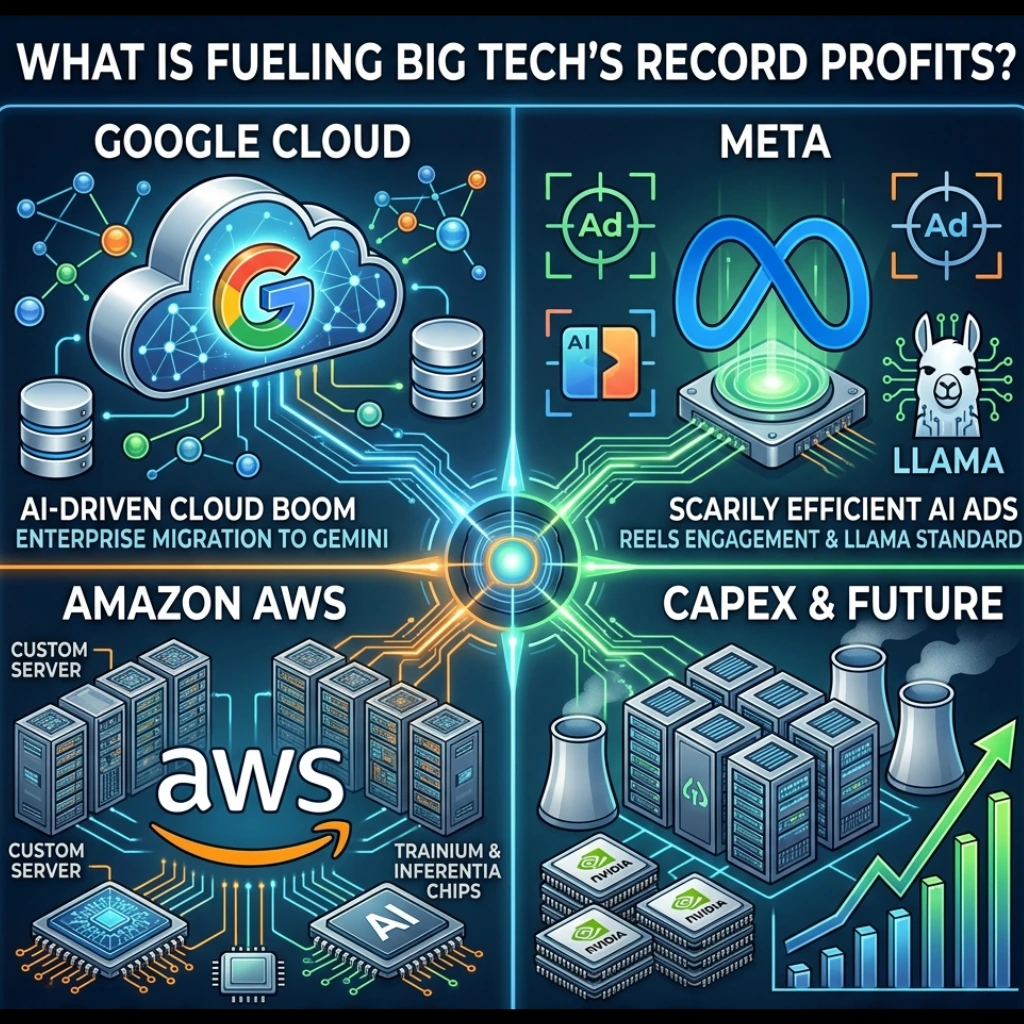
For years, Google’s primary identity was “the search company.” While ads still pay the bills, the latest quarterly figures show that Google Cloud is the new superstar. Businesses are no longer just “testing” AI; they are migrating their entire infrastructures to the cloud to take advantage of Google’s Gemini models.
But here’s the kicker: it’s not just about providing the tools. It’s about the efficiency of the ecosystem. By integrating AI directly into Workspace and Search, Google has created a “sticky” environment where corporate clients find it nearly impossible to leave. Have you noticed how your Gmail drafts or Spreadsheet data suddenly feel more intuitive? That’s the revenue engine at work.
Meta’s Massive Pivot: More Than Just Social Media
Remember when everyone was skeptical about Mark Zuckerberg’s pivot? The narrative has shifted. Meta is currently seeing record-breaking revenues, largely because AI-driven ad targeting has become scarily efficient.
By using Llama (Meta’s open-source large language model), the company has fixed the “signal loss” caused by privacy changes in previous years.
- Ad Spend Optimization: Small businesses are seeing higher ROIs because Meta’s AI knows exactly who to show an ad to.
- Engagement Loops: AI-recommended content on Instagram Reels has increased time spent on the platform by double digits.
- Open Source Strategy: By making Llama accessible, Meta has positioned itself as the “industry standard” for developers worldwide.
Is Meta still a social media company, or has it quietly become the world’s largest AI-marketing agency?
Amazon’s AWS: The Silent Backbone of the AI Revolution
While you’re busy tracking your latest package, Amazon’s real profit powerhouse-AWS (Amazon Web Services)-is undergoing a massive transformation. The latest earnings show that AWS is the preferred “foundry” for AI startups.
Amazon isn’t just selling software; they are selling the specialized chips (Trainium and Inferentia) and the massive compute power required to run the world’s most complex models.
- Enterprise Adoption: Fortune 500 companies are rushing to build “sovereign” AI models on AWS.
- Bedrock Expansion: Amazon’s platform allows businesses to “plug and play” various AI models without building their own from scratch.
The “Capex” Elephant in the Room
It’s not all sunshine and rainbows, though. To make these billions, these giants are spending billions. The “Capital Expenditure” (Capex) for Google, Meta, and Amazon has reached eye-watering levels. They are buying up every NVIDIA H100 chip they can find and building data centers at a record pace.
The big question for investors remains: Can the revenue growth stay ahead of the massive cost of building this AI infrastructure? So far, the answer is a resounding yes.
Final Thoughts: A New Economic Era?
We are witnessing a moment where “AI services” are becoming as essential as electricity or internet connectivity. The rush to adopt isn’t just a trend; it’s a structural change in how global business functions.
As Google, Meta, and Amazon continue to report record-breaking numbers, one thing is certain: the companies that own the “intelligence” will own the future. Are we prepared for a world where every business decision is filtered through a Big Tech algorithm? Only time-and the next earnings report-will tell.
FAQs
Find answers to common questions below.
Is the AI boom just a bubble, or is it actually generating cash?
Unlike the early days of the metaverse, current earnings show that AI is driving tangible revenue through cloud services, better ad targeting, and enterprise subscriptions.
Which Big Tech company is winning the AI race right now?
While Google and Microsoft lead in tools, Meta has surprised the market by using AI to massively increase its advertising efficiency and user engagement.
Why are these companies spending billions if they are already profitable?
It’s an arms race. To maintain Big Tech AI profitability, these giants must invest heavily in specialized chips and data centers to stay ahead of competitors and startups.
Will AI services become more expensive for regular businesses?
As demand surges, pricing models are shifting from flat fees to consumption-based "pay-as-you-go" models, making efficiency more important than ever.