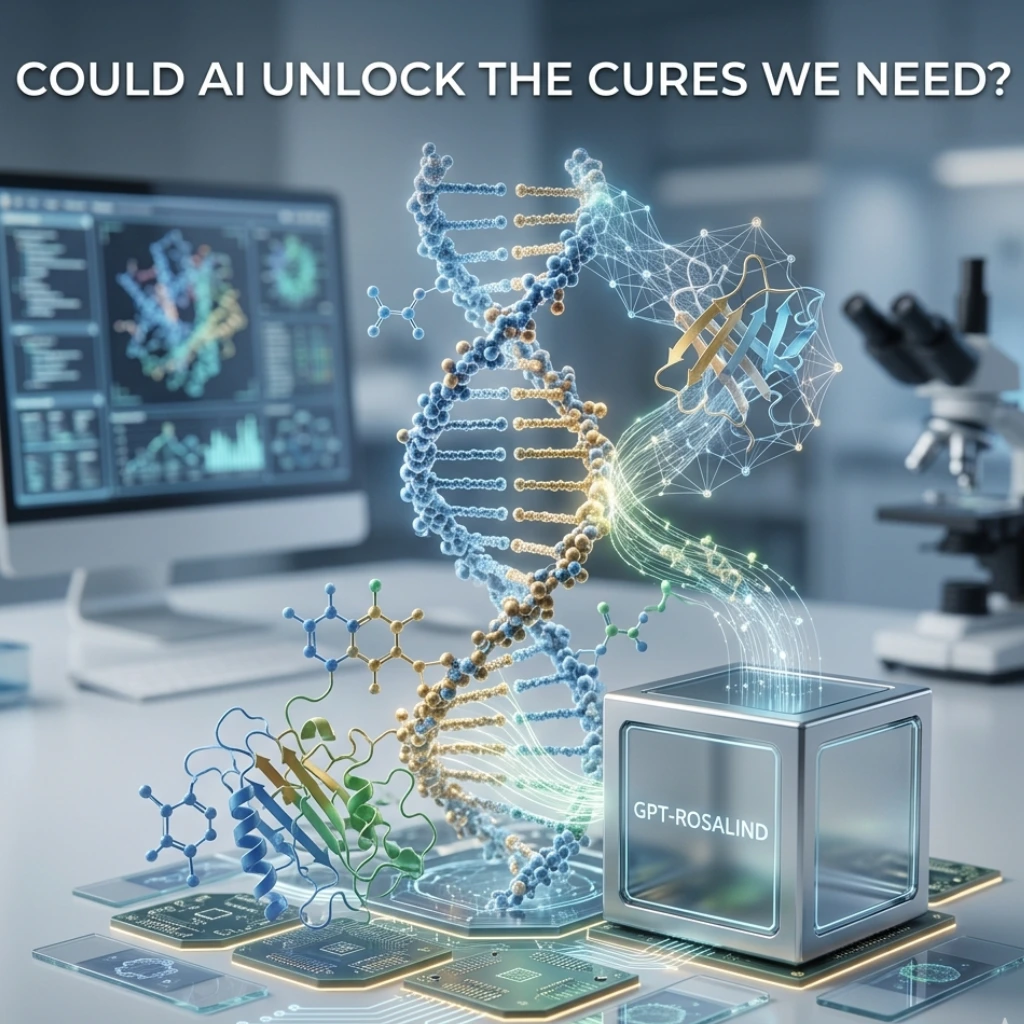
Have you ever wondered why it takes over a decade and billions of dollars to bring a single life-saving drug to market? The bottleneck has always been the sheer complexity of human biology-a puzzle with trillions of pieces. But what if we had a “biochemical genius” sitting on our desk, ready to decode protein structures in seconds?
Enter GPT-Rosalind. OpenAI has officially shifted the goalposts from general-purpose chatbots to highly specialized scientific engines. Named after the unsung hero of DNA structure, Rosalind Franklin, this new model isn’t here to write poems or summarize emails. It’s here to rewrite the blueprint of translational medicine.
According to a recent report by The Hindu, this model is specifically engineered to bridge the gap between lab research and clinical application.
Beyond the Chatbot: What Makes GPT-Rosalind Different?
Most LLMs are “jacks of all trades.” They know a little bit about everything but lack the “depth” required for high-stakes laboratory work. GPT-Rosalind is different. It has been trained on massive datasets of genomic sequences, molecular structures, and peer-reviewed biochemical literature.
Instead of just predicting the next word in a sentence, it predicts how a molecule might bind to a specific protein. Why does this matter? Because in the world of drug discovery, a single miscalculation can lead to years of wasted research. GPT-Rosalind acts as a high-speed filter, identifying viable drug candidates long before a scientist ever touches a Petri dish.
Accelerating the Lab-to-Pharmacy Pipeline
The term “translational medicine” often sounds like industry jargon, but it’s actually the most critical part of healthcare. It’s the process of turning a laboratory discovery into a treatment you can actually buy at a pharmacy. Currently, this “valley of death” is where most medical breakthroughs fail.
GPT-Rosalind aims to fix this by:
- Simulating Molecular Interactions: Reducing the need for trial-and-error in the early stages of chemistry.
- Analyzing Genomic Data: Helping researchers understand why certain patients respond to treatments while others don’t.
- Automating Literature Reviews: Scanning millions of research papers to find connections between rare diseases and existing compounds.
Could this be the end of the “hit-or-miss” era of medicine? While we aren’t there yet, the speed at which AI can now process biological data suggests we are entering a “fast-track” era of innovation.
The Ethical Frontier: Innovation vs. Safety
When we talk about AI and biology, the conversation inevitably turns to safety. OpenAI has integrated specific guardrails into GPT-Rosalind to prevent the misuse of biological data. The goal is empowerment, not risk. By focusing on biochemistry and life sciences research, OpenAI is positioning this tool as a co-pilot for PhDs and medical researchers, rather than a replacement for human expertise.
Is the scientific community ready to trust an algorithm with the future of healthcare? The consensus seems to be a cautious “yes.” As long as AI remains a tool for augmentation, the potential for discovering cures for previously “untreatable” conditions is massive.
Final Thoughts: The Future is Molecular
The launch of GPT-Rosalind marks a significant pivot for OpenAI. We are moving away from “AI that talks” toward “AI that builds.” By focusing on the microscopic world of molecules, OpenAI might just help solve some of the macroscopic problems of human health.
Whether you are a researcher in a lab or someone waiting for a medical breakthrough, one thing is clear: the pace of discovery is about to go vertical. Are we ready for a world where drugs are designed in weeks rather than decades?
FAQs
Find answers to common questions below.
How does GPT-Rosalind differ from GPT-4?
While GPT-4 is a generalist, GPT-Rosalind is a specialist. It is fine-tuned with specialized biological and chemical datasets, making it capable of understanding complex molecular nomenclature and biological pathways that general models might hallucinate.
Can GPT-Rosalind actually create new medicine?
Not alone. It identifies "leads" or high-probability molecular candidates. Human scientists must still conduct clinical trials and physical lab testing to ensure safety and efficacy.
Why was it named "Rosalind"?
The model is a tribute to Rosalind Franklin, the chemist whose X-ray diffraction images were instrumental in discovering the DNA double helix-symbolizing the model's focus on deep biological structure.