
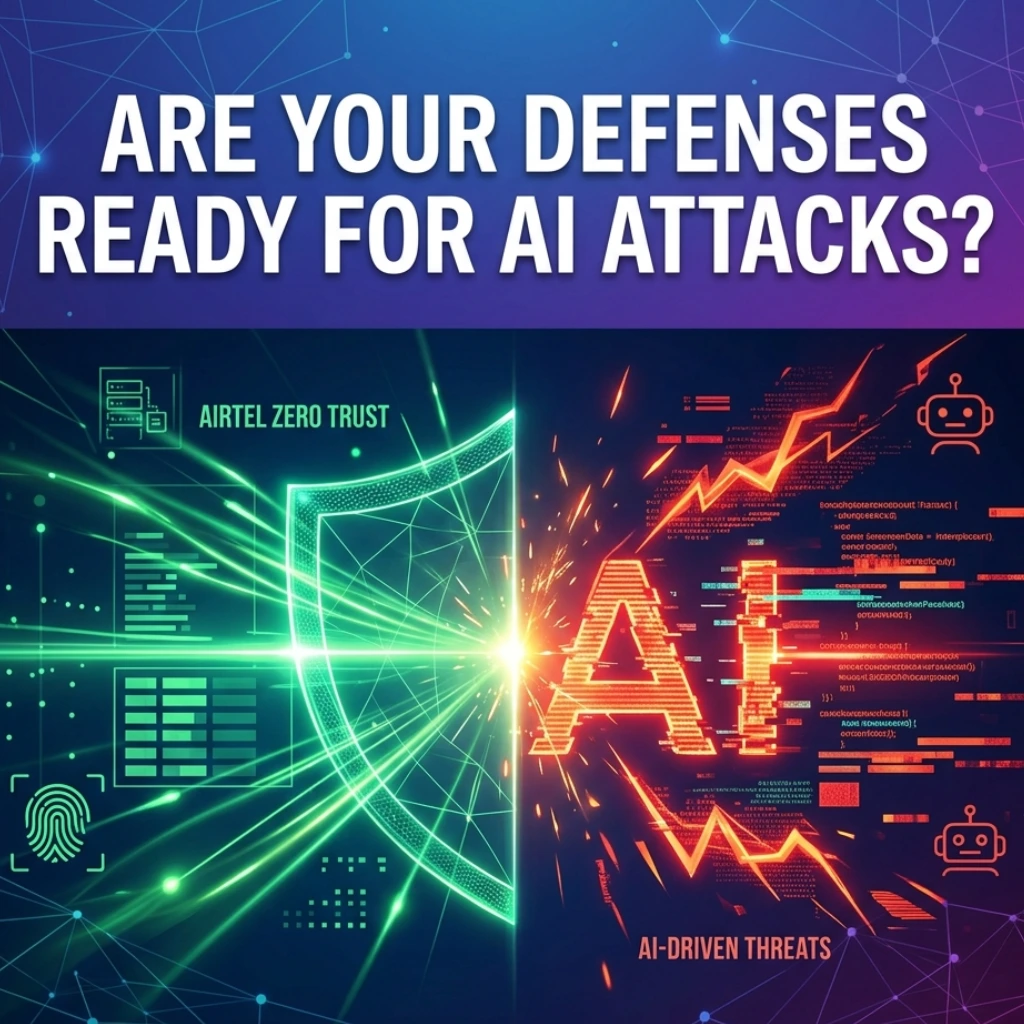
Have you ever wondered if the very technology helping your business grow is also the one sharpening the tools of your next attacker? It’s a sobering thought. As artificial intelligence becomes the backbone of modern enterprise, it has simultaneously become a weapon for cybercriminals. From hyper-realistic phishing emails to automated malware that evolves in real-time, the threat landscape in India is shifting faster than most IT teams can keep up with.
In response to this escalating digital arms race, Bharti Airtel has stepped into the ring. The telecom giant recently unveiled its unified “Zero Trust” security platform, a move specifically engineered to combat the surge of AI-driven cyberattacks. But is this just another corporate security buzzword, or is it the shield Indian enterprises have been waiting for?
The “Never Trust, Always Verify” Paradigm
For years, traditional security focused on a “castle-and-moat” strategy: protect the perimeter, and once someone is inside, they are trusted. But what happens when the attacker steals a legitimate employee’s credentials using an AI-generated deepfake? The moat becomes useless.
Airtel’s new initiative, as reported by The Times of India, adopts the Zero Trust Architecture (ZTA). This approach operates on a simple, albeit cynical, mantra: “Never trust, always verify.”
Whether you are the CEO sitting in the corner office or a remote freelancer logging in from a café in Bengaluru, the system treats every access request as a potential threat. It continuously validates identity, device health, and context before granting the minimum level of access required.
Why India? Why Now?
Why is Airtel focusing so heavily on AI-driven threats right now? The data tells a compelling story. India has seen a massive spike in sophisticated breaches targeting critical infrastructure and the BFSI (Banking, Financial Services, and Insurance) sector.
Key features of the platform include:
- AI-Enhanced Threat Detection: Using machine learning to identify patterns of “unusual behavior” that human analysts might miss.
- Unified Security Management: Consolidating multiple security tools into a single pane of glass, reducing the complexity that often leads to human error.
- Secure Access Service Edge (SASE) Integration: Ensuring that security follows the user, regardless of their location or device.
By integrating these elements, Airtel isn’t just selling a product; they are offering a proactive defense mechanism against bots that can attempt thousands of login combinations in seconds.
Neutralizing the “AI vs. AI” Conflict
The most fascinating part of this launch is how Airtel is using AI to fight AI. Traditional firewalls are often reactive—they block threats they recognize. However, AI-driven attacks are polymorphic; they change their “signature” to bypass detection.
Airtel’s platform leverages predictive analytics. It doesn’t just wait for a breach to happen; it anticipates where the vulnerabilities lie. Can an algorithm outsmart a hacker? In the world of high-speed data, it’s the only way to level the playing field. This unified platform ensures that Indian enterprises can scale their digital operations without feeling like they’ve left the front door unlocked.
Final Thoughts: A New Standard for Enterprise Security
The launch of this unified Zero Trust platform marks a significant milestone for India’s tech ecosystem. It acknowledges a harsh reality: in a world where AI is democratizing cyber-crime, “good enough” security is no longer an option.
As businesses continue to migrate to the cloud and embrace hybrid work models, the perimeter has effectively disappeared. Airtel’s move provides a much-needed resilience framework for the modern age. Will this stop every attack? Perhaps not. But it certainly makes the cost of entry for attackers much higher and gives Indian enterprises the fighting chance they deserve.
Are your current security protocols ready for an AI-generated onslaught, or are you still relying on yesterday’s defenses? It might be time to stop trusting—and start verifying.
FAQs
Find answers to common questions below.
Why is "Zero Trust" better than traditional firewalls for Indian businesses?
Traditional firewalls protect the "border," but Zero Trust assumes the threat is already inside, verifying every single request to prevent AI-driven data leaks.
Can Airtel’s Zero Trust AI actually detect deepfakes and social engineering?
Yes, by analyzing behavioral patterns rather than just passwords, the platform can flag suspicious access requests that "mimic" human behavior.
Is this platform only for large corporations?
While designed for enterprises, the scalability of Airtel’s unified platform makes it a vital shield for any organization handling sensitive digital data in India.
How does Airtel use "AI to fight AI"?
The platform uses predictive machine learning to anticipate and block polymorphic malware that constantly changes its code to dodge standard antivirus software.