
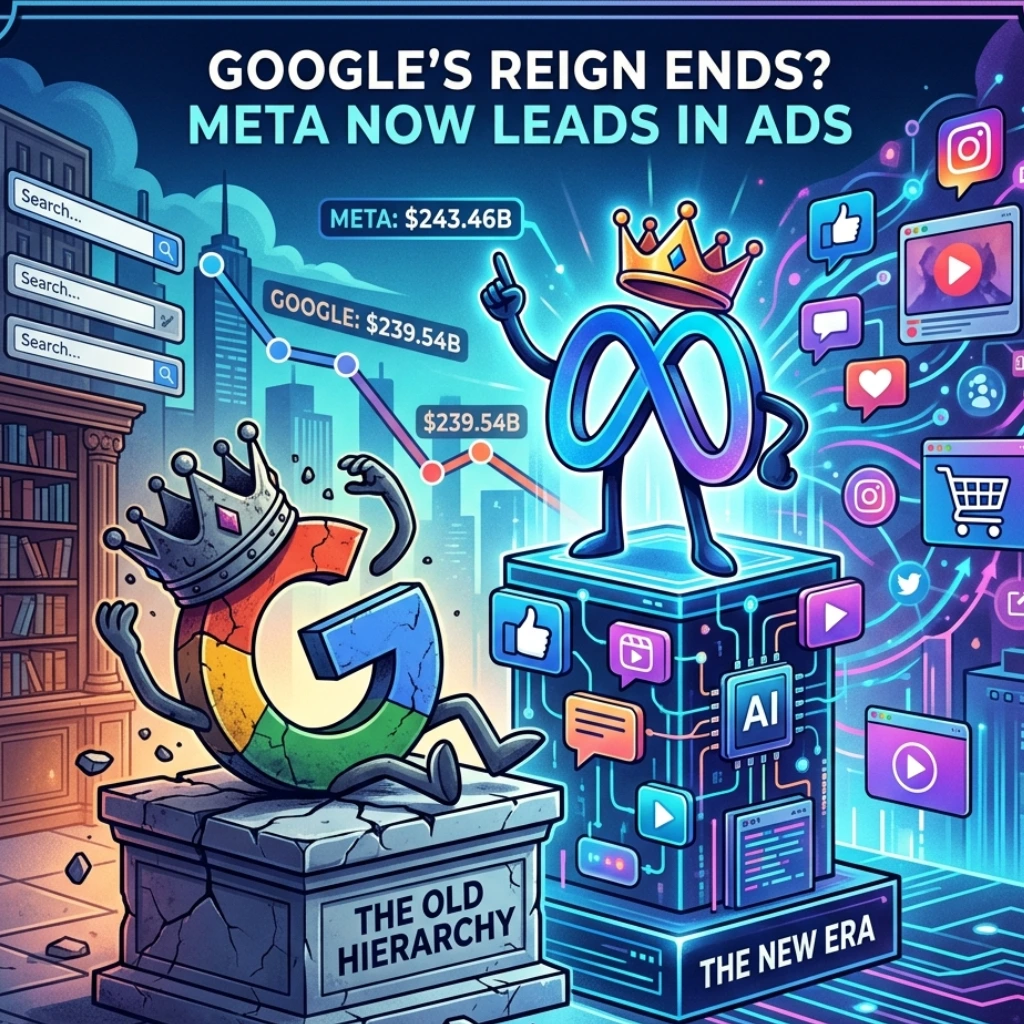
For over a decade, the hierarchy of the digital world felt written in stone: Google was the undisputed king of the mountain, and everyone else was just playing for second place. But have you noticed a shift in the wind lately?
A landmark report from eMarketer has sent shockwaves through Silicon Valley, suggesting that for the first time, Meta will surpass Google in ad revenue this year. We are looking at a projected $243.46 billion for Mark Zuckerberg’s empire, narrowly edging out Google’s projected $239.54 billion.
Is this just a statistical fluke, or are we witnessing the end of an era?
The AI Engine Under the Hood
How did Meta pull this off? Just two years ago, the company was reeling from Apple’s privacy changes, which many thought would cripple its advertising business forever. Instead of folding, Meta went all-in on AI-driven ad improvements.
While Google relies heavily on users knowing exactly what they want to search for, Meta’s AI has become eerily good at “discovery.” By leveraging massive computational power, Meta now predicts what you want before you even realize it. This pivot to Advantage+ shopping campaigns and automated creative tools has turned Facebook and Instagram into high-converting machines for small and large businesses alike.
Why Google is Feeling the Heat
It’s not that Google is failing-it’s that the nature of the internet is changing. When was the last time you “Googled” something and found exactly what you needed on the first try without scrolling through a sea of sponsored links?
Google is currently fighting a multi-front war:
- The Rise of TikTok: Gen Z is increasingly using social platforms as search engines.
- Search Generative Experience (SGE): Google’s transition to AI search risks cannibalizing its own ad clicks.
- Regulatory Pressure: Anti-trust suits are looming over its core search and ad-tech business.
Meanwhile, Meta has simplified its product strategy, focusing on Reels monetization and a unified messaging-to-ad pipeline that feels more “human” and less like a static directory.
A Landmark Shift in Digital Strategy
What does this mean for the average marketer or business owner? The “Meta vs Google” debate is no longer about which one is bigger; it’s about which one is smarter.
The eMarketer report highlights that Meta’s growth isn’t just coming from more users-it’s coming from better yields. By making ads feel like native content, Meta has bypassed the “ad blindness” that often plagues Google’s display network.
Key takeaways from the revenue shift:
- Precision over Volume: AI-targeting is now more effective than keyword-targeting for certain niches.
- The Social Commerce Boom: People are buying directly within the app, shortening the sales funnel.
- Video Dominance: Reels have successfully neutralized the threat of TikTok, keeping eyes-and dollars-on Meta’s platforms.
Final Thoughts: The New King of the Hill?
Does this mean Google is heading for irrelevance? Hardly. But the “Search Giant” label is no longer a shield against competition. We are entering a “Social-First” advertising era where engagement and predictive AI are the new gold standards.
Will Google pivot fast enough to reclaim its crown, or is Meta’s momentum simply too strong to stop? One thing is certain: the digital ad landscape will never look the same again.
FAQs
Find answers to common questions below.
Is Meta actually making more money than Google overall?
While the eMarketer report focuses on net ad revenue, Google's parent company, Alphabet, still has massive revenue streams from Cloud and YouTube. However, in the specific arena of advertising-their core business-Meta is now the projected leader.
How did Meta recover from Apple’s privacy (ATT) changes?
Meta invested billions in AI models that use "probabilistic" data and machine learning to track conversions without needing the invasive tracking that Apple blocked.
Does this mean I should move my entire ad budget to Facebook?
Not necessarily. Google still wins for "high-intent" buyers (people looking for a specific service now). Meta wins for brand discovery and impulse purchases.