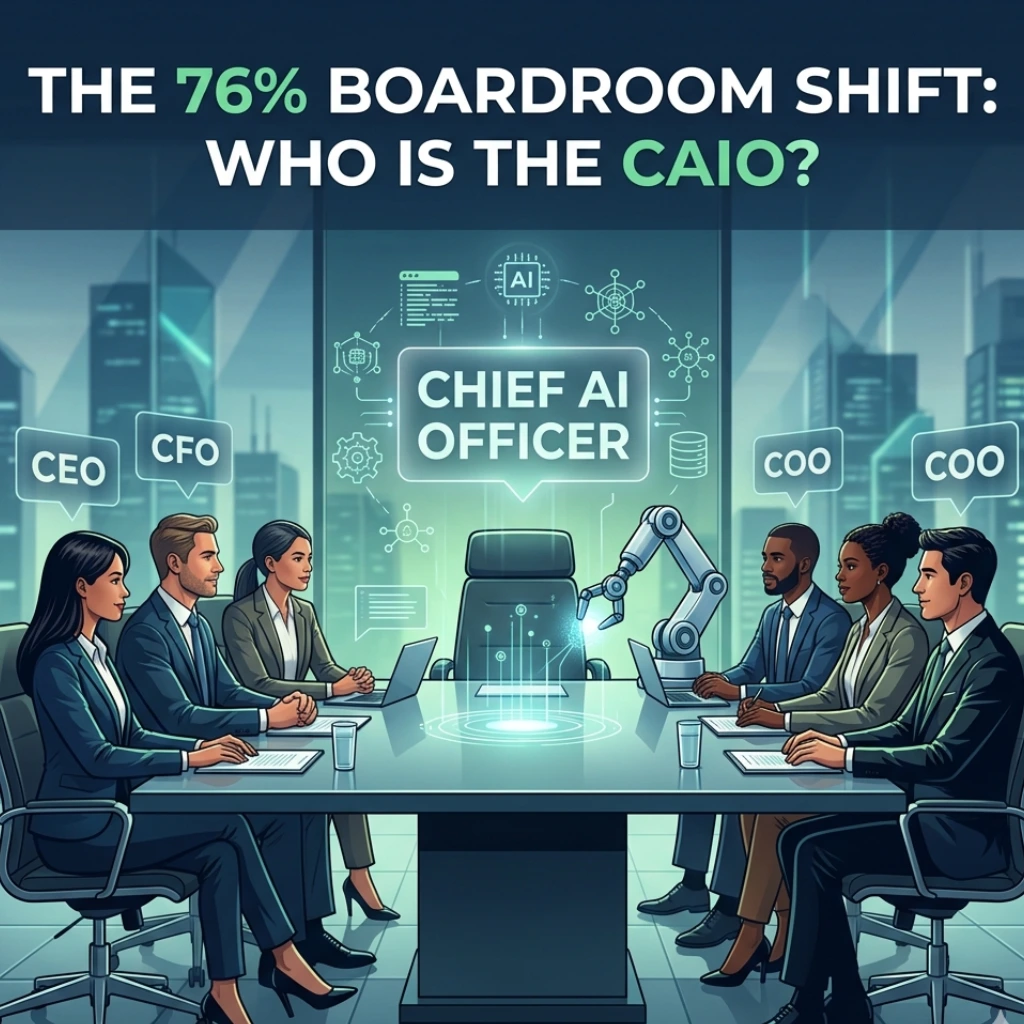
What was the last big “must-have” title in the corporate world? A decade ago, everyone scrambled for a Chief Digital Officer. Then came the Data Scientists. But if you walk into a boardroom today, there’s a new seat at the table-and it’s already occupied in three out of four companies.
According to a new IBM global study, a staggering 76% of organizations have now appointed a Chief AI Officer (CAIO). This isn’t just a trend or a fancy title for the IT guy; it’s a fundamental shift in how businesses breathe and operate. CEOs are moving past the “experimentation” phase and sprinting toward an “AI-first” operating model.
But why the sudden urgency? And does adding one more acronym to the C-suite actually solve the productivity puzzle?
From Pilot Projects to AI-First DNA
For the past year, most companies treated Generative AI like a shiny new toy. They ran small pilots, drafted “use-case” memos, and waited to see if the hype would die down. It didn’t. Instead, it became clear that AI isn’t a software update-it’s a paradigm shift.
The IBM study highlightsthat CEOs are no longer content with AI living in a silo. They are reshaping roles because AI-first models require a bridge between technical capability and business strategy. Is your HR department ready for automated talent vetting? Can your supply chain predict a shortage before it happens?
Without a Chief AI Officer to orchestrate these moves, most companies find themselves with a dozen different AI tools that don’t talk to each other. The CAIO’s job isn’t just to buy the tech; it’s to ensure the tech actually talks to the bottom line.
Why the Chief AI Officer is the New “Power Seat”
You might wonder: Don’t we already have a CTO or a CIO for this?
While the Chief Information Officer manages the pipes, the CAIO manages the intelligence flowing through them. The IBM research suggests that the modern C-suite is becoming more collaborative and fluid. Here is what this new breed of leader is actually doing:
- Governance and Ethics: Ensuring the AI doesn’t hallucinate or leak sensitive customer data.
- Cultural Translation: Convincing skeptical employees that AI is a co-pilot, not a replacement.
- Value Realization: Moving away from “cool tech” to “ROI-driven tech.”
- Legacy Integration: Figuring out how to make 20-year-old databases play nice with 2024 Large Language Models (LLMs).
Boldly put, the CAIO is the glue holding the digital transformation together. Without this role, the “AI-first” vision remains just a bullet point in an annual report.
The “Human” Friction in the Machine
Despite the 76% adoption rate, it isn’t all smooth sailing. The IBM CEO Study reveals a hidden tension: the talent gap.
While CEOs are eager to redesign their leadership teams, they are struggling with a workforce that feels overwhelmed. You can’t just flip a switch and become an AI-driven company. It requires a massive “upskilling” effort. Are your managers ready to lead teams that consist of both humans and autonomous agents?
The most successful leaders aren’t just hiring a CAIO; they are redesigning the entire C-suite ecosystem to be more agile. They are breaking down the walls between Marketing, Finance, and IT to create a “unified intelligence” strategy.
Final Thoughts: Is Your Seat Reserved?
The rise of the Chief AI Officer marks the end of the “wait and see” era. As the latest IBM data shows, the question is no longer if AI will run your business, but who will be at the helm when it does.
We are witnessing a corporate evolution where the most valuable leaders are those who can balance algorithmic efficiency with human empathy. Whether you’re a CEO, a manager, or an entry-level creator, the message is clear: AI is the new operating system, and the redesign has already begun.
Are you ready to work for a CAIO, or better yet, are you ready to become one?
FAQs
Find answers to common questions below.
Is the Chief AI Officer just a temporary trend?
Unlike short-lived buzzwords, the CAIO addresses the permanent complexity of integrating neural networks into daily operations, making it a foundational shift rather than a fad.
How does a CAIO differ from a traditional CTO?
While a CTO focuses on the overall technology stack, the CAIO specifically manages the data ethics, model training, and ROI of artificial intelligence across all departments.
Can small businesses afford a C-Suite redesign for AI?
Redesigning doesn't always mean hiring a million-dollar executive; for smaller firms, it often involves pivoting existing leadership roles to prioritize "AI-first" decision-making.
What is the biggest risk of not having a CAIO?
The primary risks include "shadow AI" (employees using unapproved tools), data leaks, and falling behind competitors who have streamlined their AI productivity.