Think about the last time a single technology felt like a gold rush. Not just a trend, but a complete tectonic shift in how money, labor, and logic function. We’ve seen it with the internet and the smartphone, but what’s happening in India right now is on a different scale entirely.
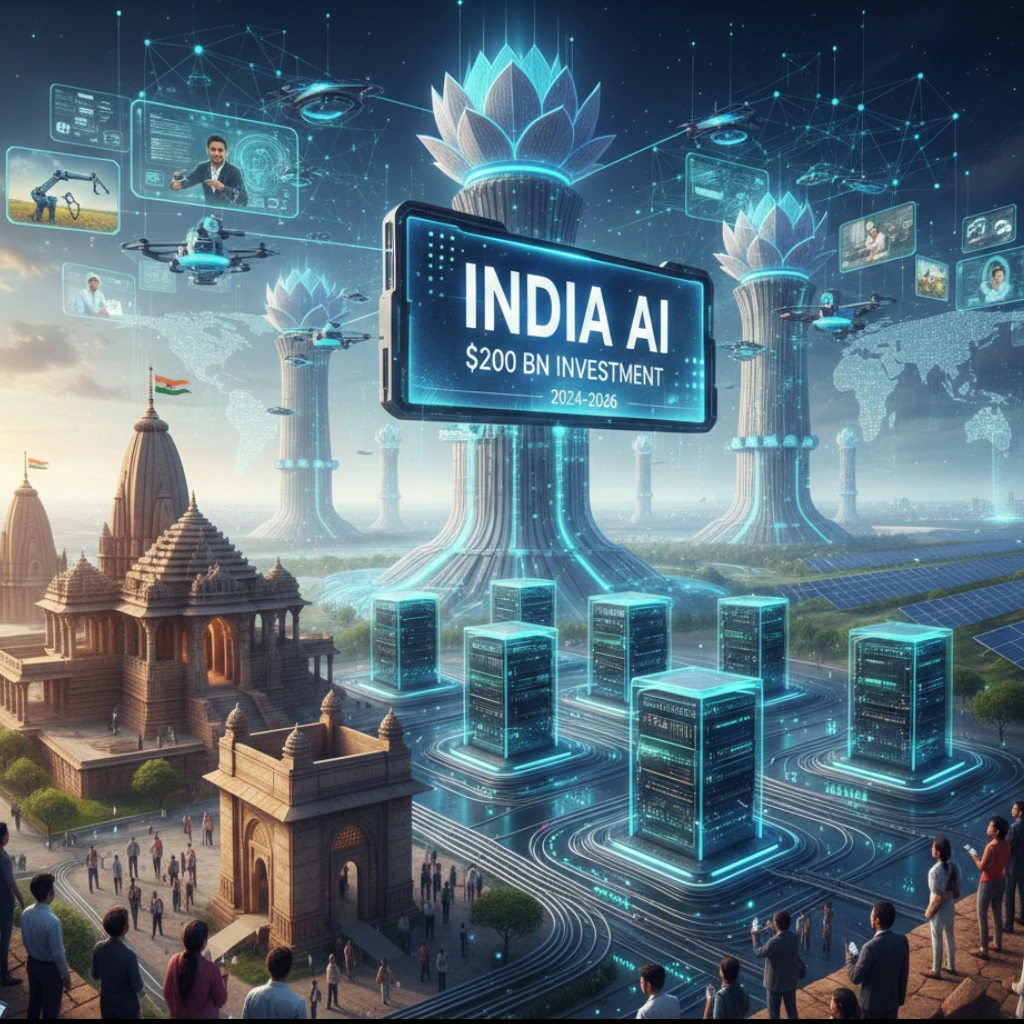
During a recent industry address, IT Minister Ashwini Vaishnaw dropped a figure that made global investors lean in: India is set to attract over $200 billion in AI investments over the next two years.
But is this just optimistic political posturing, or are we witnessing the birth of a new global AI superpower? Let’s break down what this massive capital influx actually means for the “AI stack” and why the world is suddenly betting the farm on India.
The Full-Stack Ambition: Beyond Just Chatbots
When we hear “AI,” most of us think of ChatGPT or mid-journey art. However, Vaishnaw’s vision covers the entire “AI Stack.” This isn’t just about building apps; it’s about the raw materials of the future. According to the official announcement, India to attract $200 Bn in AI investments, the capital will be spread across:
- Compute Power: Building the massive data centers and GPU clusters needed to process LLMs (Large Language Models).
- Edge Computing: Bringing AI processing closer to the user’s device, reducing latency.
- The Application Layer: Domestic startups creating localized solutions for healthcare, agriculture, and vernacular languages.
Why does the “stack” matter? Because owning the infrastructure means India won’t just be a consumer of Western AI; it will be the landlord of its own digital ecosystem.
Why India? Why Now?
You might wonder: What makes India more attractive than, say, Silicon Valley or Shenzhen right now? It comes down to the “Triple Threat” of Data, Talent, and Policy. India has the largest pool of STEM graduates globally and a staggering amount of diverse data—the “fuel” for AI. When you combine this with the government’s IndiaAI Mission, which has already earmarked significant subsidies for computing infrastructure, the environment becomes a magnet for venture capital.
We aren’t just seeing interest from local players like Reliance or Tata. Global giants are shifting their supply chains and R&D hubs to Bengaluru and Hyderabad, recognizing that the next billion AI users will come from the subcontinent.
Can the Infrastructure Keep Up?
A $200 billion projection is a massive promise. To put that in perspective, that is nearly double India’s current annual electronics production value. The challenge isn’t just getting the money; it’s spending it wisely.
- Energy Demands: AI is a power-hungry beast. Can India’s grid handle the surge in data centers?
- The Chip Question: While the investment is huge, India is still in the early stages of semiconductor fabrication.
- The Talent Pivot: We have the engineers, but do we have enough AI researchers? The shift from traditional software coding to neural network architecture is a steep learning curve.
Despite these hurdles, the momentum is undeniable. The government is actively courting global chipmakers and cloud providers to ensure the hardware matches the financial ambition.
Final Thoughts: A New Digital Sovereignty
We are moving past the era where India was simply the “back office” of the world. With a $200 billion roadmap, the goal is Digital Sovereignty.By investing in every layer of the AI stack—from the silicon chips to the final user interface—India is ensuring it doesn’t just participate in the AI revolution; it leads it.
o, is India ready to become the world’s neural network? The capital is coming, the policy is set, and the talent is hungry. The next 24 months won’t just change the Indian economy; they will likely redefine the global tech hierarchy.
FAQs
Find answers to common questions below.
Is $200 billion in AI investment realistic for India by 2026?
With the "IndiaAI Mission" and heavy interest from global chipmakers and data center developers, the roadmap is aggressive but backed by massive domestic and foreign capital.
What exactly is the "AI Stack" mentioned by the IT Minister?
It refers to the layers of AI development: the hardware (chips/GPUs), the infrastructure (cloud/data centers), the models (LLMs), and the final applications (apps/software).
How will these AI investments affect the Indian job market?
While automation is a concern, this $200 billion influx is expected to pivot India from traditional IT outsourcing to high-value AI research and semiconductor design roles.
Who are the major players driving this $200 billion surge?
A mix of global giants (like NVIDIA and Microsoft) and domestic titans (like Reliance and Tata) are leading the charge in building India’s AI infrastructure.