
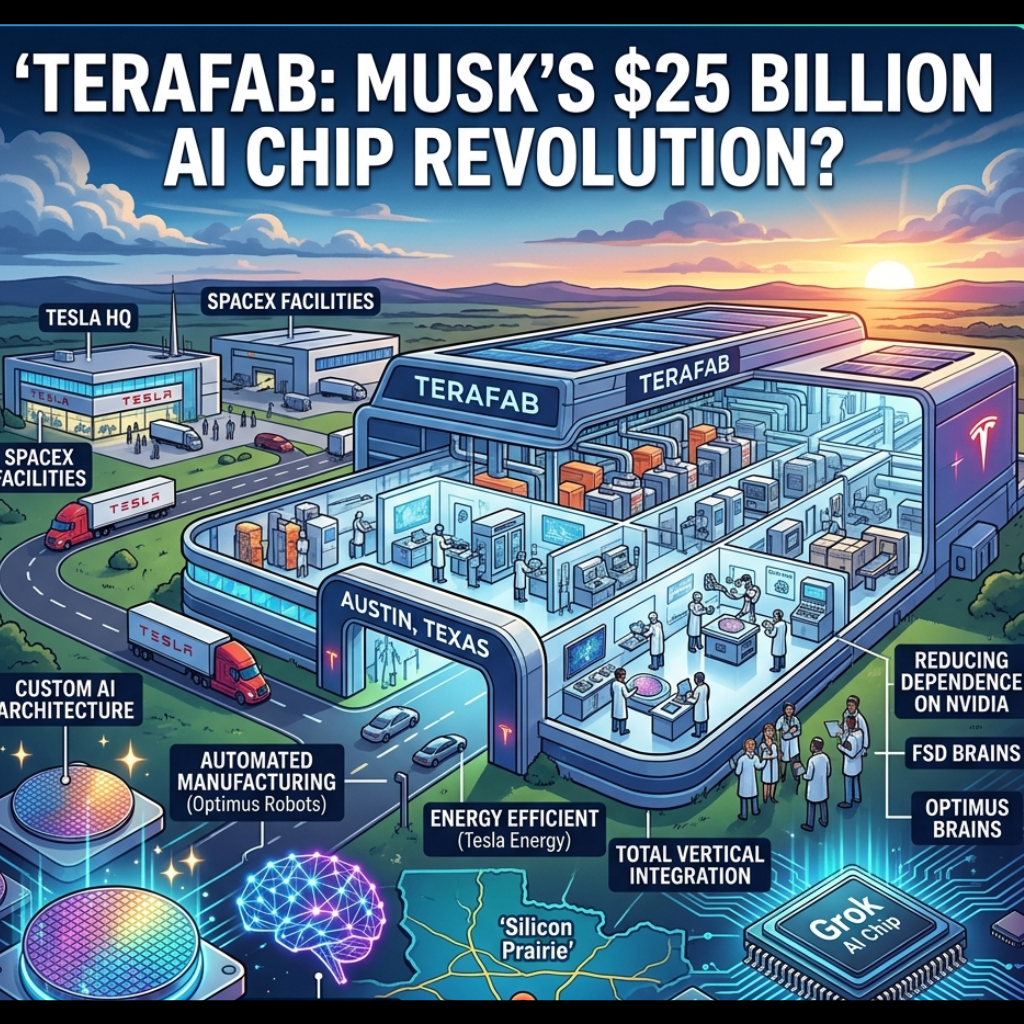
The tech world is used to Elon Musk making big promises, but his latest move might be the most audacious one yet. Imagine a facility so large and technologically dense that it makes current “Gigafactories” look like local workshops.
Enter the Terafab.
Musk has officially pulled back the curtain on a massive $20–$25 billion semiconductor project located just outside of Austin, Texas. But this isn’t just another factory; it’s a declaration of independence. For years, the tech industry has been held hostage by a tightening supply of high-end AI chips. Is Musk about to break the cycle and become his own supplier?
Why Austin? The New Silicon Prairie
Texas has rapidly transformed into the “Silicon Prairie,” and for good reason. By placing the Terafab near his existing Tesla headquarters and SpaceX facilities, Musk is creating a closed-loop ecosystem.
Building a semiconductor plant from scratch is notoriously difficult-it requires billions in capital, extreme precision, and a massive amount of water and power. So, why take the risk? Because relying on third-party manufacturers like Nvidia or TSMC has become a bottleneck for Musk’s ambitions. Whether it’s powering Tesla’s Full Self-Driving (FSD) software or training xAI’s Grok, the need for raw compute power is infinite.
According to reports from The Hindu, the Elon Musk launches Terafab project to make own AI chips, signaling a shift toward total vertical integration. If you can’t buy the brains for your robots, why not just build the factory that makes them?
Inside the Terafab: More Than Just Silicon
The scale of this investment-up to $25 billion-puts it in the same league as Intel’s and Samsung’s newest fabrication plants. But Musk’s approach is expected to be different. Industry insiders suggest the Terafab will focus on:
- Custom AI Architecture: Designing chips specifically for neural network training rather than general-purpose computing.
- Energy Efficiency: Leveraging Tesla’s energy storage technology to run the plant on a more sustainable grid.
- Automated Manufacturing: Using Tesla’s “Optimus” robot prototypes to handle delicate wafer movements within the cleanrooms.
Can you imagine a factory where robots are literally building the “brains” for the next generation of robots? It sounds like science fiction, but in the Austin suburbs, it’s becoming the new reality.
The Nvidia Problem: A Strategic Divorce?
For the past two years, Nvidia has reigned supreme, with its H100 and Blackwell chips being the “gold bullion” of the tech world. Every major player, from Microsoft to Meta, is fighting for a seat at Jensen Huang’s table.
By building the Terafab, Musk is essentially exiting the waiting room. While he has praised Nvidia in the past, he is also a man who hates being dependent on anyone else’s timeline. This move is a clear signal to the market: The future of AI isn’t just about software; it’s about who owns the hardware. But here’s the million-dollar question: Can a newcomer, even one as well-funded as Musk, master the incredibly complex physics of 3nm or 2nm chip production? The learning curve is steep, and the “yield rates” (the percentage of working chips per wafer) have bankrupted many companies before they even started.
Final Thoughts: A High-Stakes Revolution
The Terafab project is a classic Musk “moonshot.” It is expensive, incredibly risky, and potentially world-changing. If successful, it secures Texas’s spot as the global hub for AI hardware and gives Musk the “compute sovereignty” he craves to dominate the AI landscape.
Will this project solve the global chip shortage, or is it a bridge too far even for the world’s richest man? Only time-and about $25 billion-will tell. One thing is certain: the race for AI supremacy just got a lot more interesting.
FAQs
Find answers to common questions below.
What exactly is the Elon Musk Terafab project?
It is a massive, $20–$25 billion semiconductor fabrication plant located near Austin, Texas, dedicated to producing custom AI chips for Musk’s ventures like Tesla and xAI.
Why is Musk building his own chip factory instead of buying from Nvidia?
To achieve "compute sovereignty." By controlling the hardware, Musk avoids supply chain bottlenecks and can tailor chip architecture specifically for neural networks and FSD (Full Self-Driving) software.
Will the Terafab impact the global chip shortage?
While primarily for internal use, the scale of the Terafab could reduce the demand pressure on other manufacturers, potentially stabilizing the high-end AI chip market.
Is Texas becoming the new global hub for semiconductors?
Absolutely. With the Terafab joining Samsung and TI's massive investments, the "Silicon Prairie" is rivaling Taiwan and Silicon Valley for hardware dominance.