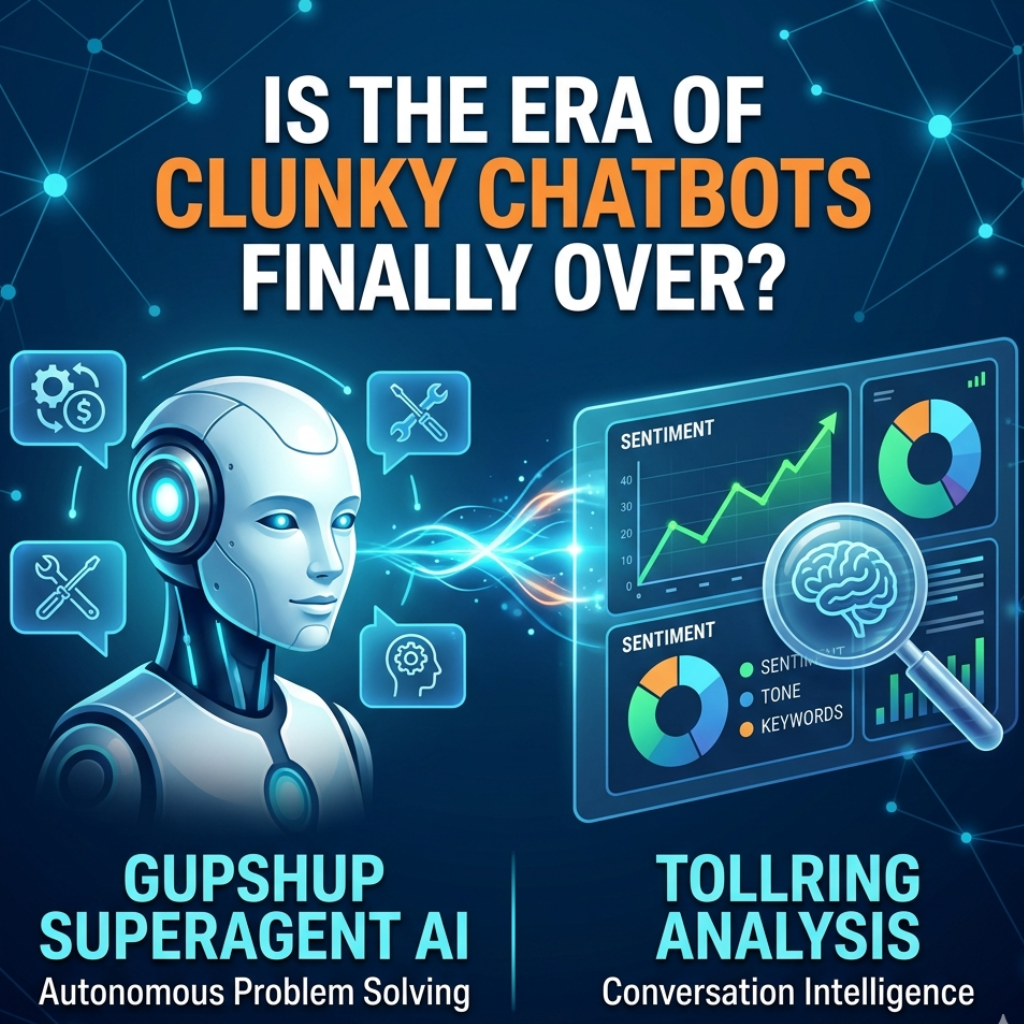
Is the era of the clunky, “I didn’t quite get that” chatbot finally over? If recent moves by industry heavyweights are any indication, we are moving past simple automation and into the age of genuine digital autonomy.
This week, the conversational AI landscape shifted significantly as Gupshup and Tollring unveiled new tools designed to do more than just answer FAQs-they are designed to think, analyze, and scale. But what does this mean for the average business trying to keep up with a customer base that demands instant gratification?
Gupshup’s ‘Superagent’: More Than Just a Bot
India-based unicorn Gupshup has long been a leader in the messaging space, but their latest launch, Superagent, feels like a leap forward. Unlike traditional bots that follow a rigid “if-this-then-that” logic, Superagent is an autonomous AI agent built to handle complex, multi-turn conversations without human intervention.
Why is this a big deal? Because it addresses the “scaling paradox.” Usually, as a company grows, the quality of customer support dips unless you hire an army of agents. Superagent aims to break that cycle.
According to a report by Tech in Asia, these agents can tap into a company’s knowledge base, understand intent, and actually solve problems-like processing a refund or troubleshooting a technical glitch-rather than just redirection.
Key features of Superagent include:
- Deep Integration: It connects directly to backend systems (CRMs and ERPs).
- Contextual Memory: It remembers what a customer said three messages ago.
- Autonomous Problem Solving: It evaluates the best path to a resolution without pre-programmed scripts.
Tollring and the Power of Conversation Intelligence
While Gupshup is focusing on the “front of house” interaction, Tollring is tackling the “back of house” intelligence. They recently debuted new analysis tools focused on conversation intelligence, proving that what happens after a call or chat is just as important as the conversation itself.
Have you ever wondered why certain customers churn while others stay loyal for years? Tollring’s new tools aim to answer that by analyzing sentiment, tone, and keywords across thousands of interactions. It’s no longer about just recording a call; it’s about extracting actionable data from the noise.
By combining Gupshup’s ability to talk and Tollring’s ability to listen and analyze, businesses are looking at a future where the feedback loop is instantaneous.
Why “Autonomous” is the New Keyword
We’ve heard the word “AI” so much it’s lost its meaning. However, “Autonomous” is different. An autonomous agent doesn’t just wait for a command; it anticipates needs.
For SEO and digital growth, this is a game-changer. Search engines are increasingly prioritizing brands that provide high-value, immediate utility. When a customer lands on your site and gets an immediate, intelligent response from a Gupshup Superagent, your “dwell time” goes up, your bounce rate drops, and your conversion gold-standard improves.
What are the immediate benefits for businesses?
- 24/7 Global Presence: No more “out of office” replies for international clients.
- Cost Efficiency: Reducing the overhead of Tier-1 support.
- Personalization at Scale: Delivering a bespoke experience to 10,000 people simultaneously.
Final Thoughts: Are We Ready for the Shift?
The tech is here, and it’s getting smarter by the minute. But as we lean into autonomous agents and high-level analytics, the question remains: Where does the human fit in?
The answer is simple: Strategy. While Superagent handles the “how-to” and Tollring handles the “what happened,” human teams are finally free to focus on the “what’s next.” We are moving from being “operators” to being “orchestrators.”
The launch of these tools isn’t just a win for Gupshup or Tollring; it’s a wake-up call for any business still relying on 2010-era support models. The future is autonomous, conversational, and-most importantly-already here.
FAQs
Find answers to common questions below.
Can an autonomous AI agent actually handle refunds without a human?
Yes! By integrating directly with a company's backend CRM and payment gateways, agents like Gupshup’s Superagent can verify policy compliance and trigger transactions autonomously.
What is the difference between a chatbot and an autonomous agent?
While chatbots follow a scripted "decision tree," autonomous agents use LLMs to understand intent, remember context, and determine the best path to a solution without a pre-written script.
How does conversation intelligence improve my SEO?
By analyzing customer sentiment and common queries through tools like Tollring, you can identify high-intent keywords and "pain points" to create content that ranks for what users are actually searching for.
Will these agents replace human support teams entirely?
Unlikely. They are designed to handle "Tier-1" repetitive tasks, allowing humans to step into "orchestrator" roles to handle complex emotional escalations and high-level strategy.