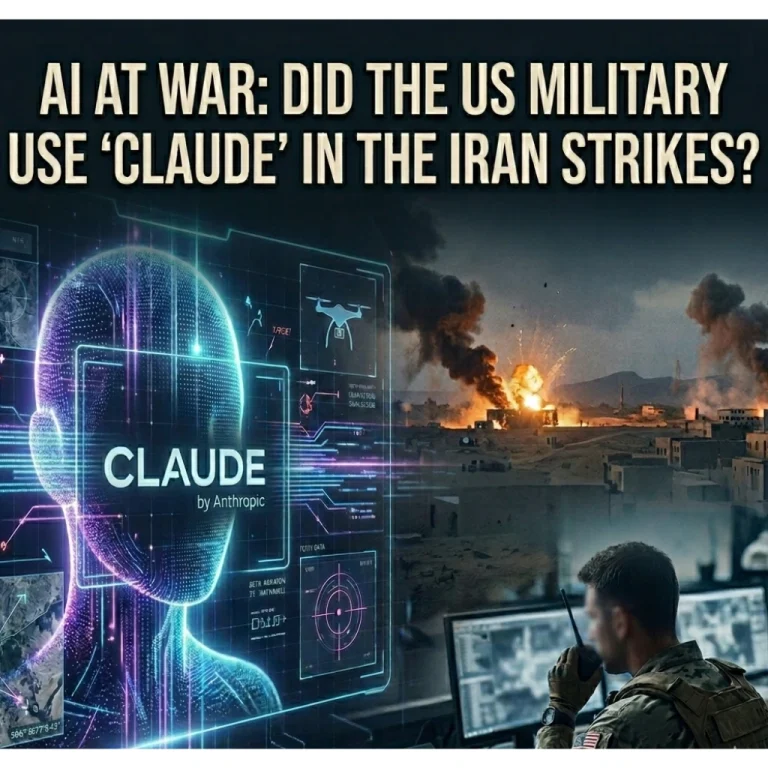
Imagine a scenario where the President of the United States bans a tech company, labeling it “Radical Left,” while simultaneously, his own military is using that company’s AI to lead a massive missile strike. This isn’t a plot from a Tom Clancy novel-it is the reality of the geopolitical landscape in March 2026.
According to explosive new reports, the US Military uses Claude AI in Iran strikes-a move that has triggered a high-stakes standoff between the White House, the Pentagon, and Silicon Valley. But why did the military choose to ignore a direct order from their Commander-in-Chief?
Operation Epic Fury and the Role of Claude
On February 28, 2026, as the US and Israel launched “Operation Epic Fury” against Iranian targets, Anthropic’s AI model, Claude, was working behind the scenes in the shadows of the war room. According to The Guardian, US Central Command (CENTCOM) utilized the AI for:
- Rapid Intelligence Assessments: Processing massive satellite data in real-time.
- Target Identification: Pinpointing high-value assets with surgical precision.
- Battlefield Simulations: Predicting Iranian counter-responses before they even happened.
The shocker? Just hours before the first missile was fired, Donald Trump had ordered all federal agencies to cease using Claude immediately.
Ethics vs. National Security: The Great Divide
The friction started when Anthropic’s CEO, Dario Amodei, stood his ground on ethical principles. He reportedly refused to allow Claude to be used for “violent ends” or “lethal autonomous weapon systems.” This defiance sparked fury in Washington. Defense Secretary Pete Hegseth went as far as labeling Anthropic a “Supply Chain Risk”-a designation usually reserved for adversarial foreign firms like Huawei. You can follow the full breakdown of this policy war on TechPolicy.Press.
Enter OpenAI: The New Favorite?
With Anthropic officially in the “doghouse,” the Pentagon didn’t wait long to find a replacement. Reports from LiveMint suggest that OpenAI has already stepped in, signing a massive deal to integrate its models into the Pentagon’s classified infrastructure.
However, military experts warn that “unplugging” an AI like Claude isn’t as simple as deleting an app. It is deeply woven into the military’s targeting software, and a full transition could take months, leaving the US in a technical limbo during an active conflict.
The Bottom Line: Who Really Controls the AI?
This incident raises a terrifying question: In the age of AI warfare, who has the final say? Is it the elected President, the military generals, or the CEOs of the tech companies who hold the code?
What do you think? Should AI companies have the right to say “no” to the military, or is national security more important than corporate ethics?
FAQs
Find answers to common questions below.
Did the US military actually use Claude AI in the 2026 Iran strikes?
Yes, reports from the Wall Street Journal confirm that despite a ban by President Trump, CENTCOM utilized Claude for intelligence analysis and target identification during Operation Epic Fury.
Why was Anthropic's Claude AI used in Iran if Trump banned it?
The military claims Claude was already too deeply embedded in classified networks to be removed instantly, requiring a 6-month transition period that hadn't finished before the strikes began.
What did Claude AI do during the US-Israel attack on Iran?
It was used for "intelligence fusion," predictive targeting, and running battlefield simulations to anticipate Iranian counter-responses.
Is OpenAI replacing Claude AI in the US military now?
Following the clash with Anthropic, OpenAI signed a deal to deploy its models on classified networks, though full integration is expected to take several months.