Have you ever wondered why it takes years-not months-to bring a new car from a concept drawing to your driveway? While hardware is part of the equation, the real bottleneck is the millions of lines of code humming beneath the dashboard. In an era where cars are essentially “smartphones on wheels,” the pressure on OEMs and semiconductor firms to deliver flawless software is reaching a breaking point.
Enter Tata Elxsi’s DevStudio.ai, a multi-agentic GenAI platform launched today that promises to do for automotive engineering what the assembly line once did for manufacturing.
But is this just another AI buzzword, or a genuine shift in how we build vehicles?
Beyond Chatbots: What is a Multi-Agentic Platform?
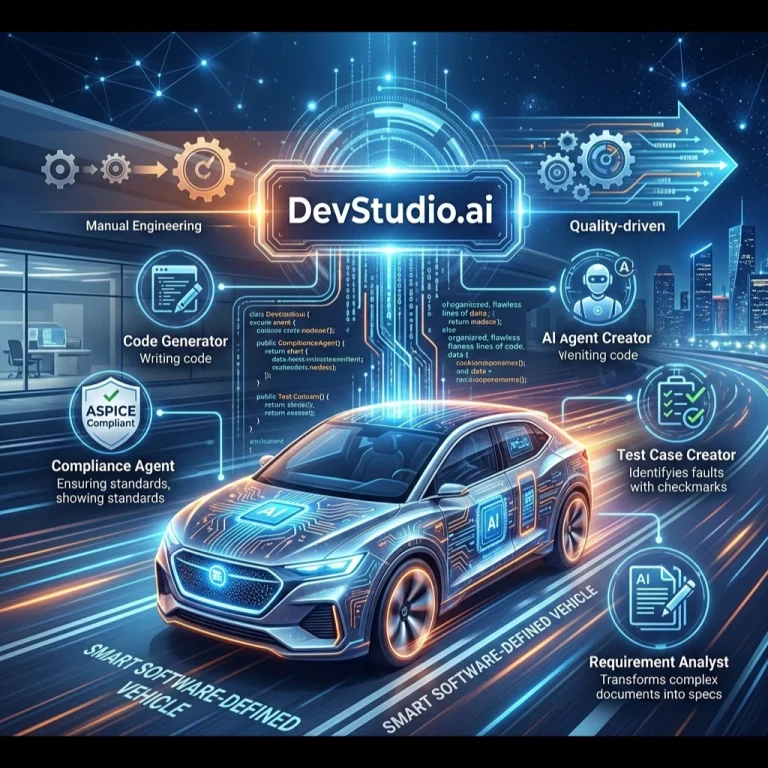
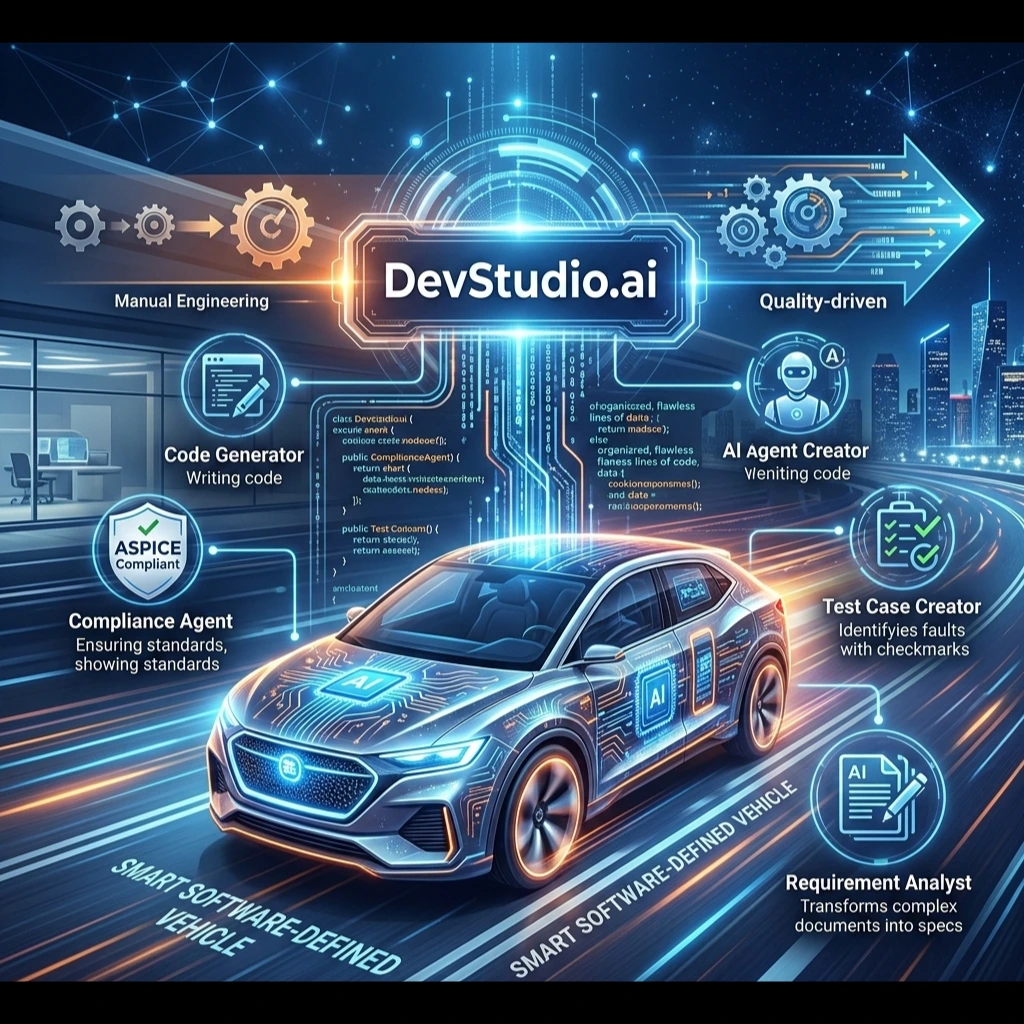
Most of us think of AI as a single window where we ask a question and get an answer. DevStudio.ai moves past that. It utilizes a multi-agent architecture, meaning different specialized AI agents work together-much like a well-oiled engineering team. One agent might focus on code generation, another on rigorous testing, and a third on compliance.
Why does this matter? Because automotive software isn’t like building a mobile app. If a social media app crashes, it’s an annoyance; if an Advanced Driver Assistance System (ADAS) glitches, it’s a safety crisis.
By integrating these agents, Tata Elxsi is offering:
- Automated Requirement Analysis: Turning complex documents into actionable tech specs.
- Code Generation & Refactoring: Writing clean, efficient code that adheres to industry standards.
- Automated Test Case Creation: Identifying potential points of failure before a single mile is driven.
The ASPICE Standard: Precision Meets Speed
In the automotive world, ASPICE (Automotive Software Process Improvement and Capability dEtermination) is the gold standard. It’s a framework that ensures quality and safety at every turn. Traditionally, staying ASPICE-compliant meant mountains of manual documentation and “check-the-box” workflows that slowed innovation to a crawl.
How does DevStudio.ai solve this? It’s ASPICE-aligned by design. The platform doesn’t just write code; it generates the necessary audit trails and documentation as it goes. This allows OEMs and semiconductor firms to move faster without cutting corners on safety.
Are we finally seeing the end of the “move fast and break things” era in favor of “move fast and build safely”? For Tier-1 suppliers, this shift is the difference between leading the market and falling behind.
Why Semiconductor Firms are Paying Attention
It isn’t just the car manufacturers (OEMs) who are celebrating. Semiconductor companies are under immense pressure to provide “software-ready” chips. As hardware becomes more standardized, the Software-Defined Vehicle (SDV) becomes the real competitive battleground.
DevStudio.ai provides these firms with a sandbox to accelerate software development lifecycles (SDLC). By using AI agents to simulate how chips will interact with complex vehicle software, they can iron out bugs months earlier than previously possible.
Key Benefits at a Glance:
- Reduced Time-to-Market: Cutting months off the development cycle.
- Error Reduction: Minimizing human oversight in repetitive coding tasks.
- Scalability: Allowing smaller teams to manage massive, enterprise-level codebases.
Final Thoughts: A New Era for the Software-Defined Vehicle
The launch of Tata Elxsi’s DevStudio.ai marks a pivot point. We are moving away from AI as a “helper” tool and toward AI as a “collaborator.”
By automating the heavy lifting of compliance and testing, Tata Elxsi is freeing up human engineers to do what they do best: innovate. The next time you step into a vehicle that feels more like a living, breathing tech ecosystem than a piece of machinery, there’s a good chance a multi-agent AI helped put it there.
The road ahead is digital-and it’s looking a lot smoother.
FAQs
Find answers to common questions below.
What exactly is a "multi-agentic" platform in automotive software?
Unlike standard AI that follows one prompt, a multi-agentic platform like Tata Elxsi DevStudio.ai uses multiple specialized AI "agents" that collaborate-one codes, one tests, and one ensures safety compliance-mimicking a human engineering team.
How does DevStudio.ai help with ASPICE compliance?
ASPICE is a rigorous quality standard. DevStudio.ai is built to automatically generate the documentation and audit trails required for compliance, significantly reducing the manual "paperwork" burden for engineers.
Can semiconductor firms use DevStudio.ai for chip design?
While it focuses on the software layer, it helps semiconductor firms create "software-ready" chips by simulating how their hardware will interact with complex vehicle software environments much earlier in the design phase.
Will DevStudio.ai replace automotive engineers?
No. It acts as a co-pilot or "force multiplier," automating the repetitive, high-volume coding and testing tasks so engineers can focus on high-level architecture and innovation.