If you thought the AI revolution was just about bigger GPUs and more data, think again. The bottleneck isn’t just how fast a chip can think-it’s how fast it can talk.
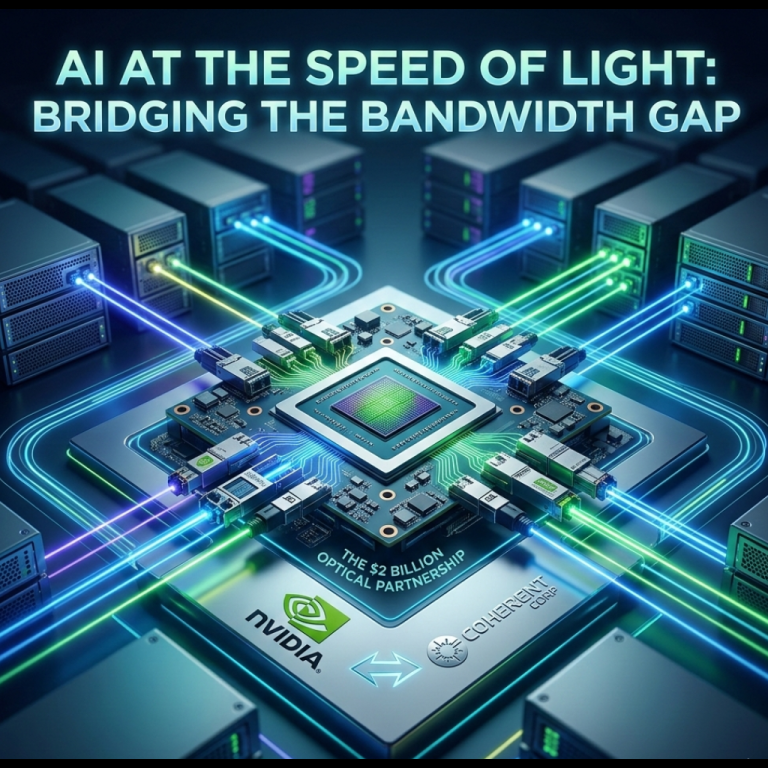
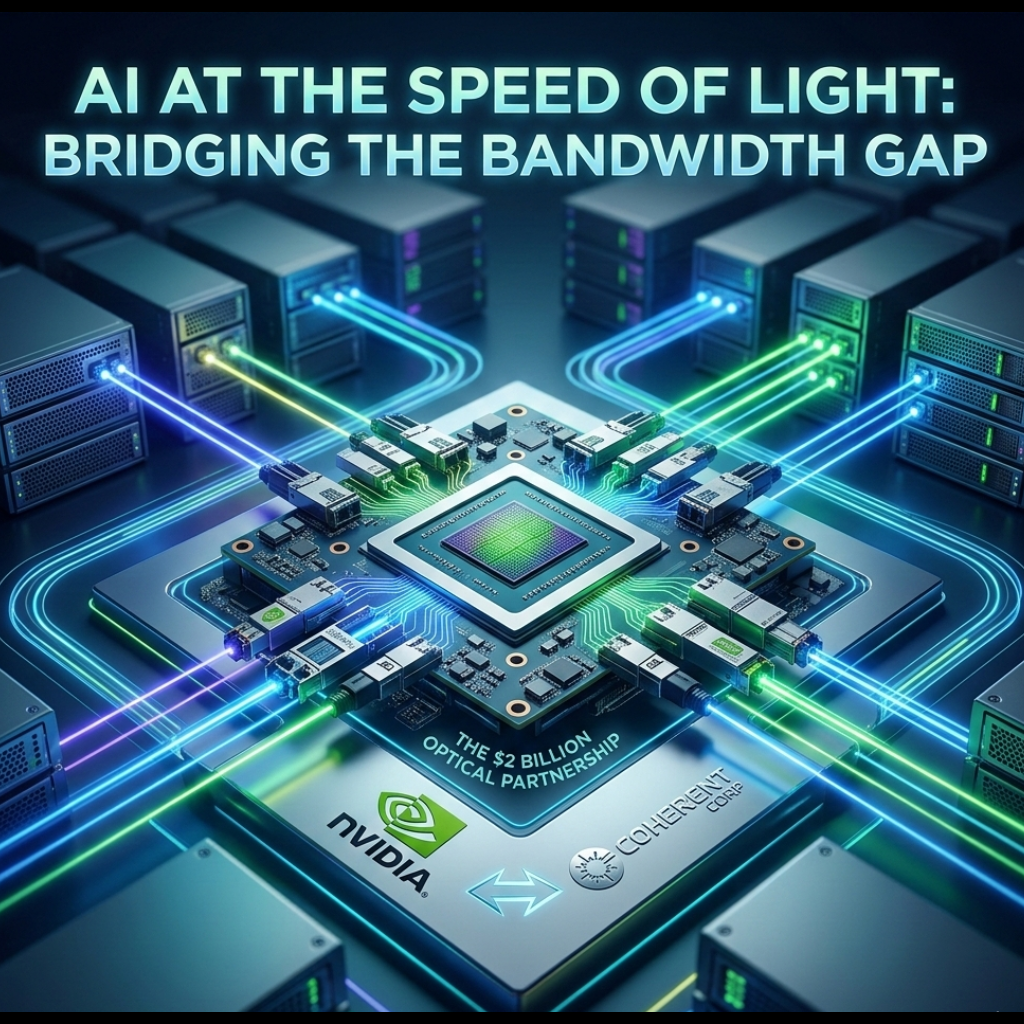
On March 2, 2026, the tech world shifted on its axis as NVIDIA and Coherent Corp announced a massive $2 billion strategic partnership. This isn’t just a simple procurement deal; it’s a foundational move to rewrite the architecture of the modern data center.
But why is the world’s most valuable chipmaker suddenly obsessed with optics and lasers?
The Bandwidth Bottleneck: Why Electricity Isn’t Enough
We’ve pushed copper wires to their physical limits. As AI models grow from billions to trillions of parameters, the “wiring” between servers has become a massive drag on performance. Traditional electrical signaling generates too much heat and loses too much signal over distance.
According to the official NVIDIA and Coherent Strategic Partnership announcement, this $2 billion investment is specifically aimed at accelerating optical networking and laser technologies.
By moving data via light (photonics) rather than electricity (electrons), NVIDIA is aiming to:
- Slash Latency: Reduced “lag” between GPU clusters means faster training times.
- Boost Energy Efficiency: Optical interconnects consume a fraction of the power of traditional copper.
- Scale “AI Factories”: Building the infrastructure required for the next generation of massive-scale computing.
What Does Coherent Corp Bring to the Table?
You might know NVIDIA, but who is Coherent? They are the “secret sauce” in the world of specialized materials and lasers. By securing this partnership, NVIDIA isn’t just buying components; they are securing a dedicated supply chain for the high-speed transceivers and optical engines that allow AI clusters to function as a single, giant brain.
Is this the end of the “Copper Era” in the data center? It certainly looks like it. As Jensen Huang moves toward integrated silicon photonics, the line between the chip and the network is blurring.
The Broader Impact on the AI Market
This move comes at a time when competitors like Broadcom and Marvell are also racing to dominate the optical space. However, NVIDIA’s $2 billion injection gives them a “first-mover” advantage in defining the standards for 800G and 1.6T (Terabit) networking.
Key takeaways from this investment include:
- Supply Chain Resilience: In an era of chip wars, owning the “light” is just as important as owning the “silicon.”
- Lowering the TCO: Total Cost of Ownership for data centers drops when you don’t have to spend half your budget on cooling copper cables.
- Next-Gen Connectivity: Expect to see these optical engines integrated directly into the next Blackwell and Rubin-class GPU architectures.
Final Thoughts: Is Your Infrastructure Ready for the Speed of Light?
NVIDIA’s $2 billion investment is a loud and clear message: the future of AI isn’t just about processing power; it’s about connectivity at scale. By partnering with Coherent, NVIDIA is ensuring that the “AI Factories” of tomorrow aren’t held back by yesterday’s wires.
We are moving into an era where “compute” and “network” are no longer two different things. They are one seamless, light-speed entity. The question for enterprises and investors now isn’t whether AI will keep growing, but rather: Can your network keep up with the light?
What do you think? Is optics the final piece of the AGI puzzle, or just another expensive upgrade in the hardware arms race? One thing is certain-the race to $10 trillion in AI value will be paved with lasers.
FAQs
Find answers to common questions below.
Why did NVIDIA invest $2 billion in a laser company?
NVIDIA is moving beyond just chips; they need Coherent’s laser and optical technology to move data between GPUs at the speed of light, bypassing the physical limits of copper wiring.
What does "Optical Networking" mean for AI performance?
It means significantly lower latency and reduced power consumption. By using photons (light) instead of electrons (electricity), AI "factories" can process massive datasets faster and more efficiently.
Is copper wiring dead in data centers?
Not yet, but for the scale NVIDIA is targeting with its next-generation Blackwell and Rubin architectures, traditional copper is becoming a bottleneck. This investment signals a massive shift toward "Silicon Photonics."
How does this impact the AI hardware market?
This deal secures NVIDIA’s supply chain, making it harder for competitors to source the high-end optical components needed for 1.6T networking speeds.