Is there such a thing as having too much ambition and too little silicon? For the longest time, the narrative surrounding the AI race was all about who had the best algorithms. But as 2024 unfolds, the conversation has shifted toward a much more grounded, physical reality: the power grid and the chip shortage.
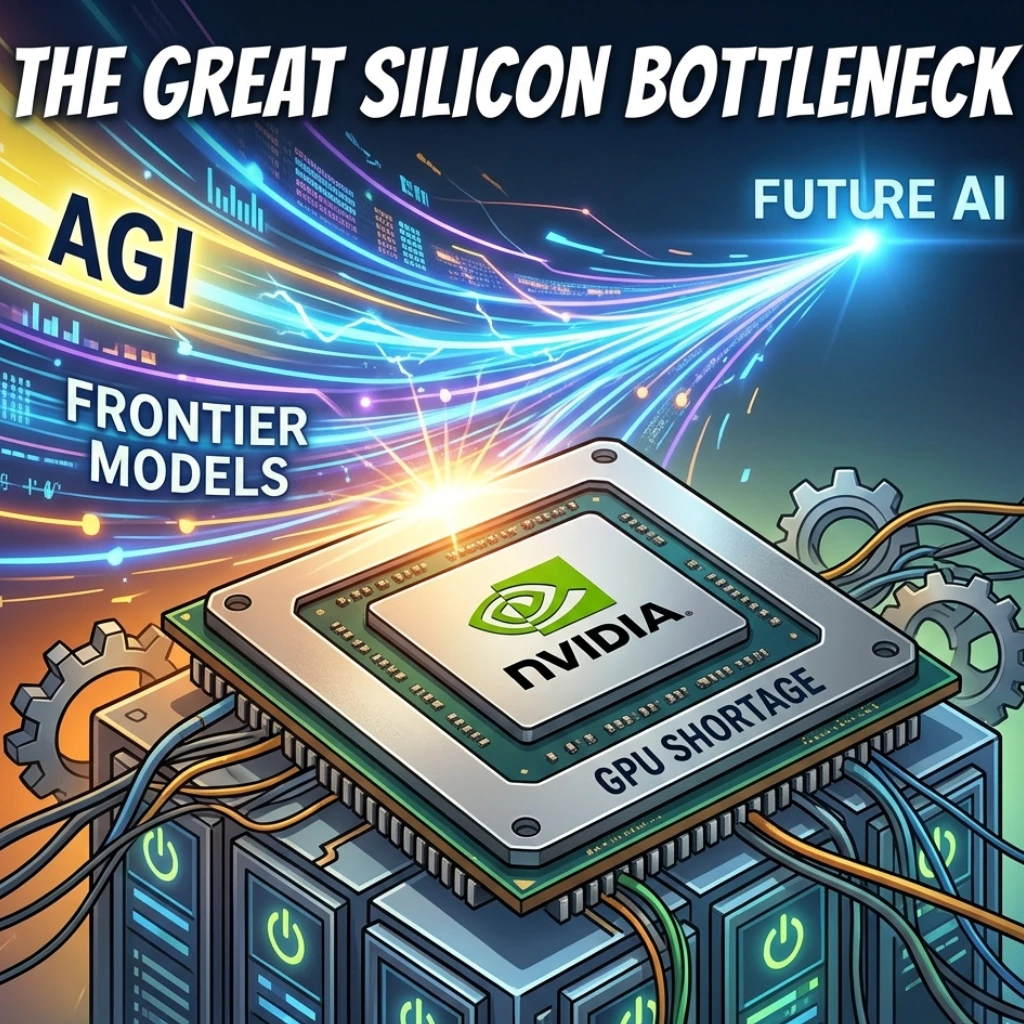
Even for a titan like Microsoft, the road to Artificial General Intelligence (AGI) isn’t just paved with code-it’s paved with H100 GPUs. In a surprisingly candid admission, Microsoft AI CEO Mustafa Suleyman recently pulled back the curtain on the company’s internal struggles, noting that Microsoft still lacks the computing power needed to train the next generation of “frontier models.”
The “Compute Crunch” Explained
We often think of the cloud as an infinite resource. But for the engineers building models that require trillions of parameters, the cloud has a ceiling. Suleyman’s “Compute Crunch” refers to the bottleneck where software capabilities have officially outpaced the available hardware infrastructure.
Why is this happening now?
- Model Scaling: Every new iteration of GPT or Phi requires exponentially more “FLOPs” (floating-point operations).
- The Nvidia Dependency: While Microsoft is developing its own Maia 100 chips, the industry is still largely beholden to Nvidia’s supply chain.
- Energy Constraints: It’s not just the chips; it’s the electricity. Data centers are consuming power at rates that local grids simply weren’t designed to handle.
Does this mean the AI revolution is slowing down? Not necessarily. But it does mean the “move fast and break things” era is entering a “wait for the shipment” phase.
The “Computation Ramp”: Light at the End of the Tunnel?
Suleyman wasn’t all doom and gloom. He highlighted an expected “computation ramp” scheduled for later this year. This suggests that Microsoft’s massive capital expenditure-billions of dollars funneled into data center expansions and custom silicon-is finally about to bear fruit.
This ramp is crucial for Microsoft to maintain its lead over competitors like Google and Meta. Without “extreme-scale” power, training the “largest frontier models” becomes a game of compromise. And in the world of Big Tech, nobody wants to settle for second place.
Why This Matters for the Rest of Us
You might wonder: Why should I care if a trillion-dollar company is short on chips? The answer lies in the tools we use every day. If Microsoft faces a compute shortage, it affects the latency of Copilot, the sophistication of Bing Search, and the rollout of AI features in Windows. Furthermore, it sets a precedent for the entire industry. If the biggest player in the game is feeling the squeeze, imagine the pressure on smaller startups trying to innovate in the same space.
Key takeaways from the current landscape:
- Prioritization: Microsoft is likely prioritizing compute for its most “frontier” projects, potentially slowing down smaller, experimental features.
- The Rise of Efficiency: Because compute is scarce, there is a renewed focus on Small Language Models (SLMs) like Microsoft’s Phi-3, which do more with less.
- Sovereign AI: Governments are now looking at compute as a national security asset, further tightening the global supply.
Final Thoughts: A Reality Check for the AI Hype
We’ve spent the last two years enamored by what AI can do. Now, we are being forced to look at what AI costs. Mustafa Suleyman’s admission is a refreshing bit of transparency in an industry often filled with hyperbole. It reminds us that even the most advanced “virtual” intelligence is still anchored to physical hardware, cooling fans, and copper wires.
As the “computation ramp” kicks in later this year, will we see the breakthrough Microsoft is promising? Or will the thirst for compute always stay one step ahead of the supply? One thing is certain: the next chapter of AI won’t be written by the best coders alone-it will be written by those who control the most silicon.
What do you think? Is the compute shortage a temporary speed bump, or are we hitting the physical limits of how fast AI can actually grow?
FAQs
Find answers to common questions below.
What exactly is the "Compute Crunch" Suleyman is referring to?
It is the physical bottleneck where the demand for training massive AI models exceeds the available supply of high-end GPUs (like Nvidia’s H100s) and the electrical power required to run them.
Is Microsoft building its own chips to solve this?
Yes. To reduce dependency on Nvidia and bypass the crunch, Microsoft is rolling out its custom Maia 100 AI accelerator chips, though scaling these to "extreme-scale" takes significant time.
Will this slow down the release of GPT-5 or other frontier models?
Likely, yes. Without the "extreme-scale" computing power mentioned by Suleyman, the training runs for next-gen models are delayed until the "computation ramp" expected later this year provides the necessary horsepower.
Can software efficiency fix a hardware shortage?
To an extent. Microsoft is pivoting heavily toward Small Language Models (SLMs) like the Phi series, which aim to provide high intelligence with a much smaller computational footprint.