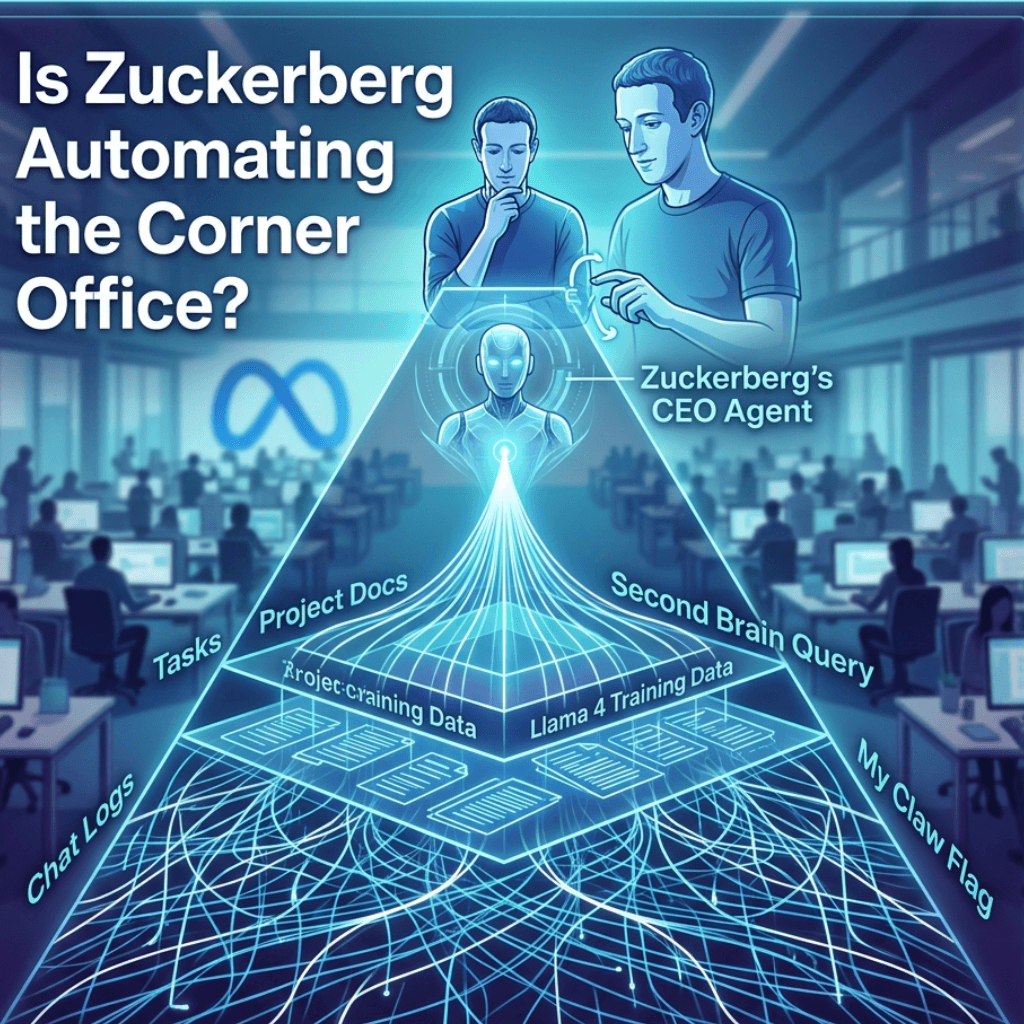
What would you do if you sat at the top of a 70,000-person pyramid? For Mark Zuckerberg, the answer isn’t “hire more middle managers”-it’s “build an AI that does the heavy lifting.”
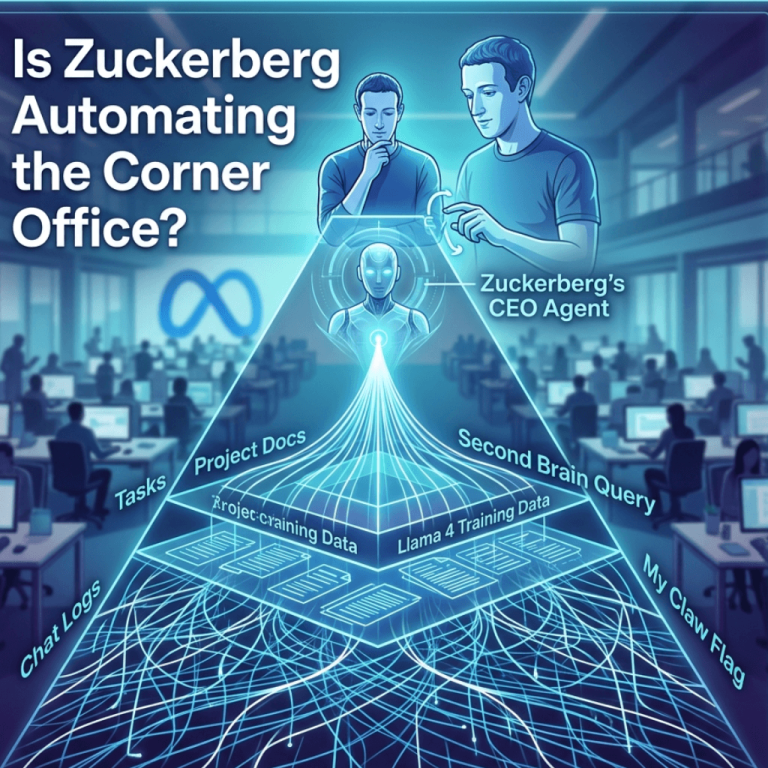
Recent reports suggest that the Meta founder is personally developing a specialized CEO Agent, a high-level AI designed to navigate the dense, often opaque layers of a global tech giant. But this isn’t just about Zuckerberg’s personal productivity. It’s part of a massive internal shift at Meta, where AI agents like “Second Brain” and “My Claw” are already changing how employees work.
Is this the future of corporate leadership, or a sign that organizations have become too complex for humans to manage alone?
Cutting Through the Red Tape with a “CEO Agent”
In a massive corporation, information often gets “trapped” in silos. By the time a report reaches the CEO’s desk, it has been filtered, polished, and potentially stripped of its most vital nuances. According to The Hindu, Zuckerberg’s under-development agent aims to solve this by retrieving real-time data from deep organizational layers.
Think of it as a digital chief of staff that never sleeps. Instead of waiting for a quarterly review, the CEO could theoretically ask the agent, “What are the three biggest bottlenecks in the Llama 4 training cluster right now?” and get an unvarnished answer in seconds.
Meet the Internals: “Second Brain” and “My Claw”
While the CEO Agent is the headline act, Meta’s rank-and-file employees are already testing the waters with specialized internal tools. These aren’t just chatbots; they are functional extensions of the workforce:
- Second Brain: A sophisticated querying tool that allows teams to search through mountains of project documentation. Instead of hunting through thousands of Wikis, engineers can simply “ask” the project for answers.
- My Claw: This tool is reportedly being used to manage employee chat logs and task lists. It helps workers stay on top of a relentless stream of internal communications, summarizing what matters and flagging what needs immediate action.
By deploying these tools internally, Meta is essentially using its own staff as a “living lab.” If these agents can streamline a company as complex as Meta, imagine what they could do for the rest of the corporate world.
Why “Eat Your Own Dog Food” Matters for Meta
In the tech industry, “eating your own dog food” (using your own products) is the ultimate litmus test. By integrating these AI agents into the daily workflow of Meta, Zuckerberg is doing two things:
- Iterating at Lightning Speed: Meta’s internal agents are reportedly outperforming external benchmarks, including OpenAI’s DeepResearch, because they have access to proprietary, real-world data.
- Proving the Utility of Llama: These tools likely run on Meta’s open-source Llama models, proving to investors and developers that their AI ecosystem is ready for “enterprise-grade” heavy lifting.
Final Thoughts: A New Era of “Agentic” Work?
We are moving past the era of “AI as a search engine” and into the era of “AI as an operator.” Zuckerberg’s CEO Agent isn’t just a fancy calculator; it’s a tool for organizational transparency.
But it also raises some fascinating questions. If an AI is summarizing employee chats and retrieving deep-layer data, how does that change the culture of trust within a company? Will employees feel more supported, or more watched?
One thing is certain: the “corner office” is getting a digital upgrade. A well-optimized algorithm might just become the next “CEO of the Year” if Zuckerberg succeeds.
FAQs
Find answers to common questions below.
What exactly is Mark Zuckerberg’s "CEO Agent"?
It is a specialized AI model designed to act as a high-level digital assistant. Unlike standard chatbots, it is built to retrieve granular data from deep within Meta’s complex organizational layers, giving the CEO unvarnished, real-time insights into company operations.
How do "Second Brain" and "My Claw" help Meta employees?
"Second Brain" acts as a massive internal encyclopedia that allows staff to query project documents instantly. "My Claw" focuses on productivity by managing and summarizing employee chat logs and task lists to prevent information overload.
Is Meta’s internal AI better than OpenAI’s tools?
Early reports indicate that Meta’s internal agents are specifically optimized for "DeepResearch" tasks, reportedly outperforming some of OpenAI’s public-facing models when it comes to navigating proprietary corporate data and complex documentation.
Will these AI agents be available to the public?
While currently used as internal "dogfooding" tools, these agents serve as a blueprint for what developers can build using the Llama ecosystem. They demonstrate the power of "agentic" AI in a professional enterprise environment.