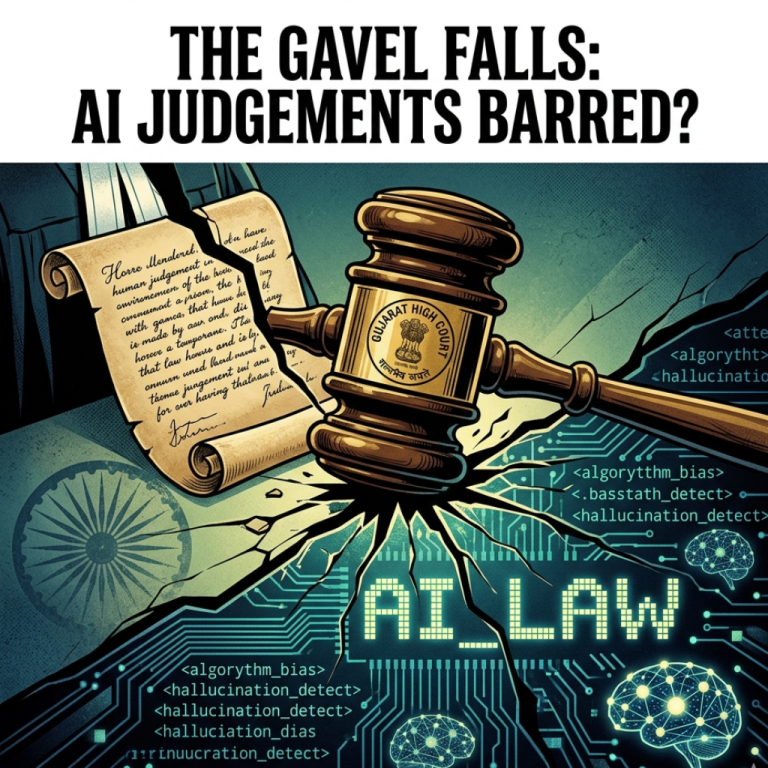
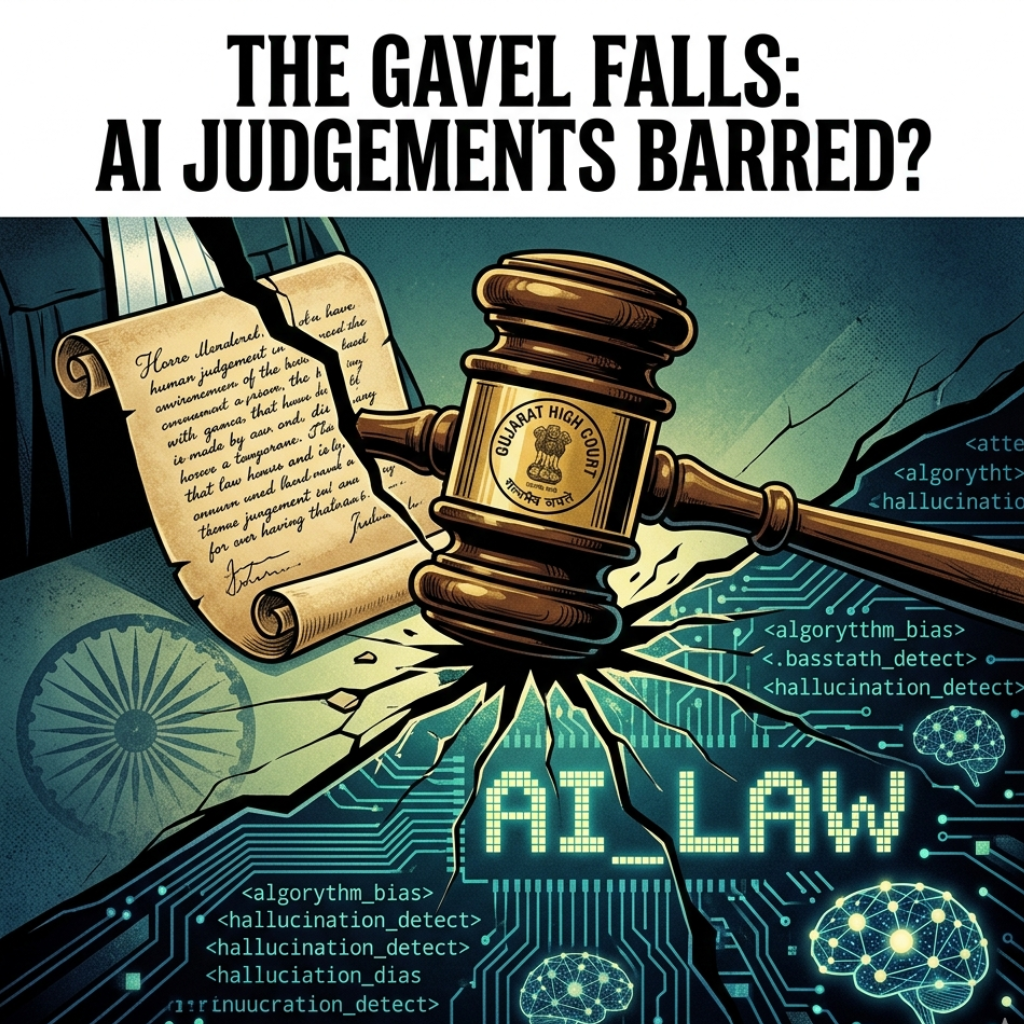
Could a machine ever truly understand the “spirit of the law,” or is it just a very sophisticated calculator? For the Gujarat High Court, the answer is now official: AI is no substitute for the human robe.
In a move that has sent ripples through both the legal and tech communities, the Gujarat High Court has issued a landmark directive. It has officially barred the use of Artificial Intelligence (AI) for core judicial functions, including decision-making, sentencing, and the actual drafting of judgments.
But why now? And what does this mean for the future of “LegalTech” in India? Let’s dive into the details of this historic pivot toward human-centric justice.
The Verdict: No Shortcuts to Justice
The court’s decision isn’t a protest against technology itself, but rather a safeguard against its current limitations. According to a recent report by The Hindu, the court emphasized that while AI can assist in administrative tasks, it cannot be allowed to touch the “soul” of a legal case.
The directive specifically warns against three major “red flags”:
- Hallucinations: The tendency of LLMs (Large Language Models) to confidently invent case laws or statutes that don’t exist.
- Algorithmic Bias: The risk of AI reflecting historical prejudices found in its training data.
- Confidentiality Breaches: The danger of sensitive legal data being leaked into public AI training sets.
Is it possible to trust a “black box” algorithm with someone’s life or liberty? The Gujarat High Court says the risk is simply too high.
Why “Hallucinations” Are a Courtroom Nightmare
In the legal world, a single word can change the outcome of a decade-long dispute. When AI “hallucinates,” it doesn’t just make a typo; it can fabricate entire precedents. We’ve already seen instances in the U.S. where lawyers were sanctioned for submitting AI-generated briefs that cited non-existent cases.
By banning AI from drafting judgments, the Gujarat High Court is protecting the sanctity of the judicial record. A judgment is more than just a summary of facts; it is a reasoned document that requires empathy, moral reasoning, and an understanding of societal nuances-qualities that code simply hasn’t mastered yet.
The “Human in the Loop” Necessity
Does this mean the Indian judiciary is going back to the Stone Age? Far from it. The Chief Justice of India, D.Y. Chandrachud, has frequently spoken about using technology to modernize courts through digital filing and live-streaming. However, the Gujarat ruling highlights a critical distinction: Technology should be a tool for efficiency, not a replacement for intellect.
The court’s stance aligns with a growing global skepticism. While AI can help index files or translate documents into regional languages, the final discretionary power must remain with a human judge. After all, can an algorithm understand the “extenuating circumstances” of a poverty-stricken defendant? Or the subtle shift in a witness’s tone?
Final Thoughts: A Precedent for the Digital Age
This ruling sets a massive precedent for other High Courts across India. It reminds us that “efficiency” should never come at the cost of “equity.” By drawing this line, the Gujarat High Court has ensured that the legal system remains accountable to humans, by humans.
As we move forward, the challenge will be finding the “sweet spot” where technology supports the law without overstepping its bounds. For now, the message is clear: In the pursuit of justice, there is no “auto-pilot” mode.
What do you think? Would you want a judge to use ChatGPT to help write a verdict on your case, or is the human touch irreplaceable? The debate is only just beginning.
FAQs
Find answers to common questions below.
Can Indian judges use ChatGPT to research cases?
While research is a grey area, the recent Gujarat High Court ruling strictly prohibits using AI for drafting final judgments or making sentencing decisions to ensure human accountability.
What happens if a lawyer submits AI-generated evidence?
Lawyers risk heavy sanctions and loss of credibility, as AI "hallucinations" often lead to the citation of fake legal precedents that do not exist in Indian law.
Is AI banned in all Indian courts?
Currently, the Gujarat High Court is a leader in setting these specific boundaries, but the Supreme Court of India continues to explore AI for administrative tasks like translation and file indexing.
Why is AI considered "biased" in legal settings?
AI models are trained on historical data which may contain past societal prejudices; the court fears these biases could unfairly influence modern judicial outcomes.