Can anyone actually catch up to Nvidia? For the last eighteen months, that’s been the only question worth asking in Silicon Valley. While the world was busy watching Jensen Huang’s every move, a quiet giant in San Jose was sharpening its tools.
Today, the market felt the earthquake. Broadcom shares surged 7% after the company dropped a bombshell: they are forecasting over $100 billion in AI chip sales by 2027. This isn’t just a bold prediction; it’s a declaration of war for the future of the data center.
According to the latest reports from Broadcom projects AI chip revenue above $100B in 2027, the company is no longer just a “networking guy”-it is now a primary challenger to the AI throne.
The Secret Sauce: Custom Silicon and the “XPU”
What makes Broadcom different from the dozens of other startups trying to build “Nvidia killers”? It comes down to ASICs (Application-Specific Integrated Circuits).
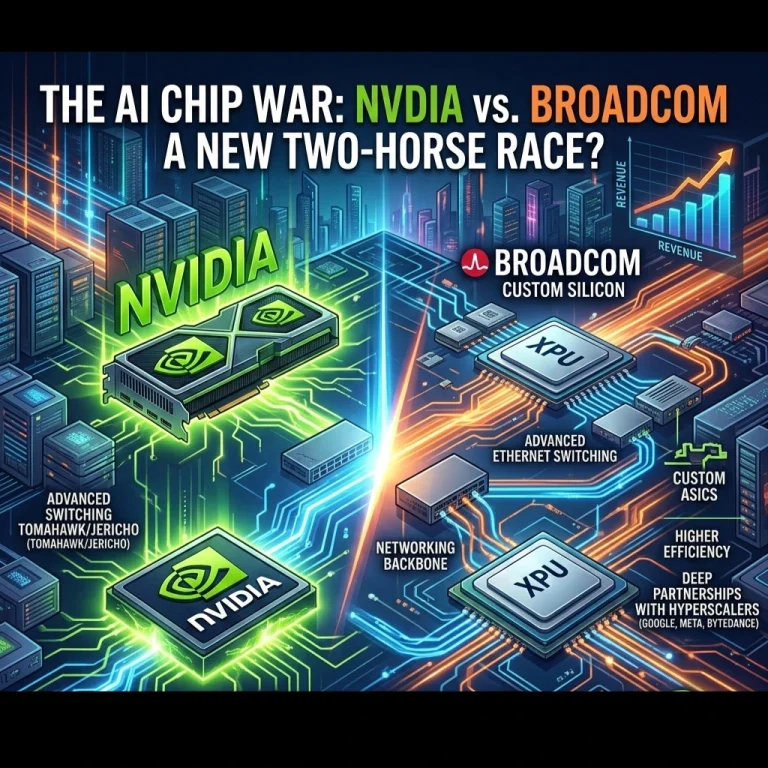
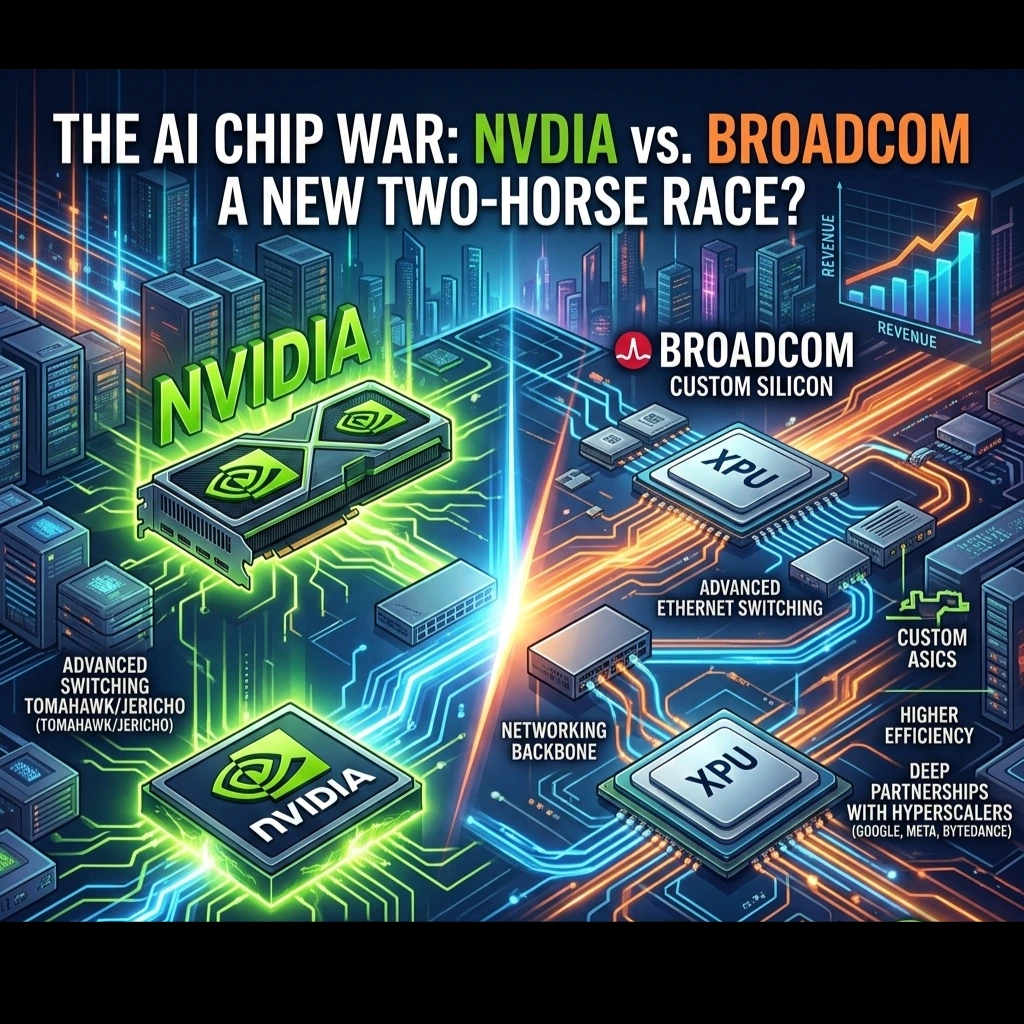
While Nvidia sells a powerful, general-purpose GPU that can do everything, Broadcom works behind the scenes with titans like Google, Meta, and ByteDance to build custom chips tailored to their specific needs. Think of it this way: Nvidia sells the best off-the-rack Italian suit money can buy, but Broadcom is the master tailor crafting a bespoke tuxedo.
- Efficiency over everything: Custom chips (XPUs) often run specific AI workloads faster and with less power than general GPUs.
- Deep Partnerships: By co-designing hardware with hyperscalers, Broadcom locks in long-term revenue that isn’t as sensitive to market hype.
But can they really hit that $100 billion mark? If their current trajectory in Ethernet switching and optical interconnects is any indication, the math starts to look very realistic.
More Than Just Chips: The Networking Backbone
Have you ever wondered how thousands of GPUs actually talk to each other? You can have the fastest processor in the world, but if the “pipes” connecting them are clogged, the whole system crawls. This is where Broadcom owns the room.
As AI models grow to trillions of parameters, the networking fabric becomes the bottleneck. Broadcom’s dominance in high-end switching (like the Tomahawk and Jericho lines) ensures that as more companies buy GPUs, they must buy Broadcom tech to make them work. They aren’t just selling the engines; they’re building the entire multi-lane highway.
Why Investors Are Suddenly Crowding the Trade
The 7% jump in share price wasn’t just a reaction to a big number. It was a realization of diversification. Investors are starting to worry about “Nvidia fatigue.” If the AI bubble has any soft spots, it’s the reliance on a single architecture.
Broadcom offers a different flavor of AI growth:
- Sustainable Margins: Custom silicon contracts are multi-year deals, providing a “moat” that is hard to cross.
- The VMWare Synergy: Beyond hardware, Broadcom is integrating its software acquisitions to create a full-stack enterprise AI offering.
- The “Second Source” Reality: Big Tech doesn’t want to be beholden to one supplier. Broadcom is the most logical “Plan B” for the entire industry.
Final Thoughts: A New Two-Horse Race?
We’ve spent the last year talking about AI as a winner-take-all game. But the latest guidance from Broadcom suggests the pie is getting much bigger-and the slices are being redistributed.
Is Broadcom the “new Nvidia”? Probably not. They play a different game, focusing on custom integration rather than mass-market dominance. However, by positioning themselves as the indispensable partner for the world’s largest tech companies, they’ve made one thing clear: the path to $100 billion is paved with custom silicon.
What do you think? Will custom chips eventually eat the general GPU market, or is there plenty of room for both giants to thrive? One thing is certain-the AI hardware war is just getting started.
FAQs
Find answers to common questions below.
Why did Broadcom’s stock jump 7% today?
The surge was triggered by the company’s ambitious financial outlook, specifically a Broadcom AI chip sales forecast exceeding $100 billion by 2027. Investors are pivoting toward Broadcom as a diversified alternative to Nvidia.
How does Broadcom compete with Nvidia if they don’t make the same GPUs?
While Nvidia dominates general-purpose GPUs, Broadcom specializes in custom AI accelerators (ASICs) and high-end networking. They provide the "bespoke" hardware that tech giants like Google and Meta use to run their specific AI models more efficiently.
Is the $100 billion target realistic for Broadcom?
Analysts suggest it is, provided the demand for custom silicon continues to outpace general hardware. Broadcom’s deep integration into the infrastructure of "Hyperscalers" (the world's largest data centers) gives them a massive, stable revenue runway.
What role does networking play in Broadcom’s AI strategy?
AI isn't just about the processor; it's about the connection. Broadcom’s Ethernet switching technology acts as the "nervous system" for AI clusters, making their tech essential even for companies that primarily use Nvidia chips.