Is India finally ready to stop borrowing AI compute and start owning it? For years, the conversation around Artificial Intelligence in the subcontinent has centered on software services and talent pools. But the infrastructure-the actual “brains” behind the models-often lived elsewhere.
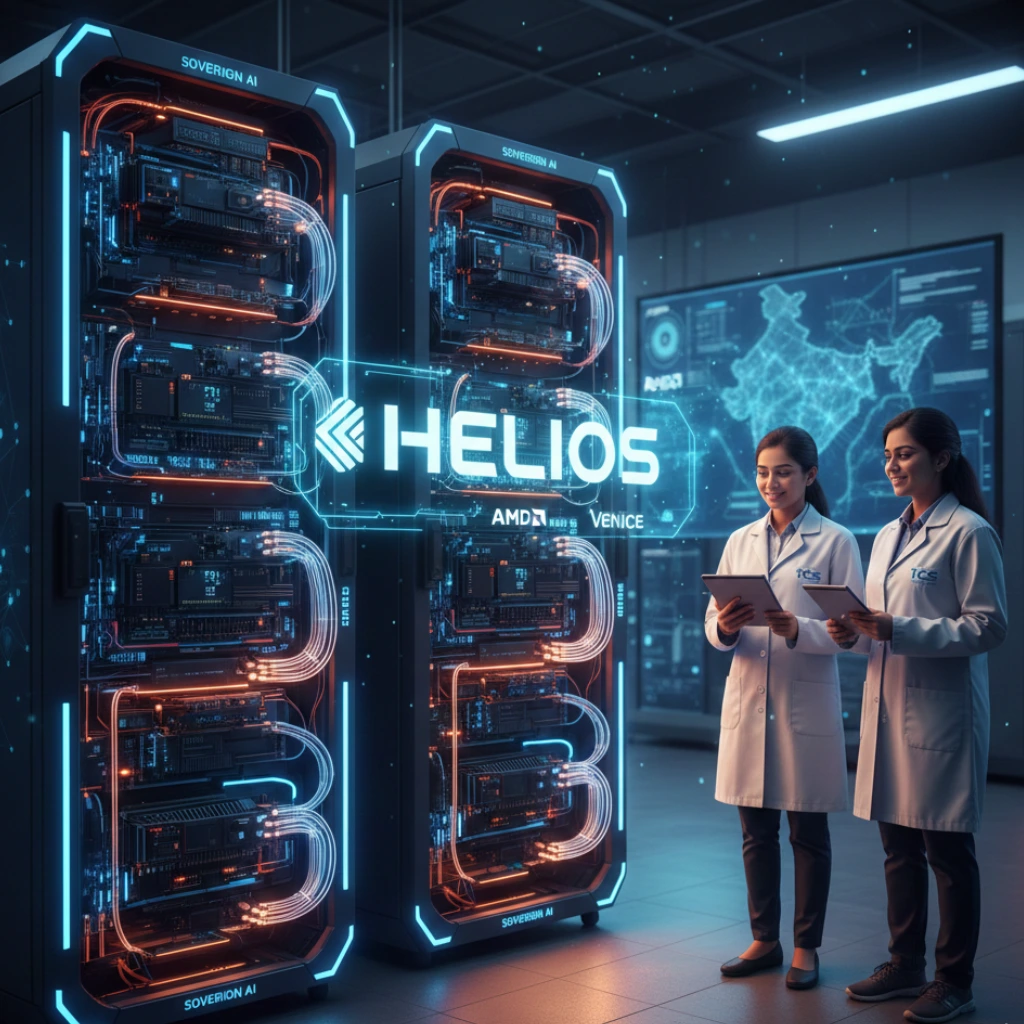
That is changing. In a landmark move, AMD and HyperVault (a strategic subsidiary of Tata Consultancy Services – TCS) have unveiled “Helios,” a rack-scale AI architecture designed specifically to fuel India’s ambitious “Sovereign AI” mission.
This isn’t just another hardware announcement; it’s a blueprint for digital independence.
Inside the Engine Room: MI455X and Venice CPUs
What makes Helios tick? While many data centers are still scrambling for legacy chips, AMD is bringing its “heavy hitters” to the Indian market. The Helios platform is built on the backbone of AMD Instinct™ MI455X GPUs and the next-generation “Venice” CPUs.
Why does this hardware mix matter?
- MI455X GPUs: Designed for massive generative AI workloads, these chips offer the memory bandwidth needed to train Large Language Models (LLMs) locally.
- Venice CPUs: Utilizing the latest Zen architecture, these processors handle the complex data orchestration that keeps AI factories running without bottlenecks.
- Optimized Interconnects: Helios isn’t just a box of chips; it’s a rack-scale architecture, meaning the networking and cooling are tuned to ensure these components talk to each other at lightning speeds.
Why “Sovereign AI” is the Real Game-Changer
We keep hearing the term “Sovereign AI,” but what does it actually mean for a business or a citizen in India? Simply put: it’s about data gravity.
When a nation builds its own AI factories, the data never has to leave its borders. This is crucial for sensitive sectors like healthcare, defense, and banking. By partnering with HyperVault, AMD is ensuring that Indian enterprises can build and deploy AI models that are compliant with local regulations while maintaining high-performance standards.
Could this be the end of “latency anxiety” for Indian startups? By having high-density compute available locally, developers can iterate faster, test models more cheaply, and scale without the massive overhead of international cloud providers.
The HyperVault Factor: Scaling the “AI Factory”
TCS, through HyperVault, isn’t just acting as a middleman. They are the architects of the AI Factory concept. Think of an AI Factory not as a data center, but as a production line where raw data enters and refined, actionable intelligence exits.
Key highlights of the Helios rollout include:
- Turnkey Integration: Enterprises don’t need to be hardware experts; the Helios rack comes ready to plug into existing TCS-managed ecosystems.
- Sustainability: AMD’s latest chips are increasingly focused on performance-per-watt, a critical metric for India’s power-conscious infrastructure.
- Localized LLMs: With this much power, we can expect a surge in “Indic” language models that actually understand the nuances of local dialects.
Final Thoughts: A New Chapter for ‘Make in India’
For a long time, the global AI race felt like a two-horse sprint. But with the AMD and TCS Helios architecture, India is asserting its place as a primary hub for AI infrastructure, not just AI consumption.
Is Helios the spark that will ignite a trillion-dollar AI economy in India? It’s certainly a massive leap in the right direction. By combining AMD’s cutting-edge silicon with TCS’s unparalleled reach, India is no longer just waiting for the future of AI-it’s building it on its own soil.
Keep an eye on this space; the era of the Sovereign AI Factory has officially arrived.
FAQs
Find answers to common questions below.
What makes the Helios platform different from standard AI servers?
Unlike general-purpose servers, Helios is a specialized rack-scale architecture co-developed by AMD and TCS HyperVault. It integrates AMD’s highest-end MI455X GPUs with "Venice" CPUs to create a "factory" environment optimized specifically for training Large Language Models (LLMs) within national borders.
Why is "Sovereign AI" important for India?
Sovereign AI ensures that sensitive data-ranging from government records to local linguistic nuances-is processed on domestic soil. This prevents data leakage to foreign clouds and allows India to build AI models tailored to its specific cultural and regulatory needs.
Can startups access the AMD and TCS Helios platform?
Yes. While the architecture is designed for "AI Factories," the goal is to provide high-density compute power that Indian startups and enterprises can leverage through TCS’s infrastructure, reducing their reliance on expensive international cloud credits.