Have you ever seen a video of yourself saying something you never said? For a growing number of people, this isn’t a scene from a sci-fi movie-it’s a digital nightmare. As AI tools become more sophisticated, the line between reality and fabrication is blurring.
At a recent high-level summit, policymakers and tech leaders pivoted away from the idea of “just another law.” Instead, they proposed a “techno-legal” framework to combat AI-generated harm. The centerpiece of this strategy? A controversial 3-hour takedown rule for deepfake content.
But can we really scrub the internet that fast, or are we risking something even more valuable in the process?
The ‘Techno-Legal’ Shift: Beyond the Rulebook
For years, the response to digital crime has been reactive-wait for a crime, then cite a law. However, leaders now argue that AI moves too fast for traditional litigation. A “techno-legal” approach means embedding the law into the code itself. Think of it as digital guardrails that identify, flag, and neutralize harmful content before it goes viral.
But why the sudden urgency?
- Viral Velocity: A deepfake can reach millions of viewers in under an hour.
- Identity Theft: It’s no longer just about celebrities; “regular” citizens are being targeted for extortion and harassment.
- Erosion of Trust: When we can’t believe our eyes, the foundation of public discourse crumbles.
The 3-Hour Takedown: Efficiency or Overreach?
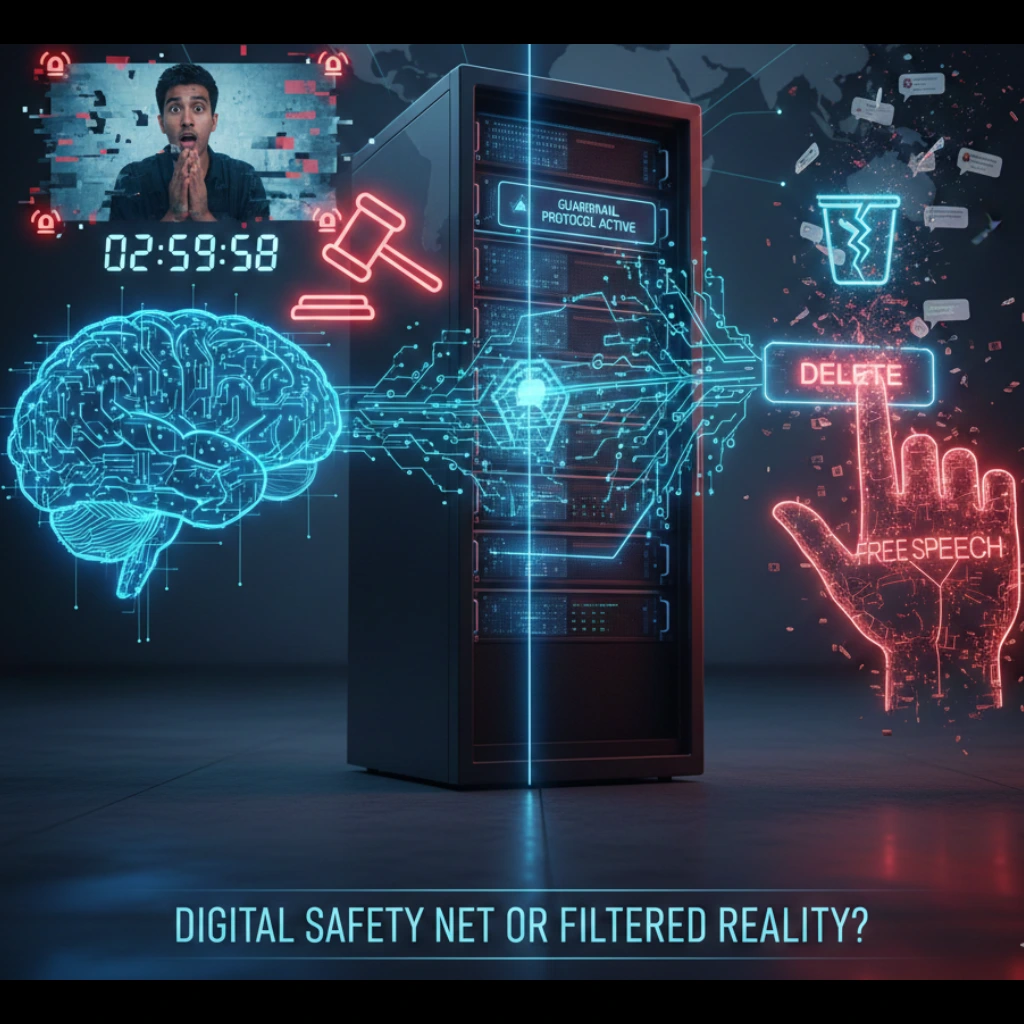
The most talked-about proposal is the mandate for platforms to remove deepfakes within 180 minutes of a report. On paper, it sounds like a victory for victims. If a malicious video is uploaded, the clock starts ticking immediately.
However, critics are raising red flags. According to a recent analysis by the Indian Express, there is a significant concern that a new 3-hour takedown rule will restrict free speech, potentially leading to privatized censorship.
If platforms face heavy fines for missing the three-hour window, will they simply delete anything that looks suspicious? When “delete first, ask questions later” becomes the default setting, satire, political parody, and legitimate dissent often end up in the digital trash can.
The Global Context: India’s Digital Ambitions
India isn’t acting in a vacuum. The EU AI Act and various US executive orders are also grappling with deepfake regulation. However, India’s approach is unique because of the sheer scale of its social media consumption.
Key trends we are seeing include:
- Watermarking Mandates: Forcing AI companies to embed invisible “signatures” into generated media.
- Platform Accountability: Shifting the burden of proof from the victim to the hosting platform.
- Algorithmic Detection: Using AI to catch AI-developing tools that can spot “digital fingerprints” that the human eye misses.
Is it possible to balance safety with the fundamental right to express ourselves? It’s the trillion-dollar question facing the tech industry today.
Final Thoughts: A Digital Safety Net or a Filtered Reality?
We are entering an era where our digital identity is as vulnerable as our physical one. The push for a techno-legal approach shows that leaders are finally taking the speed of AI seriously. The 3-hour rule might offer a necessary shield for victims of non-consensual deepfakes, but the implementation must be surgical, not a sledgehammer.
As we move forward, the goal shouldn’t just be a “cleaner” internet, but a more transparent one. After all, if we sacrifice free speech to gain safety, what kind of digital world are we actually saving?
FAQs
Find answers to common questions below.
Why is a "techno-legal" approach better than just passing new laws?
Because AI evolves faster than the judicial system; a techno-legal approach embeds the law into the software, allowing for real-time enforcement rather than waiting years for a court verdict.
Is it technically possible for platforms to remove content in 180 minutes?
While AI detection tools are fast, the challenge lies in human verification. Critics worry that such a tight window will lead to "trigger-happy" censorship where platforms delete legal content just to avoid fines.
Does the 3-hour deepfake takedown rule apply to parody and satire?
This is the "grey zone." While the rule targets malicious harm, the lack of nuanced AI filters means your favorite political satire could accidentally be flagged as a deepfake and removed.
How can I tell if a video is a deepfake before the authorities step in?
Look for "digital artifacts"-unnatural blinking, inconsistent lighting on the face compared to the background, or blurring around the mouth during speech.