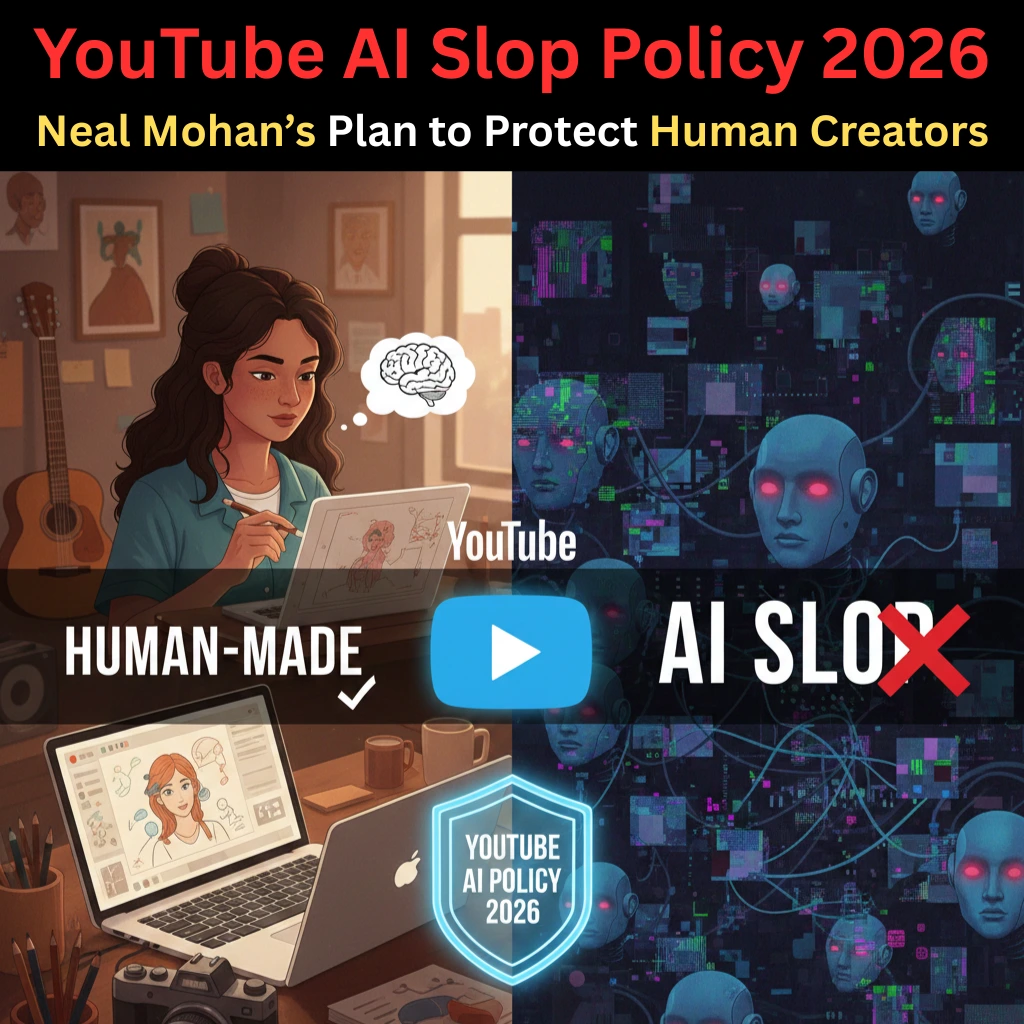
In a landmark announcement for the creator economy, YouTube CEO Neal Mohan has confirmed that the platform’s top priority for 2026 is the elimination of “AI Slop.” As generative AI continues to flood the internet with low-effort, mass-produced content, YouTube is stepping in to ensure that human creativity remains the heart of the platform.
What is “AI Slop” and Why is it a Threat?
“AI Slop” refers to low-quality, high-volume videos generated entirely by AI with little to no human oversight. These videos often clutter search results and recommendations, providing a poor experience for viewers. To combat this, the YouTube AI Slop Policy 2026 will introduce sophisticated detection systems to filter out “hollow” content.
Transparency Through New Labeling Tools
One of the core pillars of this update is the introduction of advanced transparency tools. YouTube will now make it easier for users to distinguish between human-made and AI-generated videos. Mandatory AI Disclosure: Content that features realistic synthetic media (faces, voices, or events) must be labeled. “Human-Verified” Badges: Rumors suggest YouTube is testing badges for creators who consistently produce high-effort, original human content. Enhanced Discovery Algorithms: The 2026 algorithm will prioritize “meaningful engagement” over simple watch time to discourage bulk AI uploads.
A Message to Creators
During his keynote, Neal Mohan emphasized that AI is not the enemy, but its misuse is.
AI should be a tool that amplifies human potential, not a substitute for it. Our goal for 2026 is to ensure that when a user clicks on a video, they are getting genuine value, not an automated script designed to farm views. Neal Mohan, CEO of YouTube.
For creators, this means a shift in strategy. Those using AI for brainstorming or editing will likely remain unaffected, but channels relying solely on “one-click” AI video generators may see a significant drop in reach and monetization eligibility.
FAQs
Find answers to common questions below.
Will YouTube ban all AI-generated videos in 2026?
No. YouTube is not banning AI. Instead, it is targeting "AI Slop"content that lacks creative value and human effort. High-quality AI-assisted videos will still be allowed but must be clearly labeled.
How will YouTube identify AI-generated content?
YouTube is deploying new AI-powered detection tools and metadata tracking (such as C2PA standards) to identify if a video was created using generative software.
Does this policy affect monetization?
Yes. YouTube has hinted that "low-effort" content, which includes AI Slop, may face stricter monetization hurdles as the platform seeks to reward original, high-value creators.