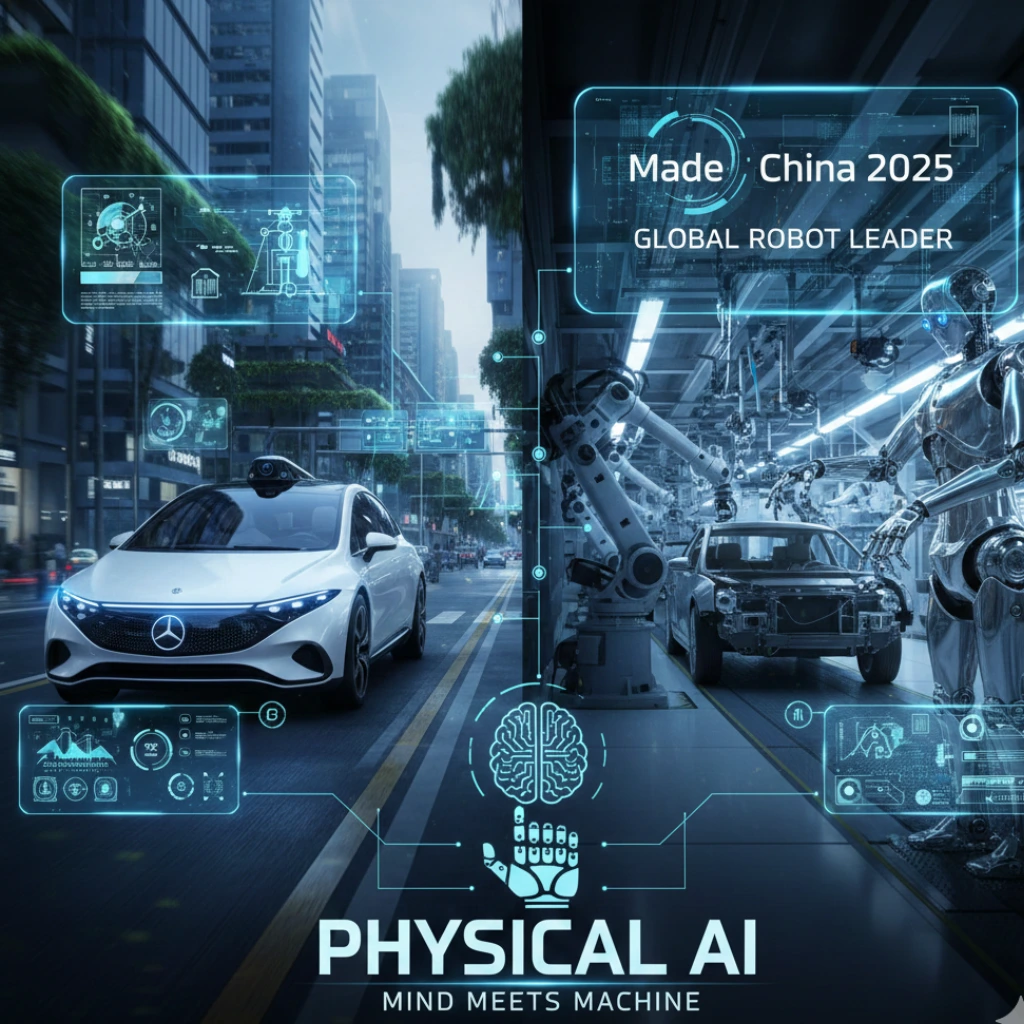
Imagine a world where artificial intelligence isn’t just a voice in your phone or a chatbot on your screen, but a tangible force that can open doors, build cars, and navigate busy city streets. Welcome to 2026, the era of Physical AI.
While the last few years were dominated by “Digital AI” (like ChatGPT), the current frontier is Embodied Intelligence. This is the fusion of powerful AI models with real-world hardware. Sensors, cameras, and actuators-that allows machines to not just process data, but to “feel” and act within our physical environment.
What Exactly is Physical AI?
Physical AI is the “brain” that allows a robot to understand the laws of physics. Unlike traditional robots that follow rigid, pre-programmed paths, Physical AI uses Vision-Language-Action (VLA) models.
- Perception: It “sees” through LiDAR and high-def cameras.
- Reasoning: It “thinks” using platforms like NVIDIA Cosmos, which acts as a prefrontal cortex for machines.
- Action: It executes tasks, like a humanoid robot cleaning a spill by reasoning through the absorbency of the cloth and the physics of the liquid.
The Automotive Industry: Ground Zero for Disruption
The car in your driveway is becoming the world’s most advanced mobile robot. The automotive sector is leading the charge, moving beyond simple cruise control to Level 4 Autonomy.
- NVIDIA & Global Giants: From Mercedes-Benz to Geely, manufacturers are integrating open-source models to create “software-defined” vehicles.
- Edge Computing: Companies like General Motors are using “Edge AI” to make split-second decisions without needing to talk to the cloud, reducing latency to near-zero.
- Next-Gen Logistics: Self-driving trucks, powered by the Cosmos platform, are already reshaping long-haul freight, making highways safer and more efficient.
China’s “Robot Boom”: A Global Shift
If you want to see the future of manufacturing, look at China. By the start of 2026, China has solidified its lead in the global robot race.
- Annual Installations: -295,000 industrial units
- Global Market Share: 54% of all deployments
- Robot Density: 470 robots per 10,000 workers
- Operational Stock: Over 2 million units
Driven by the “Made in China 2025” initiative, Chinese factories have moved from “performance guests” to “essential workers.” Interestingly, domestic brands now command over 57% of the market, overtaking traditional giants from Germany and Japan.
The $60 Billion Market: Who’s Winning?
The market for Physical AI is exploding. Valued at just $5.41 billion in 2025, it is projected to skyrocket to $61.19 billion by 2034, growing at a staggering 31.26% CAGR.
- NVIDIA: Providing the “Android for Robotics” through its open-source Cosmos models.
- ARM: Launched a dedicated division to handle the massive compute needs of physical devices.
- Humanoid Pioneers: Companies like Ubtech and Boston Dynamics (with the production version of Atlas) are now delivering thousands of units to EV factories and warehouses.
Future Outlook: Safer, Smarter, Faster
As we move through 2026, Physical AI is solving the “Reality Gap”. The difficulty of moving a robot from a digital simulation to the messy real world.
The Impact:
- Safety: Factory injuries are projected to drop by 15% as AI-powered “cobots” take over hazardous tasks.
- Efficiency: AI-driven predictive maintenance can reduce unplanned downtime by up to 50%.
- Sustainability: Smarter logistics and optimized manufacturing are cutting carbon emissions by nearly 20% in leading plants.
The transition isn’t just about replacing labor; it’s about “Human-Robot Collaboration.” In this new era, the most valuable skill won’t just be coding software, it will be training and managing the physical intelligence that moves our world.
FAQs
Find answers to common questions below.
What makes Physical AI different from ChatGPT?
Unlike digital AI that only processes text or images, Physical AI (Embodied AI) uses sensors and actuators to interact with the physical world, like a robot picking up a glass or a car turning a corner.
Is China really winning the global robot race?
Yes! As of 2026, China accounts for over 54% of global robot deployments, with a density of 470 robots per 10,000 workers, overtaking Japan and Germany.
How does Physical AI make driving safer?
It uses "Edge AI" to process data locally on the vehicle. This allows for near-zero latency in decision-making, helping cars avoid accidents faster than a human brain can react.
Will humanoid robots be in our homes soon?
While currently dominant in EV factories and logistics, the 80% surge in humanoid sales suggests they will enter specialized service roles and eventually homes within this decade.