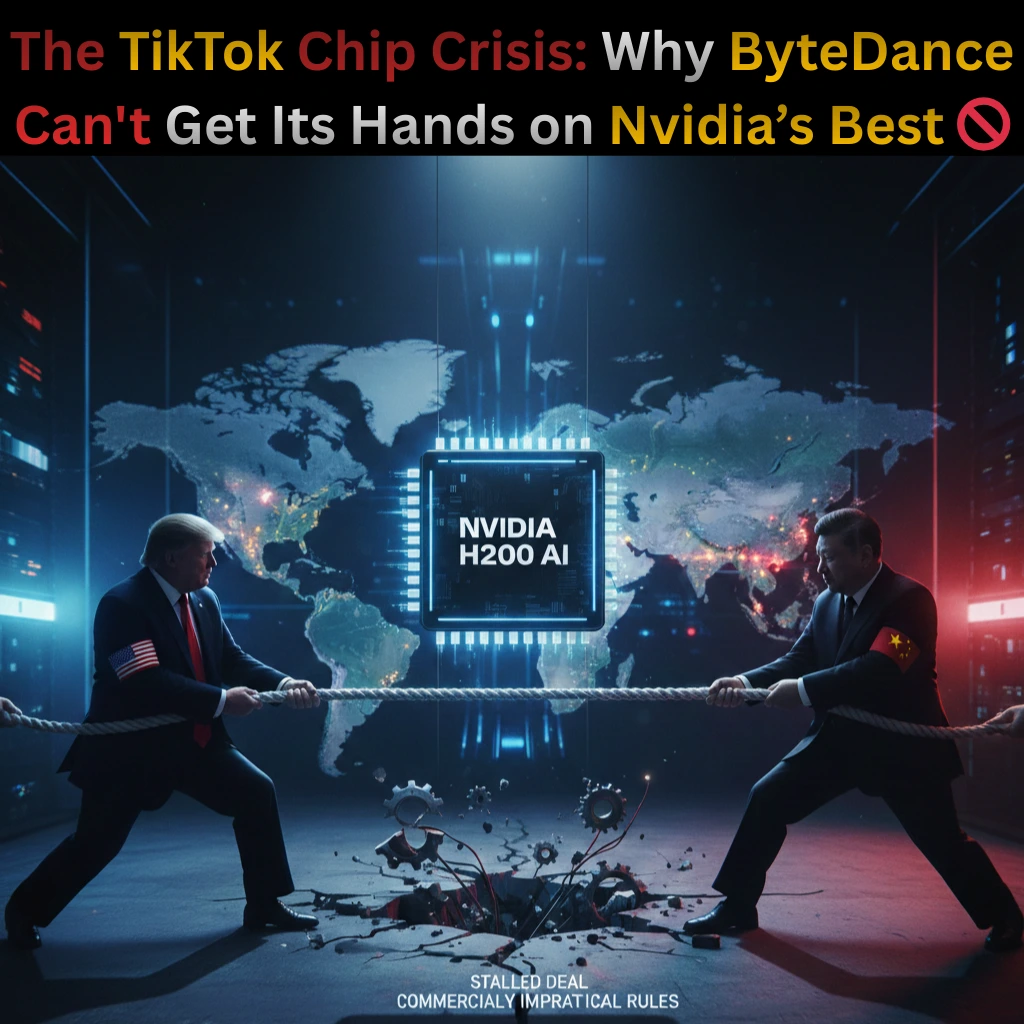
In the high-stakes poker game of global tech, Nvidia just found itself in a bit of a “checkmate” moment. You’d think that having the world’s most sought-after hardware would make for a smooth sales process, right? Well, not when you’re caught between a resurgent Trump administration and a tech giant like ByteDance.
Currently, a massive deal to supply Nvidia H200 AI chips to the parent company of TikTok is effectively stalled. It isn’t for a lack of demand. ByteDance is hungry for that compute power-but because of a three-letter acronym that’s becoming the bane of Silicon Valley: KYC.
But what exactly is holding up the gears of this multi-billion-dollar machine?
The “Know-Your-Customer” Headache
We usually hear about Know-Your-Customer (KYC) in the context of opening a bank account. However, the Trump administration has repurposed it into a geopolitical shield. The logic is straightforward. If Nvidia intends to sell its second-most powerful chip to China, it must prove with absolute certainty that these chips will not end up in the hands of the Chinese military.
The administration’s requirements are, to put it lightly, intense. They don’t just want a “pinky promise.” The proposed rules include:
- Rigorous data reporting on how and where the chips are used.
- Third-party testing in U.S.-based labs before the chips even leave for China.
- Real-time monitoring to prevent unauthorized remote access from “countries of concern” like Iran or Russia.
Nvidia, acting as the intermediary, is pushing back. Why? Because these rules aren’t just strict-they might be commercially impractical. If the paperwork becomes more expensive than the hardware, does the deal even make sense?
A 25% “Cut” and the Competitive Edge
It’s not just about the red tape. In a move that has sent shockwaves through the industry, the U.S. government isn’t just regulating these sales-it’s taking a piece of the pie. President Trump has proposed a 25% tariff (or “cut”) on these H200 exports.
Can you imagine trying to maintain a competitive edge when a quarter of your revenue is taxed before the product even lands? Nvidia’s CEO Jensen Huang has been vocal about the high demand in China, but he’s also warned that if the U.S. makes it too difficult to buy American, the market will simply pivot to foreign alternatives.
“For American industry to make any sales, the conditions need to be commercially practical,” an Nvidia spokesperson recently noted.
Is Beijing Pulling the Plug from the Other Side?
Here’s where it gets even more complicated. While Nvidia and Washington argue over the “how,” Beijing might be deciding on the “if.”
Recent reports suggest that Chinese customs have started blocking some of these H200 shipments without a clear explanation. At the same time, the Chinese government is pressuring firms like Tencent, Alibaba, and ByteDance to ditch the Silicon Valley shiny toys and prioritize domestic hardware, like Huawei’s Ascend chips.
+1 Is it possible that by the time Nvidia and the U.S. government reach an agreement, the Chinese market will have already moved on?
Final Thoughts: A Tech Tug-of-War
At its heart, the Nvidia vs. ByteDance saga is about more than just some high-end silicon. it’s a battle for AI supremacy. The H200 is a powerhouse, capable of training the next generation of LLMs, and neither superpower wants the other to have the upper hand.
For Nvidia, the clock is ticking. With a $50 billion market at stake, they need a middle ground that satisfies national security without strangling the business. But in a world of “America First” policies and China’s “Self-Reliance” push, is there any room left for a middle ground?
FAQs
Find answers to common questions below.
What is the "KYC" requirement holding up Nvidia's sales?
Unlike banking, tech KYC (Know-Your-Customer) requires Nvidia to prove that their H200 chips aren't being diverted to the Chinese military or used in state-sponsored surveillance.
Why is the H200 chip so valuable to ByteDance?
The H200 is the gold standard for training Large Language Models (LLMs). For ByteDance, it's the engine behind TikTok's algorithm and their future AI breakthroughs.
Will Trump’s 25% tariff end Nvidia’s dominance in China?
It’s a massive hurdle. If the "Trump Tax" makes American chips too expensive, ByteDance may be forced to switch to domestic alternatives like Huawei’s Ascend 910C.
Can Nvidia bypass these restrictions?
Legally, no. Nvidia must negotiate a "commercially practical" framework with the U.S. government or risk losing the $50 billion Chinese market entirely.