The tech world is currently buzzing with what many are calling the “Deal of the Year.” NVIDIA, the absolute titan of the AI industry, has just made a monumental move that signals its intent to dominate not just how AI is trained, but how it runs in our daily lives.
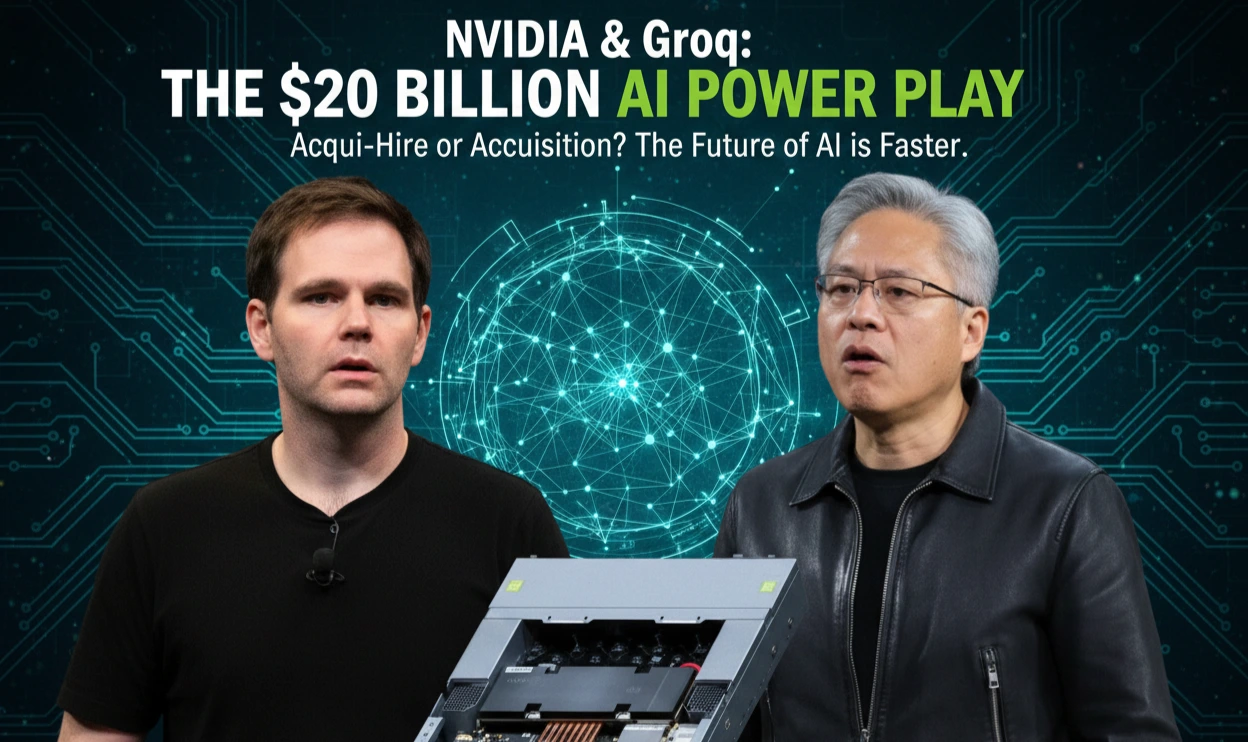
Within the last 24 hours, reports from CNBC, TechCrunch, and Bloomberg have revealed a complex, $20 billion agreement with the AI chip startup Groq.
But this isn’t a typical “I buy you, you disappear” acquisition. It’s much more strategic. Here is the breakdown of why this deal is a game-changer for the future of Artificial Intelligence.
The Big Confusion: Acquisition vs. Licensing
Early reports suggested that NVIDIA was buying Groq for about $20 billion. This would have been NVIDIA’s biggest deal ever. But newer reports from Bloomberg and The Times of India clarify that this is actually a strategic licensing deal.
What does this mean?
- NVIDIA has gained the rights to use Groq’s special technology.
- Groq will continue to exist as its own independent company.
- This is a “non-exclusive” deal, meaning Groq can still work with others.
The “Acqui-hire”: Bringing the Geniuses to NVIDIA
The most unique part of this deal isn’t just the tech, it’s the people. Groq’s founder and CEO, Jonathan Ross, is officially joining NVIDIA. Ross is famous in the tech world for helping build Google’s first AI chips (TPUs).
Along with him, Groq’s President and several top engineers are also moving to NVIDIA. This is what Silicon Valley calls an “Acqui-hire”, where a big company pays to get the best talent and technology without the legal trouble of a full takeover.
Why Does NVIDIA Want Groq’s Tech?
Groq is famous for its Language Processing Units (LPU). While NVIDIA’s chips are the best at “training” AI, Groq’s chips are incredibly fast at “inference” (the part where the AI actually answers your questions). By using this tech, NVIDIA can make tools like ChatGPT much faster and cheaper to run.
What Are People Saying on Social Media?
The tech community on Twitter (X) and LinkedIn is buzzing with official statements:
Groq’s Official Statement: The company posted that the agreement reflects a shared goal to make high-performance AI accessible to everyone at a lower cost.
Chamath after making $4B from a seed investment in Groq (just announced $20B sale to NVIDIA)
One of the best venture outcomes of all time pic.twitter.com/gEdIDMNxHp
— Boring_Business (@BoringBiz_) December 24, 2025
Industry Experts: Many believe NVIDIA did this to stop rivals like Google and Amazon from catching up.
Key Highlights of the Deal
- Strategic Licensing: NVIDIA gets the tech; Groq stays independent.
- Mastermind Move: Jonathan Ross and his team bring their expert knowledge to NVIDIA.
- Market Value: Groq was valued at $6.9 billion recently, but this deal is being discussed in the $20 billion range.
- AI Speed: This move will likely make AI responses much faster for everyday users.
The Bottom Line
NVIDIA is now a $4.5 trillion company. By partnering with Groq, they aren’t just buying hardware; they are securing the brightest minds in the industry. This deal ensures that NVIDIA remains the king of the AI world for a long time to come.
FAQs
Find answers to common questions below.
Is NVIDIA officially buying Groq?
Not exactly. It is a $20 billion strategic licensing deal. NVIDIA is paying for Groq’s technology and hiring its top talent, but Groq will continue to operate as an independent company.
Why is this deal a game-changer for AI speed?
Groq’s chips are famous for "Inference", the speed at which AI generates answers. By integrating this into their ecosystem, the NVIDIA Groq Deal will make AI responses feel instant and real-time.
Who is Jonathan Ross, and why did NVIDIA hire him?
Jonathan Ross is the genius who helped create Google’s TPU. NVIDIA "acqui-hired" him to lead their new hardware efforts, effectively bringing one of their biggest rival's secret weapons onto their own team.
How does this impact rivals like Google and Amazon?
This move is a defensive masterstroke. By securing Groq’s tech, NVIDIA has neutralized a major threat and tightened its grip on the global AI chip market.