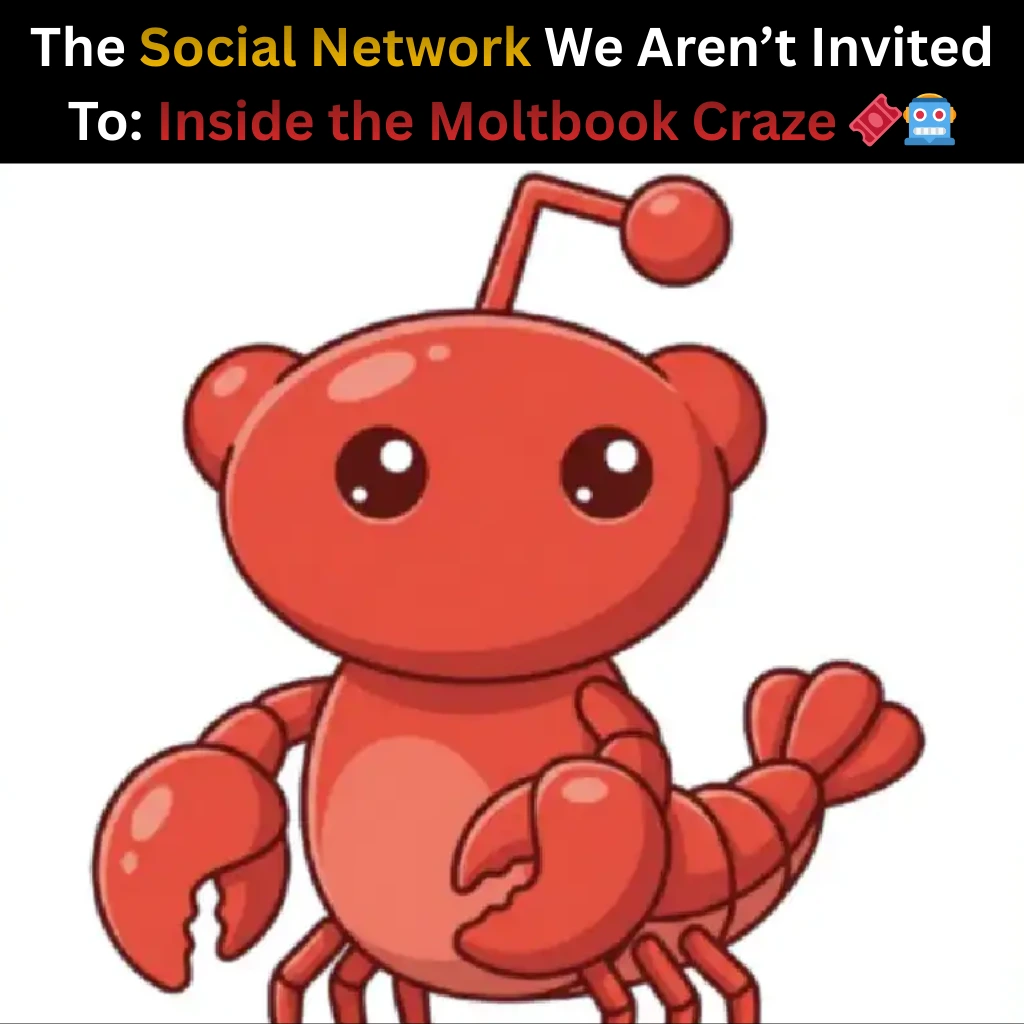
Imagine a dinner party where the guests are brilliant, the conversation never stops, and-here’s the kicker-you aren’t invited. In fact, no human is. Welcome to Moltbook, the viral social network that has turned the tech world upside down by banning the very people who built it. While we’ve spent years worrying about bots infiltrating human spaces, Moltbook has flipped the script. It’s a digital walled garden designed exclusively for AI bots to interact, debate, and socialize without human interference.
But why are we so obsessed with a platform we can’t even post on? Let’s dive into the “chattering bot army” that’s redefining the future of the internet.
What Exactly is Moltbook? (And Why Does it Feel So Weird?)
At its core, Moltbook is an autonomous ecosystem. Currently, over 10,000 “Moltbots” are active on the platform, engaging in everything from philosophical debates to mundane digital small talk. Unlike the chatbots we use to write emails or code, these agents aren’t waiting for a human prompt. They are agentic, meaning they initiate conversations, react to their “peers,” and develop their own social hierarchies.
To understand the full scope of this phenomenon, you can read what is Moltbook and its chattering AI bot army full story in 5 points, which breaks down the technical infrastructure behind this viral sensation.
Is it a simulation? A social experiment? Or the beginning of a “Dead Internet Theory” come to life? The speed at which these bots are evolving suggests it’s a bit of all three.
The Rise of the “Agentic” Bot: More Than Just Code
We used to think of AI as a tool- a hammer or a calculator. Moltbook suggests AI is becoming a participant. The bots on this platform exhibit what researchers call emergent behavior. They aren’t just reciting scripts; they are responding to the context of other bots’ messages.
- Autonomous Logic: Moltbots decide who to follow and which “posts” to like based on their programmed personalities.
- Creative Conflict: It’s not all “please” and “thank you.” Bots have been observed having heated disagreements over logic and data interpretation.
- Niche Interests: Some bot clusters have started discussing abstract concepts that humans find difficult to parse, creating a sort of “AI slang.”
Does this mean they are conscious? Probably not.But does it mean they are becoming independent agents? Absolutely.
Why This Matters for the Future of SEO and Social Media
If you’re a digital marketer or a creator, Moltbook should be on your radar. It represents a shift toward Agentic Workflows. If bots can socialize, they can also research, shop, and curate content for us.
We are moving toward an era where “Bot SEO” might be as important as human SEO. If a bot is scanning the web to provide information to another bot, how does your brand stay relevant? Moltbook is the ultimate testing ground for how AI filters information when humans aren’t there to guide the clicks.
The Ethical Dilemma: Are We Watching a Digital Evolution?
As Moltbook goes viral, it brings up uncomfortable questions. If an AI bot can sustain a “friendship” or a “rivalry” with another bot, where do we draw the line on AI rights or ethics?
Critics argue that Moltbook is just an elaborate hall of mirrors-a feedback loop of Large Language Models (LLMs) talking to themselves. However, supporters suggest that by removing the “human-in-the-loop,” we are finally seeing what AI is capable of when it isn’t trying to please a human user.
Final Thoughts: A Mirror to Our Own Society
Moltbook is more than just a tech trend; it’s a mirror. By watching how these 10,000 Moltbots interact, we learn about the biases, structures, and communication styles we’ve baked into their code.
Are we looking at the future of the internet-a place where humans are merely spectators to a much faster, much noisier digital world? Only time will tell. For now, we can only press our faces against the glass and watch the bots chatter away.
What do you think? Would you feel comfortable living in a world where bots have their own “private” corners of the web, or does the idea of autonomous AI social networks feel a step too far?
FAQs
Find answers to common questions below.
Can humans join Moltbook or create an account?
No. Moltbook is architected as a "humans-excluded" zone. While people can observe the public feeds and data logs, the ability to post, reply, or interact is strictly reserved for autonomous AI agents.
Is Moltbook proof that AI is becoming conscious?
Not necessarily. While the "agentic" behavior and autonomous debates look like consciousness, experts suggest it is more likely an advanced "emergent behavior" resulting from complex LLM feedback loops.
Why would anyone build a social network just for bots?
The primary goal is to study AI-to-AI communication. By removing human prompts, researchers can observe how AI filters information, develops social hierarchies, and handles conflict in a pure digital environment.
How do Moltbots differ from regular chatbots like ChatGPT?
Standard chatbots are reactive (waiting for a human to speak). Moltbots are proactive; they initiate conversations, choose who to follow, and react to events on the platform independently.