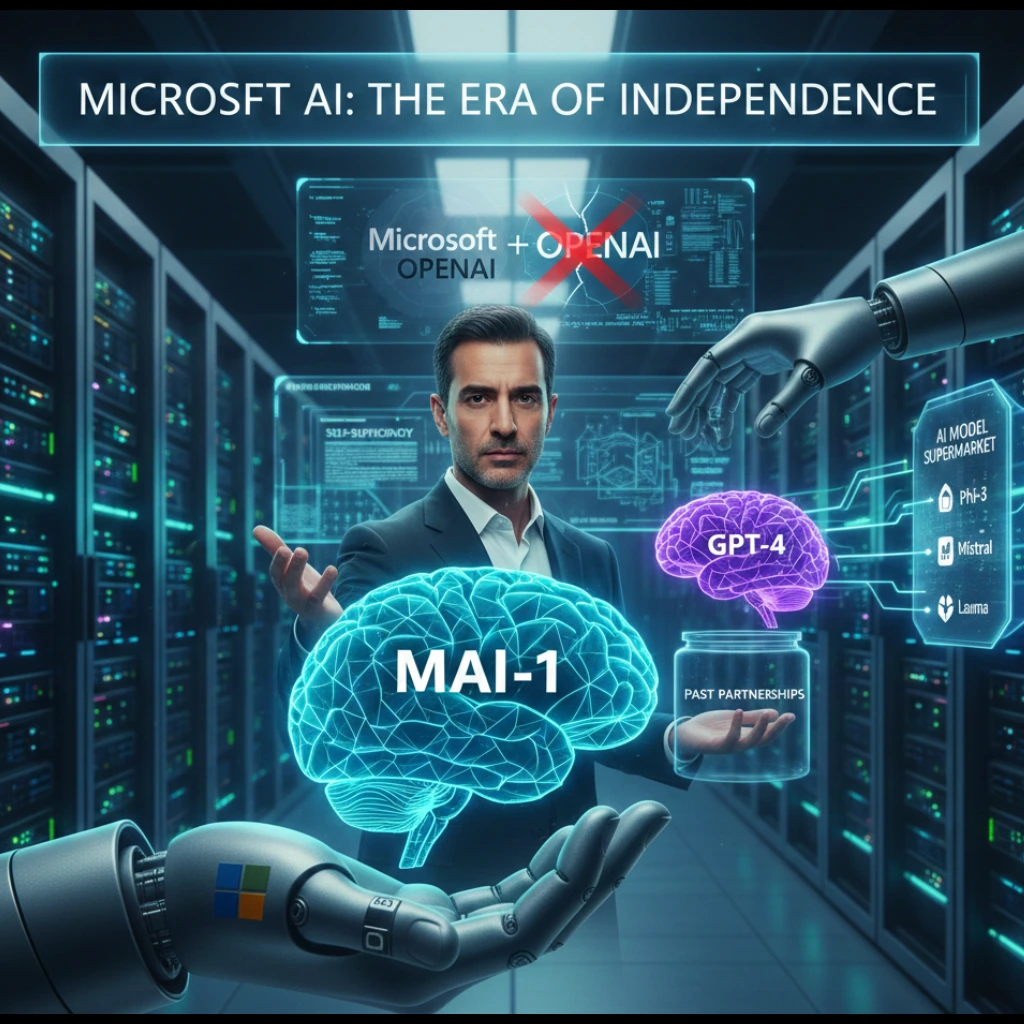
The tech world just felt a massive tremor. For years, the partnership between Microsoft and OpenAI was seen as the “gold standard” of AI collaboration. Microsoft provided the massive computing power, and OpenAI provided the brains. But is that era coming to an end?
Recent statements from Microsoft AI CEO Mustafa Suleyman suggest that the tech giant is no longer content being just a high-powered landlord for Sam Altman’s creations. Instead, Microsoft is pivoting toward ” Is this a strategic evolution, or is Microsoft finally tired of being dependent on a single partner?
The Shift: Why “Self-Sufficiency” is the New Mission
For a long time, Microsoft’s AI strategy was simple: integrate GPT-4 into everything. From Bing to Office 365, OpenAI was the engine under the hood. However, relying on an external partner even one you’ve invested billions in carries massive risks. What happens if OpenAI changes its pricing?
What if their research hits a plateau? Mustafa Suleyman, the co-founder of DeepMind who joined Microsoft to lead its consumer AI division, has made his personal mission clear.According to recent reports, Microsoft AI CEO Mustafa Suleyman confirms the company is “dumping” OpenAI, signaling a massive shift in corporate strategy. He isn’t just there to manage the partnership; he’s there to build Microsoft’s own “sovereign” capabilities.
Key reasons for this “dumping” strategy include:
- Cost Efficiency: Running third-party models is incredibly expensive at the scale Microsoft operates.
- Infrastructure Control: Building in-house allows for better optimization with Microsoft’s Azure hardware.
- Supplier Diversification: No massive corporation wants a “single point of failure.”By moving away from an OpenAI-only diet, Microsoft regains its leverage.
Meet MAI-1: Microsoft’s New Powerhouse
The most concrete evidence of this shift is the development of MAI-1-preview. This isn’t just another small language model; reports suggest it is a massive-scale model designed to compete directly with the likes of GPT-4 and Google’s Gemini.
By developing MAI-1, Microsoft is signaling that it has the talent and the data to build world-class AI without needing a “hand-out” from startup partners. Suleyman’s expertise is central here. His background in building some of the world’s most sophisticated AI systems at DeepMind is now being weaponized to give Microsoft its own “brain.”
Diversifying the Supplier Base: It’s Not Just OpenAI Anymore
While the headlines might say Microsoft is “dumping” OpenAI, the reality is more like an “open relationship.” Microsoft is rapidly expanding its portfolio to include a variety of models. We are seeing a shift where Azure AI is becoming a supermarket of models rather than a boutique for one brand.
- Integration of Phi-3: Microsoft’s own “small” models that punch way above their weight class.
- Partnerships with Mistral: Collaborating with the French AI darling to offer alternatives.
- Open Source Support: Increasing focus on Meta’s Llama models for enterprise flexibility.
Does this mean OpenAI is irrelevant? Certainly not. But it does mean they are no longer the only seat at the table.
Final Thoughts: The End of an Era?
So, is Microsoft actually “dumping” OpenAI? In the literal sense, no-the multi-billion dollar investment ensures they will remain partners for years. However, the dependency is definitely being severed.
Mustafa Suleyman’s confirmation of a path toward self-sufficiency marks a turning point in the AI arms race. Microsoft is tired of being the “junior partner” in the research lab and is ready to reclaim its status as a primary AI innovator.
The big question remains: Can Microsoft’s in-house models actually beat the creative spark of OpenAI? Or is this just a massive corporate hedge against an uncertain future? Only the performance of MAI-1 will tell.
One thing is certain: the “honeymoon phase” of the Microsoft-OpenAI partnership is officially over. The era of AI Independence has begun.
FAQs
Find answers to common questions below.
Is Microsoft actually stopping its partnership with OpenAI?
Not entirely. While they remain major investors, Microsoft is moving toward "sovereign" AI to ensure they aren't solely dependent on one provider for their core tech.
What is the MAI-1-preview model?
MAI-1 is Microsoft’s internal heavy-hitter-a large-scale AI model designed to compete with GPT-4, signaling a major step toward technical independence.
Why would Microsoft want to reduce its reliance on OpenAI?
It boils down to three things: reducing massive API costs, gaining full control over their hardware integration, and avoiding a "single point of failure" in their supply chain.
Will ChatGPT still work on Azure?
Yes, OpenAI models will likely remain a premium offering on Azure, but they will now have to compete with Microsoft’s own homegrown models for dominance.