
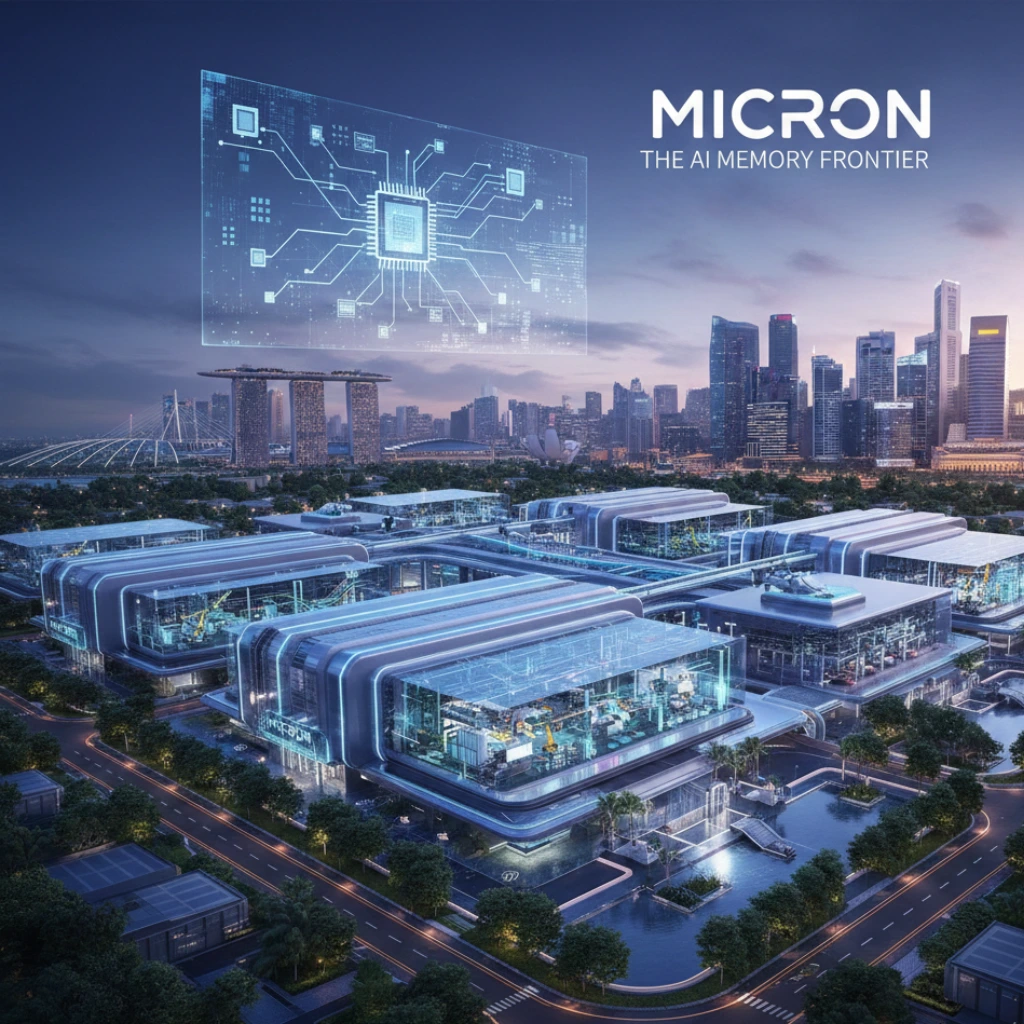
The global race for Artificial Intelligence dominance has hit a physical wall, and it’s not just about software or algorithms. It’s about hardware-specifically, the specialized memory required to keep AI models like ChatGPT and Gemini running. As the industry grapples with an unprecedented “Memory Crunch,” Micron Technology has just dropped a bombshell: a massive $24 billion commitment to expand its operations in Singapore.
This isn’t just a corporate expansion; it’s a strategic lifeline for the entire tech ecosystem. Here is why this deal is the talk of the semiconductor world.
The $24 Billion Blueprint
Micron’s latest move involves the construction of a state-of-the-art wafer fabrication facility in Singapore, sprawling across a massive 700,000 square feet. This facility is designed to meet the skyrocketing demand for NAND flash memory and advanced HBM (High Bandwidth Memory) chips. Micron will start wafer output in 2028 as part of a plan to boost Singapore’s semiconductor role. It is also investing $7 billion in an advanced HBM packaging facility for AI.
Why Is the World Running Out of Memory?
In the era of Generative AI, data isn’t just being stored; it is being processed at lightning speeds. Traditional memory chips simply can’t keep up with the data “traffic jams” created by massive AI training models. This has led to a supply-demand gap so wide that enterprise SSD prices are projected to surge by up to 60%.
By planting its flag firmly in Singapore, Micron is betting that the AI boom isn’t just a bubble, but a long-term shift in how humanity uses technology.
The Singapore Edge
Why Singapore? The city-state has long been a neutral, highly efficient hub for tech manufacturing. For Micron, Singapore offers a stable regulatory environment, a highly skilled workforce, and a strategic location that connects Eastern manufacturing prowess with Western design. This $24 billion injection will create thousands of high-tech jobs and further protect the global supply chain from geopolitical volatility.
The Ripple Effect: What It Means for You
While this sounds like “big tech” business, the implications reach your pocket. A stabilized memory supply means:
- More Powerful Devices: Faster smartphones and laptops capable of running “on-device” AI without lagging.
- Cheaper Cloud Services: As data centers become more efficient, the cost of cloud storage and AI subscriptions could stabilize.
- Faster Innovation: When the “memory crunch” eases, researchers can train more complex AI models, leading to breakthroughs in medicine, climate science, and autonomous systems.
Is It Enough?
While Micron’s $24 billion investment is a giant leap, the question remains: Can supply ever truly catch up with AI’s infinite appetite for data? With rivals like Samsung and SK Hynix also ramping up production, the “Memory Wars” of the late 2020s are just beginning.
For a deeper dive into the technical specifications and the strategic roadmap of this deal, you can read more about Micron’s $24B investment in Singapore.
FAQs
Find answers to common questions below.
What exactly is an 'AI Memory Crunch'?
It’s a shortage of high-speed memory chips (like HBM) caused by the sudden, massive demand from AI data centers, which require much more data throughput than traditional servers.
Will this investment lower the price of laptops?
In the long run, yes. By increasing global supply, it helps prevent the price spikes we currently see in SSDs and RAM.
When will the new Singapore plant be fully operational?
Production is slated to begin in 2028, with the full project spanning over the next decade.
Is HBM different from the RAM in my PC?
Yes, High Bandwidth Memory (HBM) is much faster and more expensive, designed specifically to sit close to AI processors to minimize data delay.