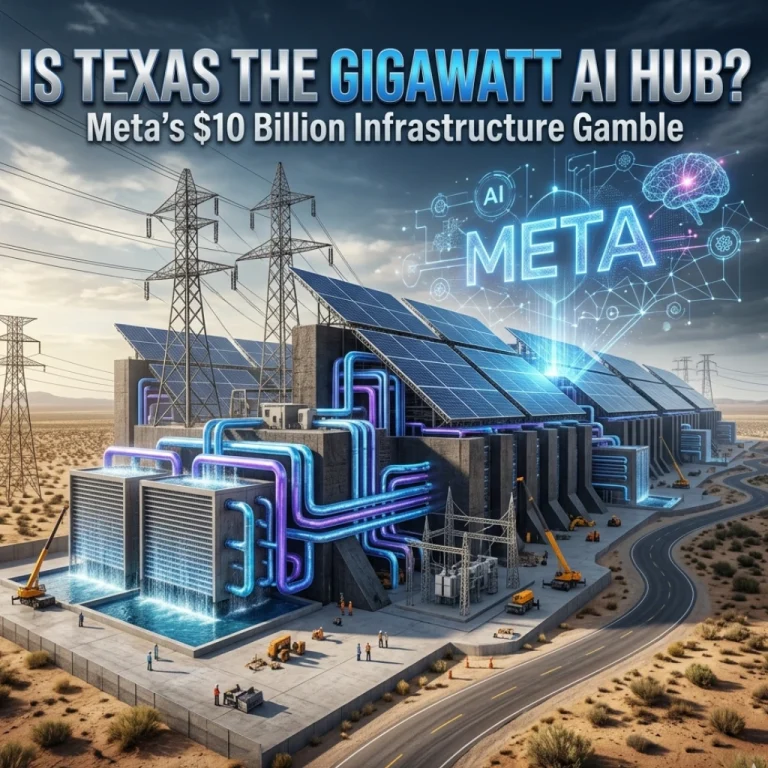
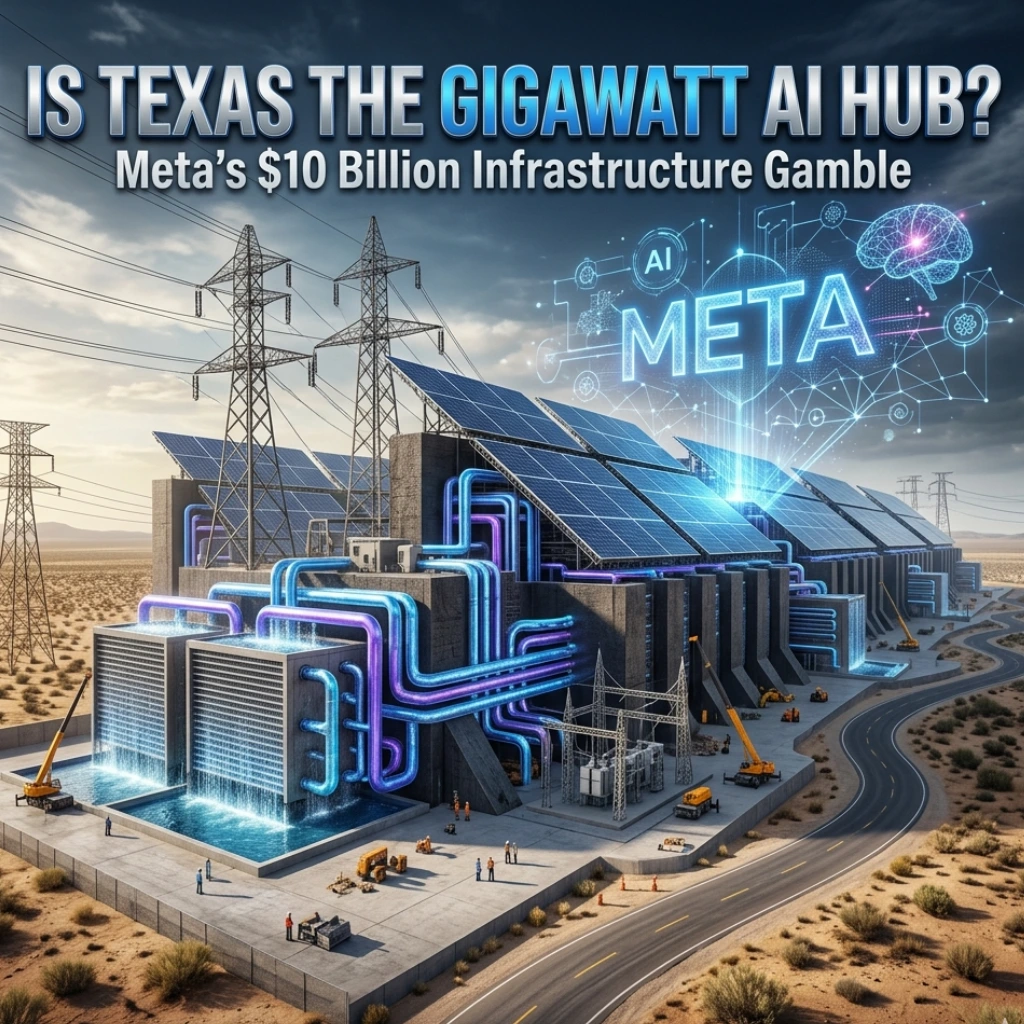
If you thought the AI arms race was just about smarter chatbots and viral image generators, think again. The real battle isn’t happening in the cloud-it’s happening in the dirt, the concrete, and the power grids of West Texas.
Meta just sent a massive shockwave through the tech industry by announcing a staggering $10 billion investment into its El Paso, Texas data center. To put that in perspective, that is a sixfold increase from their original plan. We aren’t just talking about a few extra server racks here; we are witnessing the birth of a 1-gigawatt AI titan.
But why El Paso? And why now? Let’s dive into why Mark Zuckerberg is doubling down on the Lone Star State to secure the future of Meta’s “Next-Gen” Generative AI.
From Social Media to Infrastructure Giant
For years, Meta was seen primarily as a software company-the “Facebook and Instagram people.” But as the demand for Llama 3 and future iterations of generative AI skyrockets, the company has had to pivot. According to recent reports, Meta boosts Texas AI data center investment to $10 billion, signaling a shift from being an app developer to a heavy-industrial infrastructure player.
This El Paso facility is designed to be the beating heart of Meta’s global AI operations. By the time it reaches its target 1-gigawatt capacity in 2028, it will be one of the largest data centers on the planet.
Why the $10 Billion Price Tag?
You might be wondering: What does $10 billion actually buy in the world of tech? It isn’t just about the bricks and mortar. The cost reflects a massive technological leap:
- Liquid Cooling Systems: Traditional fans can’t handle the heat generated by the thousands of H100 (and future B200) GPUs required for AI. This facility will likely feature advanced liquid-to-chip cooling.
- The Power Hungry Grid: A gigawatt of power is enough to light up roughly 750,000 homes. Securing this level of energy requires specialized electrical substations and a deep partnership with Texas energy providers.
- Custom AI Chips: Meta is increasingly moving toward its own custom silicon (MTIA) to reduce reliance on third parties, and these data centers are being built specifically to house this specialized hardware.
Is Texas the New Silicon Valley for AI?
Texas has always been “big,” but it’s now becoming the undisputed capital of high-performance computing. With its independent power grid (ERCOT) and vast stretches of land, it offers something Northern California simply can’t: scale.
But is the grid ready for a 1-gigawatt tenant? That is the multi-billion dollar question. Meta’s investment includes significant work on local infrastructure, ensuring that while they pull massive amounts of power, they are also contributing to the modernization of the local utility landscape. This isn’t just about Meta; it’s about the economic transformation of El Paso, creating thousands of construction jobs and hundreds of permanent high-tech roles in a region that is quickly becoming a tech hub.
The Race for General Intelligence
Why is Meta in such a rush? Because the window for AI dominance is closing. With Google, Microsoft, and OpenAI all vying for the “AGI” (Artificial General Intelligence) crown, the winner won’t just be the one with the best code-it will be the one with the most compute.
By 2028, this facility won’t just be hosting your holiday photos. It will be training the models that could eventually handle complex reasoning, real-time video generation, and seamless AR integration for the Metaverse.
Final Thoughts: A Gigawatt of Potential
Meta’s $10 billion pivot in El Paso is more than a budget increase; it’s a statement of intent. It tells us that the future of AI isn’t just “virtual”-it requires massive physical footprints, incredible amounts of electricity, and a long-term commitment to infrastructure.
As we look toward 2028, one thing is certain: the road to the next generation of AI runs straight through Texas. Will this massive gamble pay off and give Meta the edge it needs? Only time-and a whole lot of gigawatts-will tell.
FAQs
Find answers to common questions below.
Why did Meta increase its El Paso investment sixfold?
The surge to $10 billion reflects the massive hardware and cooling costs required for next-gen Generative AI. As models like Llama grow more complex, Meta needs exponentially more physical "compute" space than originally planned.
What does a "1-Gigawatt" capacity actually mean for AI?
In data center terms, a gigawatt is a massive threshold. It provides enough raw electrical power to run hundreds of thousands of high-end AI chips (like NVIDIA’s Blackwell) simultaneously, making it one of the most powerful AI training grounds on Earth.
How will this impact the local El Paso economy?
Beyond the $10 billion construction injection, the hub transforms El Paso into a premier tech corridor. It brings high-salary utility engineering jobs, data center operations roles, and puts the city at the center of the global AI infrastructure map.