
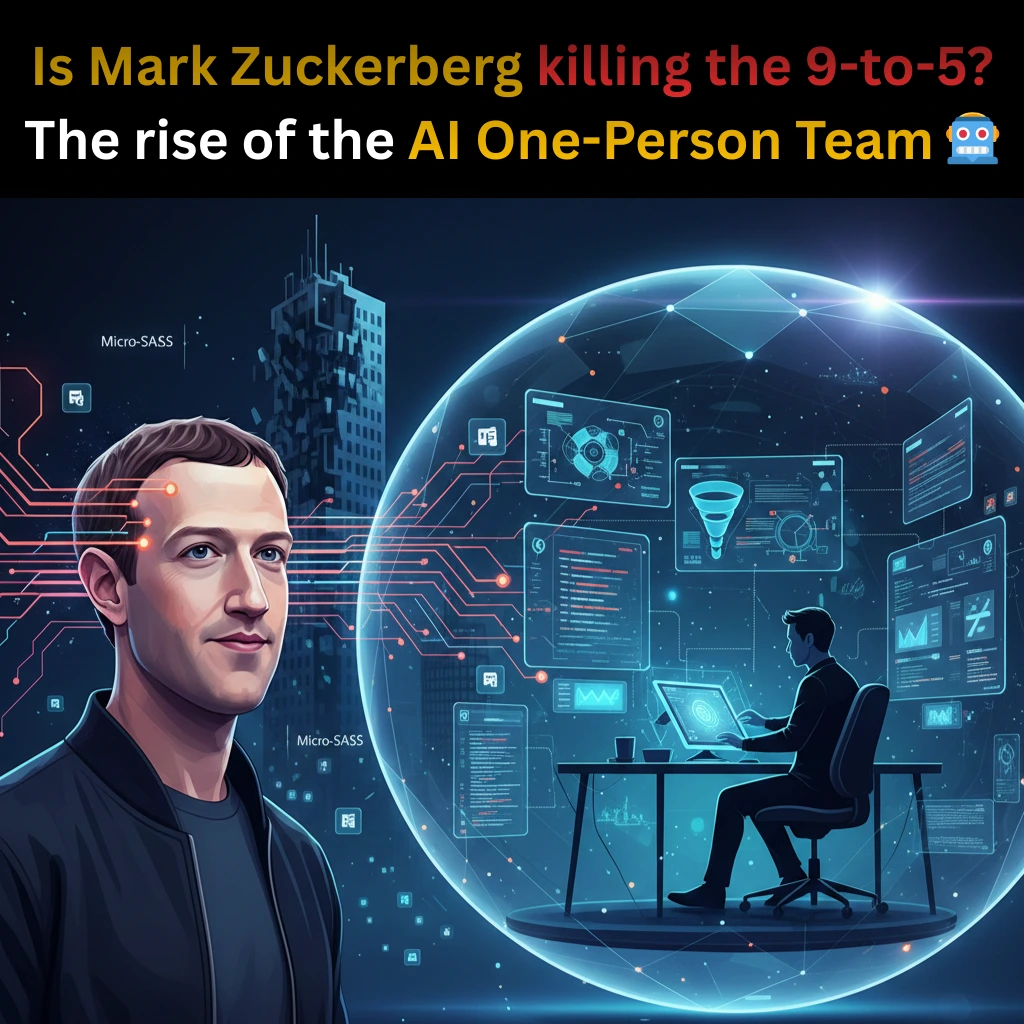
During Meta’s most recent earnings call, Mark Zuckerberg dropped a statement that sent a chill through Silicon Valley and a spark of excitement through the solopreneur community. He noted that AI is no longer just a “helper” but a force multiplier so potent that a “single very talented person” can now execute projects that once required an entire department.
Is the traditional corporate hierarchy crumbling? Or are we simply entering an era where being “talented” isn’t enough anymore you have to be AI-augmented?
The End of the “Middle-Management” Era?
For decades, the tech industry operated on a “more is more” philosophy. If a project was big, you hired more engineers, more designers, and more project managers. Zuckerberg’s latest pivot suggests those days are over. By leveraging generative AI for coding (Llama 3), content creation, and data analysis, Meta is proving that leaner is not just cheaper-it’s faster.
But this raises a stinging question: If one person can do the work of ten, what happens to the other nine?
We aren’t just talking about automation in factories anymore. We are talking about high-level strategic roles. Zuckerberg’s “Year of Efficiency” wasn’t a one-time event; it appears to be a permanent shift in how Meta and by extension, the rest of the tech world views human capital.
Why “Talent” Now Means “AI-Literacy”
When Zuckerberg talks about a “very talented person,” he isn’t just referring to someone who can write clean code. He’s talking about the “AI Orchestrator.” In this new landscape, the most valuable players are those who can:
- Prompt-Engineer Complex Workflows: Using AI to draft initial architectures or marketing funnels in minutes.
- Audit vs. Create: Shifting from “doing the work” to “reviewing the AI’s work.”
- Bridge the Gap: Combining technical skills with business intuition to steer AI tools toward a finished product.
The barrier to entry for starting a company or launching a product has never been lower. However, the barrier to staying employed in a traditional “cog-in-the-machine” role has never been higher.
The Economic Ripple Effect: Jobs vs. Productivity
While the “One-Person Team” sounds like a dream for CEOs looking at bottom-line margins, it presents a complex puzzle for the labor market.
- The Upside: We are seeing a boom in “Micro-SaaS” startups. Individuals are building million-dollar businesses from their bedrooms without a single full-time hire.
- The Downside: The “Junior” problem. If AI handles the entry-level tasks, how do newcomers gain the experience needed to become that “one very talented person”?
Key Trends to Watch:
- Fractional Leadership: More companies hiring “part-time” experts because AI handles the grunt work.
- The “Talent Density” Push: Firms like Netflix and Meta are prioritizing high salaries for a few “10x” employees rather than moderate salaries for many.
- Skill Convergence: Designers learning to code and coders learning to write, all powered by AI shortcuts.
Mark Zuckerberg isn’t just predicting the future;
Mark Zuckerberg isn’t just predicting the future; he’s actively building it. The message is clear: the safety net of the “large team” is disappearing.
So, what’s the move? It’s time to stop viewing AI as a tool and start viewing it as your unpaid intern, your co-founder, and your research team all rolled into one. The goal isn’t to compete with the machine it’s to be the person who knows how to flip the switch.
Are you ready to become a one-person powerhouse, or is your current role built on tasks that a clever prompt could replace by tomorrow morning? The answer to that question might be the most important career realization you’ll have this year.
FAQs
Find answers to common questions below.
Does Zuckerberg’s "One-Person Team" comment mean more layoffs are coming?
While not an explicit announcement of cuts, it signals a shift toward "Talent Density" where companies prefer a few AI-empowered experts over large, traditional departments.
What skills do I need to become a "One-Person Team"?
The focus is shifting from deep specialization to "AI Orchestration". The ability to use tools like Llama 3 to bridge gaps in coding, design, and project management.
Can a single person really replace a 10-person team?
In terms of output volume and speed, yes. However, human oversight is still critical for high-level strategy, ethics, and creative nuance that AI hasn't mastered yet.
Is this trend limited to Meta and Silicon Valley?
No. The "Year of Efficiency" started in Big Tech but is now being adopted by startups and mid-sized firms looking to cut overhead via automation.