
Have you ever wondered if the algorithms governing our daily lives actually share our values? As Artificial Intelligence shifts from a futuristic novelty to the very backbone of our economy, the question isn’t just about what AI can do, but what it should be allowed to do.
Speaking at a recent high-level summit, Prime Minister Narendra Modi didn’t just talk about code and chips; he introduced a philosophy. With the unveiling of the M.A.N.A.V. vision, India is moving beyond being a mere consumer of global tech. It is positioning itself as the architect of a “human-centric” digital future.
But what exactly does this five-pillar framework mean for the average citizen, and why is the world suddenly taking notes?
Decoding the M.A.N.A.V. Framework: More Than Just an Acronym
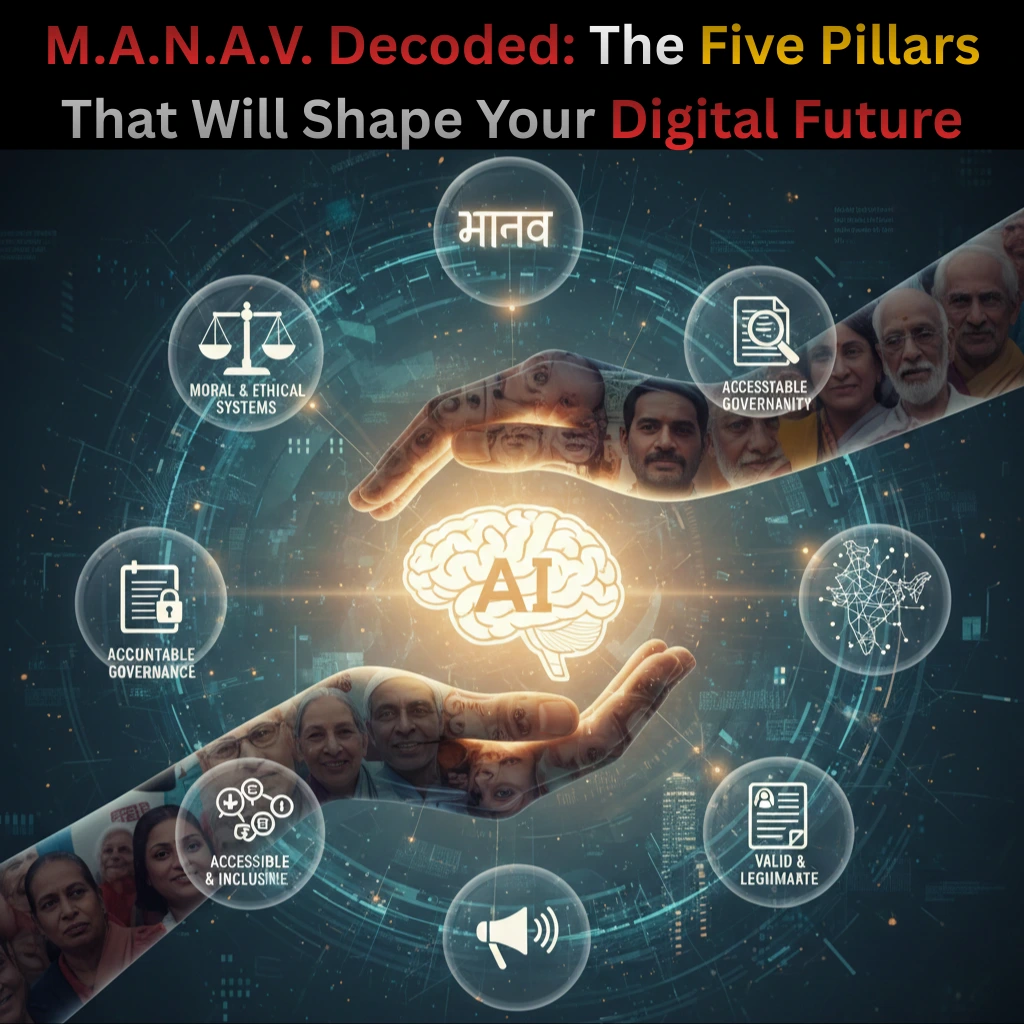
The term ‘Manav’ the Sanskrit word for ‘Human’ is a deliberate choice. It signals a departure from the “move fast and break things” culture of Silicon Valley. According to the official report on how PM Modi outlines India’s ‘MANAV’ vision for inclusive, sovereign AI, the framework rests on five non-negotiable pillars:
- Moral and Ethical Systems: Can an algorithm be “fair”? Modi insists that AI must be rooted in ethical guardrails to prevent bias and discrimination.
- Accountable Governance: When an AI makes a mistake, who signs the check? This pillar demands transparency and clear lines of responsibility.
- National Sovereignty: In a world of data colonialism, India wants to ensure that Indian data stays within Indian borders to empower Indian citizens.
- Accessible and Inclusive: Technology shouldn’t be a luxury for the elite. This vision prioritizes making AI tools available in local languages and for rural populations.
- Valid and Legitimate: This focuses on the “truth” factor-ensuring AI outputs are factually accurate and legally sound.
Why ‘Sovereign AI’ is the New Global Currency
For decades, the Global South has relied on tech stacks built in the West. But is it safe to outsource the “brain” of your country?
By emphasizing National Sovereignty, the M.A.N.A.V. vision suggests that India is ready to build its own Sovereign AI stack. This isn’t about isolationism; it’s about strategic independence. By developing indigenous Large Language Models (LLMs) that understand the nuances of 22 official languages and thousands of dialects, India is ensuring that its digital future isn’t lost in translation.
Think about it: would you rather have a medical AI trained on data from a different continent, or one that understands the specific genetic and environmental realities of your own community?
Can India Lead the ‘Third Way’ of AI Regulation?
The world currently sees two dominant AI models: the “unregulated market” approach of the US and the “strict control” approach of China. India is proposing a Third Way.
This middle path seeks to foster innovation without sacrificing safety. It’s a delicate balancing act. How do you encourage a startup to build the next big thing while also demanding Accountable Governance? The answer lies in the government’s shift from being a regulator to a “facilitator.” With initiatives like the IndiaAI Mission and a $1.2 billion investment in supercomputing and startups, the vision is backed by real capital, not just rhetoric.
The Road Ahead: Turning Vision into Reality
Of course, a vision is only as good as its execution. To make AI truly Accessible and Inclusive, India faces massive hurdles:
- Closing the Digital Divide: Millions still lack high-speed internet.
- The Talent Gap: While India has the world’s largest pool of developers, specialized AI researchers are still in short supply.
- Data Privacy: Balancing “Sovereignty” with user privacy will require the strict implementation of the DPDP Act.
Final Thoughts: A Human-First Future
The M.A.N.A.V. vision is a bold statement that technology must serve humanity, not the other way around. By focusing on Moral and Ethical systems, India is reminding the global community that at the end of every data point is a real person.
Will India become the global laboratory for “Ethical AI”? Only time will tell. But one thing is certain: the conversation has shifted. We are no longer just talking about how fast AI is-we are finally talking about how responsible it needs to be.
FAQs
Find answers to common questions below.
What exactly does M.A.N.A.V. stand for in India's AI strategy?
It stands for a five-pillar framework: Moral and ethical systems, Accountable governance, National sovereignty, Accessible and inclusive, and Valid and legitimate. It aims to put "human-centric" values at the core of coding.
Why is 'National Sovereignty' a big deal for Indian AI?
It’s about "Data Colonization." India wants to ensure that the data generated by 1.4 billion citizens is stored and processed locally to build indigenous AI models (Sovereign AI) rather than relying solely on foreign tech giants.
How will the MANAV vision impact the common man?
The focus on "Accessibility and Inclusivity" means AI tools will be developed in local Indian languages, making high-tech healthcare, farming advice, and education available to rural populations, not just urban techies.
Is India competing with the US or China in the AI race?
Instead of a race to the bottom, India is proposing a "Third Way"-a middle ground that balances the innovation-heavy approach of the US with the regulated approach of the EU, focusing heavily on ethics and public good.