
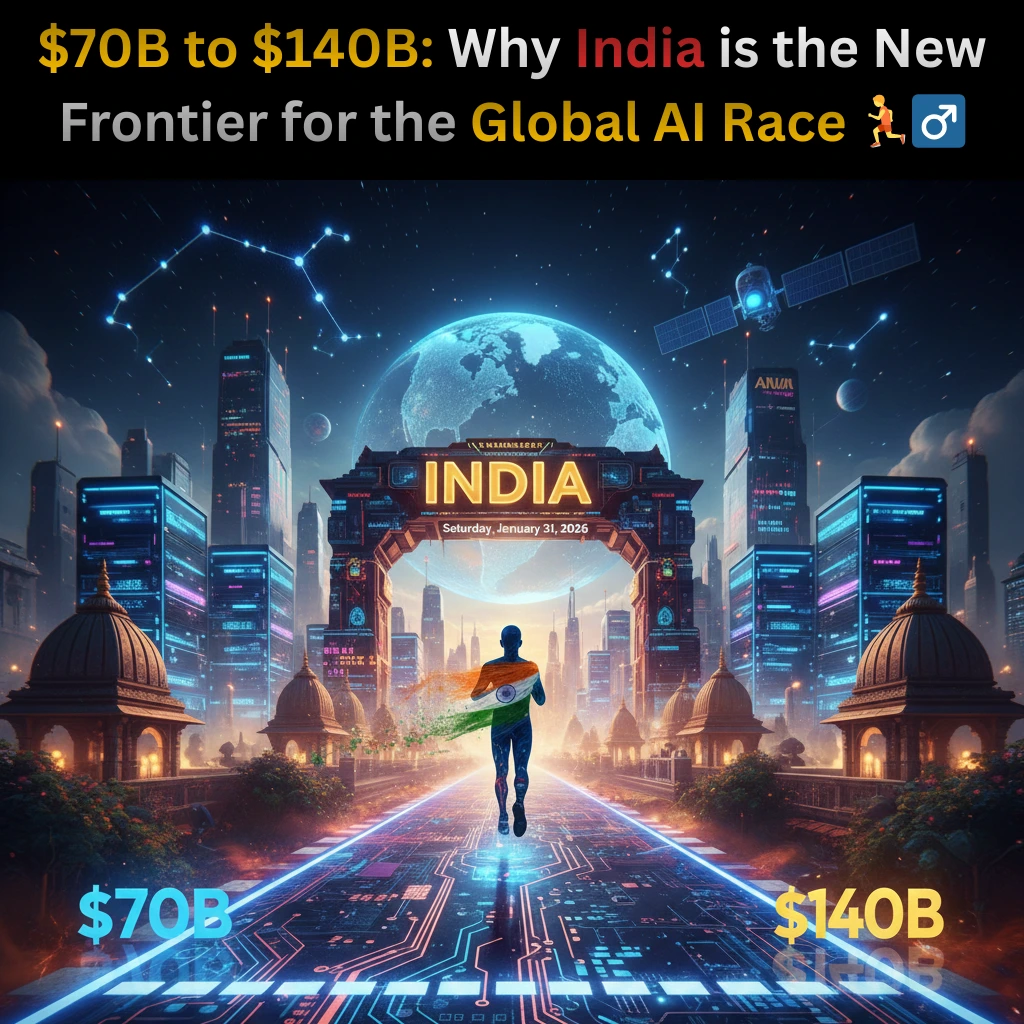
Have you ever wondered what happens when one of the world’s largest digital economies decides to stop just using AI and starts owning it?
We aren’t talking about a few startups building chatbots. We are talking about a massive, nation-scale transformation. Recently, IT Minister Ashwini Vaishnaw dropped a bombshell: India’s current AI infrastructure investments stand at a staggering $70 billion. But here’s the kicker-that number is expected to double following the upcoming IndiaAI Impact Summit next month.
If you’ve been following the global tech race, you know this isn’t just about money. It’s about sovereignty, data, and the next decade of economic dominance.
The Road to $140 Billion: What’s Fueling the Surge?
Why is the Indian government suddenly ready to double down? The answer lies in the transition from Phase 1 to Phase 2 of the IndiaAI Mission. While the first phase was about setting the foundation, the second phase is where the “real magic” happens.
Minister Vaishnaw highlighted that the upcoming summit will be a turning point. We are looking at a massive influx of private and public capital aimed at:
- GPU Clusters: Building the raw computing power needed to train massive models locally.
- Edge Computing: Bringing AI capabilities to devices without relying on distant cloud servers.
- Talent Pipelines: Training millions of developers to move beyond coding and into AI architecture.
But can a nation really “buy” its way into AI leadership? Not without a unique strategy. Unlike the Silicon Valley model, which is driven purely by corporate profit, India is carving out a path for Sovereign AI.
Why “Sovereign AI” is the Secret Sauce
What exactly is Sovereign AI? Think of it as a digital “home-court advantage.” Instead of relying on proprietary models from Big Tech firms in the US or China, India is building its own.
Why does this matter?
- Linguistic Diversity: A model built in San Francisco might struggle with the nuances of Bhojpuri, Tamil, or Bengali. India’s sovereign models will be “language-first.”
- Data Privacy: By keeping data processing within national borders, the government ensures that the “oil” of the 21st century stays home.
- Affordability: Sovereign models can be offered as a public good, allowing small businesses to integrate AI without paying exorbitant licensing fees.
Is it ambitious? Absolutely. Is it necessary? In a world where AI defines geopolitical influence, the answer is a resounding yes.
The IndiaAI Impact Summit: More Than Just a Meeting
Next month’s IndiaAI Impact Summit isn’t just another tech conference with stale coffee and PowerPoint slides. It’s being framed as the “catalyst” for the next $70 billion.
Industry insiders expect major announcements regarding Public-Private Partnerships (PPPs). The government isn’t just spending taxpayer money; it’s creating a de-risked environment where global tech giants feel confident moving their AI factories to Indian soil. We are talking about incentives for chip design, specialized AI data centers, and ethical AI governance frameworks that could set a global standard.
Scannable Highlights: The IndiaAI Mission at a Glance
- Current Investment: $70 Billion (and growing
- TheGoal: To double infrastructure capacity by 2025-26.
- Core Focus: Sovereign AI models and indigenous compute power.
- Key Event: IndiaAI Impact Summit (Scheduled for next month).
- The Vision:Making AI “work for every Indian,” not just the tech elite.
Final Thoughts: A New Digital Dawn?
We’ve seen India dominate the IT services sector for decades. But the shift from “service provider” to “product creator” has always been the missing piece of the puzzle. With a $140 billion roadmap and a focus on sovereign technology, is India finally ready to lead the AI revolution rather than just follow it?
The upcoming summit will likely provide the answers. One thing is certain: the global AI landscape is about to get a lot more interesting.
FAQs
Find answers to common questions below.
Is India really spending $70 billion on just AI?
Yes, but it's more than just a "spend"—it’s an infrastructure play. This includes massive investments in data centers, GPU clusters, and semiconductor ecosystems required to power AI at a national scale.
What makes a "Sovereign AI" model different from ChatGPT?
While ChatGPT is a general-purpose tool, a sovereign model is built on local datasets, respecting national privacy laws and linguistic nuances. It’s AI built by a country, for its specific socio-economic needs.
Will this investment affect the average Indian citizen?
In the long run, yes. The second phase of the IndiaAI Mission aims to democratize tech, potentially lowering costs for AI-driven healthcare, agriculture, and education tools for non-English speakers.
Why is the IndiaAI Impact Summit such a big deal?
It’s the "matchmaker" event. This is where the government aligns with global tech giants and private investors to secure the next $70 billion in capital, moving India from the planning phase to execution.