Have you ever wondered why, despite all the hype, most enterprises still struggle to move their AI projects from “cool experiment” to “daily workhorse”? It usually comes down to a silent killer: the efficiency gap. Our current hardware is screaming under the weight of massive datasets, and the energy bills are screaming even louder.
Well, the landscape just shifted. In a move that feels like a masterclass in industrial synergy, IBM and Arm have announced a strategic collaboration to develop dual-architecture hardware. This isn’t just another corporate handshake; it’s a blueprint for the next decade of mission-critical computing.
But what does this mean for the CTOs, the developers, and the businesses trying to survive the AI gold rush? Let’s dive into the “why” behind this powerhouse pairing.
Breaking the Bottleneck: What is Dual-Architecture Hardware?
For years, the industry has lived in a bit of a divided house. You had the raw, brute-force power of traditional enterprise systems and the lean, ultra-efficient agility of Arm’s architecture (the tech that likely powers the phone in your pocket).
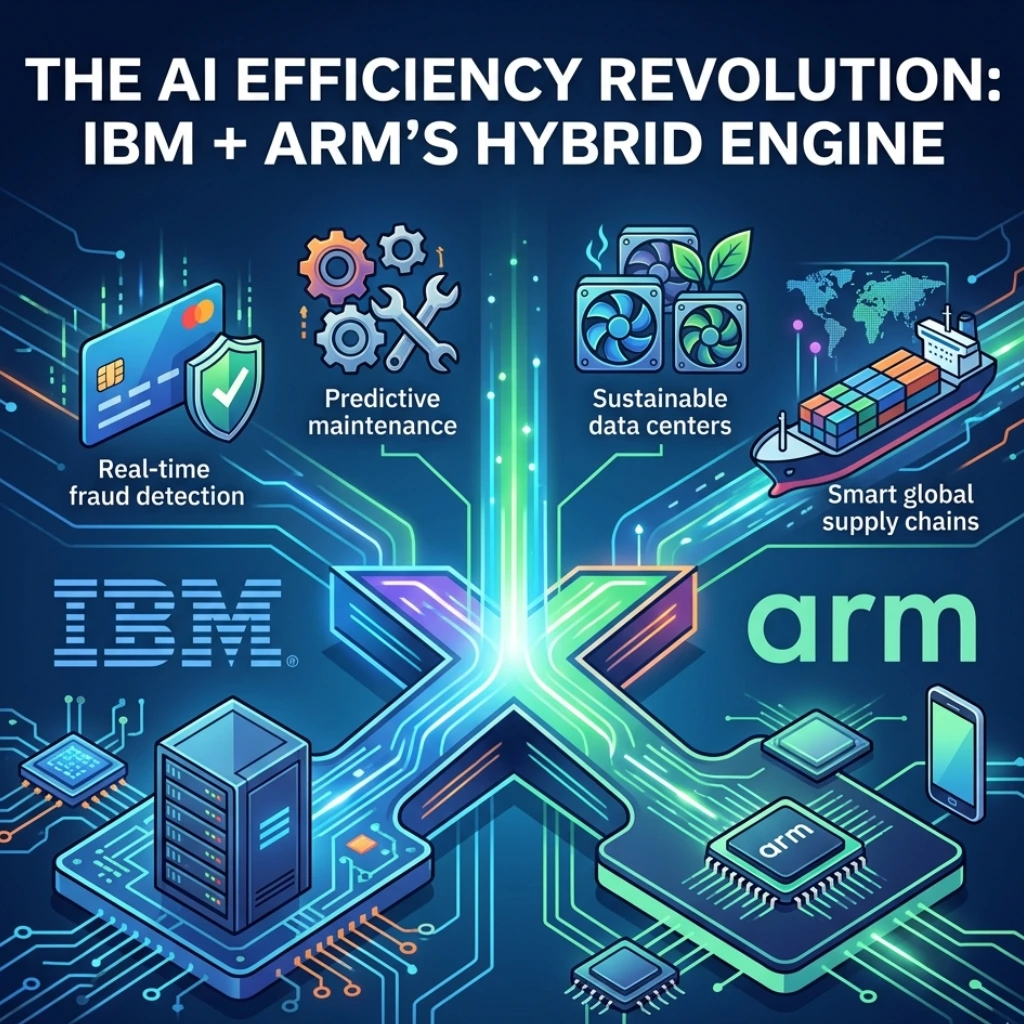
By joining forces, IBM announces strategic collaboration with Arm to shape the future of enterprise computing, the two giants are effectively building a “hybrid engine” for data.
Why does this matter?
- Workload Optimization: Not every AI task needs a sledgehammer. Some need a scalpel. This deal allows systems to switch between architectures based on the specific demand of the task.
- Reduced Latency: By processing data-intensive workloads on hardware specifically tuned for those tasks, the “lag” between data input and AI insight shrinks to almost zero.
- Scale without the Burn: It allows enterprises to scale their AI operations without needing to build a dedicated power plant next door.
Moving Beyond “AI Experimentation”
We’ve all seen the flashy AI demos, but how many of them actually work at scale in a high-stakes environment like banking or healthcare? Not many. The primary goal of this IBM-Arm alliance is to move AI from the “sandbox phase” into “mission-critical reality.”
When we talk about mission-critical, we’re talking about systems that cannot fail-think real-time fraud detection during peak shopping hours or predictive maintenance for global supply chains. These tasks require higher efficiency and unwavering reliability. By leveraging Arm’s energy-efficient designs alongside IBM’s legendary enterprise security and hybrid cloud expertise, they are creating a playground where AI can finally grow up.
The Sustainability Factor: Can AI Be Green?
Let’s be honest: AI has an energy problem. The massive compute power required to train and run Large Language Models (LLMs) is putting a strain on global ESG goals. Is it possible to be a tech leader and a responsible global citizen at the same time?
This collaboration suggests the answer is “yes.” Arm’s architecture is famous for its performance-per-watt ratio. When you integrate that into IBM’s enterprise ecosystem, you get a system that does more while consuming less. This isn’t just a win for the IT department; it’s a win for the Chief Sustainability Officer.
Key benefits of this “Green AI” approach include:
- Lower Total Cost of Ownership (TCO) for data centers.
- Reduced carbon footprints for massive AI training clusters.
- Better thermal management, leading to longer hardware lifespans.
Final Thoughts: A New Standard for Enterprise Tech
Is this the moment the “AI bubble” turns into an “AI foundation”? It certainly looks like it. By combining IBM’s deep-rooted enterprise trust with Arm’s ubiquitous, efficient architecture, the duo is solving the most boring-but most important-problem in tech: infrastructure.
We are moving away from a world of “one size fits all” hardware. The future belongs to specialized, dual-architecture systems that know when to be powerful and when to be precise.
The question is no longer if your business will run on AI, but whether your hardware is efficient enough to keep the lights on when it does. With IBM and Arm at the helm, the path forward looks a lot clearer-and a lot faster.a
FAQs
Find answers to common questions below.
What exactly is "dual-architecture" hardware in this context?
It refers to a system that integrates both IBM’s traditional high-performance enterprise processing and Arm’s energy-efficient architecture, allowing the hardware to switch "gears" based on the intensity of the AI task.
Why did IBM choose Arm for this specific partnership?
Arm’s architecture offers an industry-leading performance-per-watt ratio. By integrating this into IBM’s ecosystem, they can tackle the massive energy demands of AI while maintaining the security and scale IBM is known for.
Will this collaboration affect the average consumer?
While this is an "enterprise-first" deal, the trickle-down effect is massive. Better efficiency in banking, healthcare, and logistics means faster services, more secure transactions, and more sustainable corporate practices globally.
Does this mean IBM is moving away from its own chip designs?
Not at all. This is a strategic synergy. It’s about creating a hybrid environment where different architectures work together to solve the "efficiency gap" that single-architecture systems currently face.