Have you ever wondered why, despite all our talk about “smart factories,” most industrial machines are still effectively deaf, blind, and disconnected? For years, the bottleneck hasn’t been the data itself-it’s been the speed at which we can process it. Sending massive amounts of video and sensor data to a distant cloud server creates a lag that simply doesn’t work when a robotic arm needs to make a split-second decision.
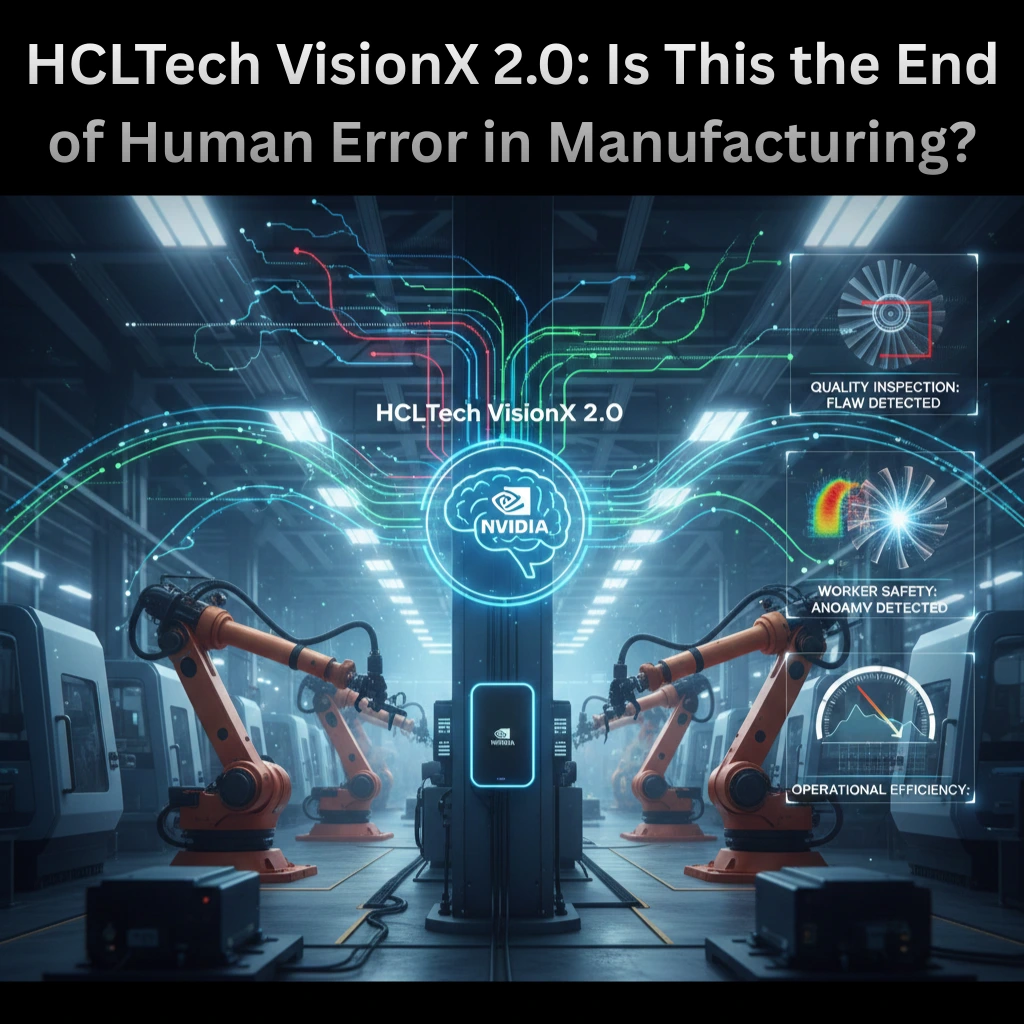
Enter HCLTech VisionX 2.0. Recently, HCLTech unveiled VisionX 2.0, a next-generation multi-modal AI edge platform that aims to bring “Physical AI” out of the research lab and straight onto the factory floor.
But what does this actually mean for the future of manufacturing?
Bridging the Gap Between the Digital and Physical Worlds
VisionX 2.0 isn’t just a software update. It’s a sophisticated platform built for multi-modal data. Think of it as a system that sees, hears, and feels—all at once. By merging these “senses,” it creates a complete view of industrial operations that no human could match alone.
Why is this shift to “Physical AI” so significant? In the past, AI lived in digital bubbles-analyzing spreadsheets or generating text. VisionX 2.0 brings AI into the physical realm. We’re talking about machines that can detect a microscopic crack in a turbine blade or predict a motor failure based on a slight change in its hum, all in real-time.
The Powerhouse Under the Hood: The NVIDIA Connection
The secret sauce behind this leap in performance is HCLTech’s deep integration with NVIDIA’s physical AI computing stack. By leveraging NVIDIA’s high-performance GPUs and AI software libraries, VisionX 2.0 processes data directly at the “edge”-right where the action is happening.
- Zero Latency: Decisions are made in milliseconds, which is critical for safety-critical applications.
- Reduced Bandwidth: You no longer need to stream gigabytes of raw video to the cloud; only the actionable insights are transmitted.
- Scalability: The platform is built to handle everything from a single assembly line to a global network of manufacturing plants.
By using NVIDIA’s stack, HCLTech is essentially giving industrial machines the equivalent of a high-performance brain, capable of running complex computer vision algorithms and predictive maintenance models simultaneously.
Why “Multi-Modal” is the New Standard
Is a camera enough to monitor a high-stakes production line? Probably not. Visuals can be obscured by steam, dust, or poor lighting. This is where the multi-modal aspect of VisionX 2.0 shines.
By combining visual intelligence with other data streams, the platform eliminates “blind spots.” If a robotic welder starts behaving erratically, the system doesn’t just look at the video feed; it analyzes the electrical draw and the heat signature. This sensor fusion approach ensures a level of accuracy that minimizes false alarms and prevents costly downtime.
Key benefits include:
- Enhanced Quality Inspection: Catching defects that are invisible to the naked eye.
- Worker Safety: Identifying hazardous movements or equipment malfunctions before accidents occur.
- Operational Efficiency: Optimizing energy consumption and reducing waste through precise machine control.
Final Thoughts: A New Era for Industry 4.0
We’ve spent the last decade collecting data; VisionX 2.0 suggests that the next decade will be about finally acting on it. HCLTech isn’t just selling a platform; they are providing the infrastructure for a world where machines are autonomous, perceptive, and incredibly efficient.
As industries face increasing pressure to go green and stay lean, can they afford to stick with “blind” machinery? Probably not. With the launch of VisionX 2.0, the “smart factory” is finally moving from a buzzword to a tangible, physical reality. The edge has found its brain, and the industrial world will likely never look the same.
FAQs
Find answers to common questions below.
Is VisionX 2.0 just a software update for existing cameras?
Not exactly. While it works with visual data, it’s a "multi-modal" platform. This means it integrates feeds from microphones, vibration sensors, and heat maps alongside cameras to give a 360-degree "nervous system" to a factory, rather than just a set of eyes.
Why did HCLTech partner with NVIDIA specifically for this?
To run "Physical AI" (AI that interacts with the real world), you need massive computing power with zero lag. NVIDIA’s physical AI computing stack provides the specialized GPUs and libraries required to process complex sensor data instantly at the edge, without needing to ping a distant cloud server.
Can VisionX 2.0 actually predict a machine failure before it happens?
Yes. By using predictive maintenance models, the platform looks for "micro-anomalies"-like a specific acoustic frequency or a tiny spike in power consumption-that humans can't detect, allowing repairs to happen before a total breakdown occurs.
Does this platform replace human supervisors?
Think of it more as a superpower for supervisors. It filters out the "noise" of thousands of data points and only alerts humans to critical issues, allowing them to focus on high-level decision-making rather than staring at monitor screens all day.