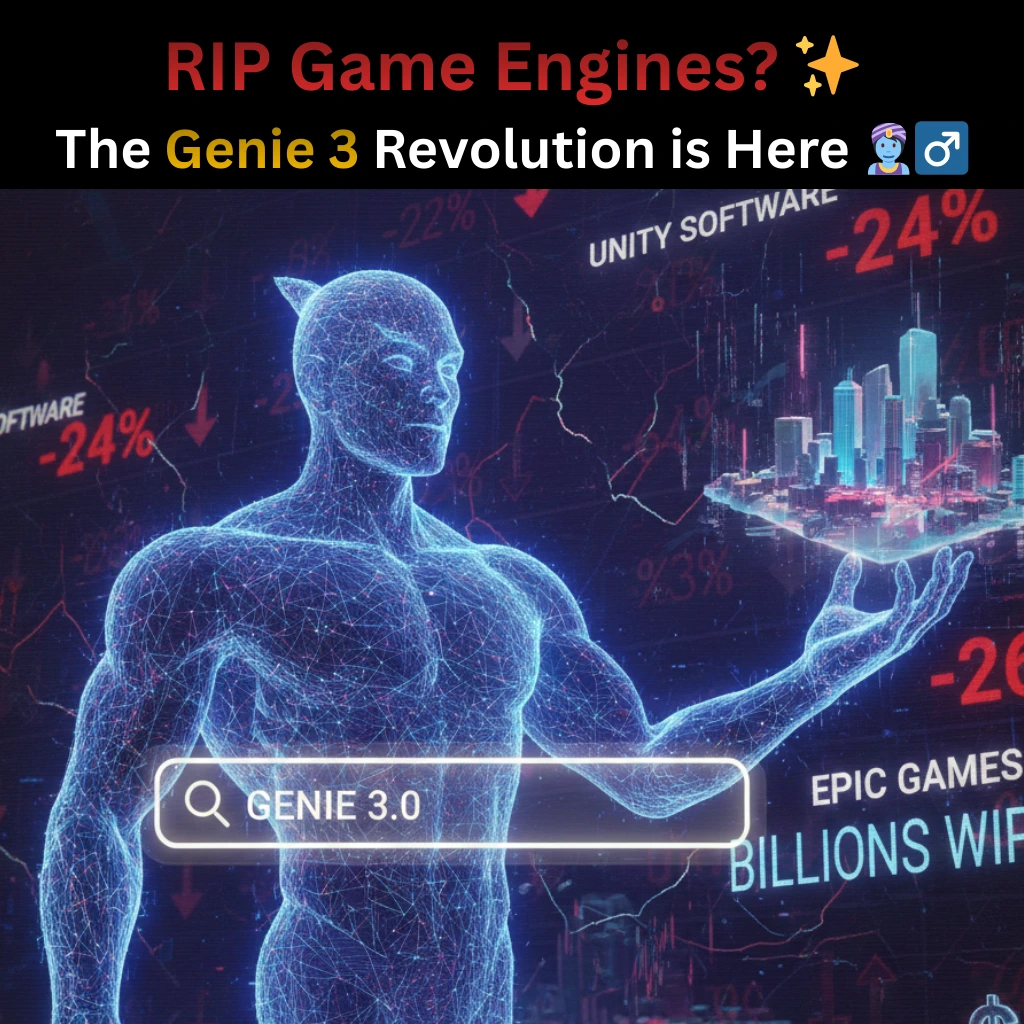
The gaming world just had its “Black Monday” moment, but the culprit wasn’t a financial crisis-it was a prompt box.
When Google DeepMind pulled the curtain back on Genie 3, the latest evolution of its generative AI, the shockwaves didn’t just stay on social media. They hit Wall Street. Within hours of the announcement, Unity Software shares plummeted by 24%, while other industry titans saw billions in market cap evaporate.
But why is a research project causing seasoned investors to hit the panic button? Is this the end of game development as we know it, or just a massive overreaction to a shiny new toy?
The “Genie” is Out of the Bottle: What Just Happened?
For years, we’ve seen AI generate text and static images. Then came video. But Genie 3 is a different beast entirely. It’s an “interactive world model” that can take a simple text prompt or a single image and turn it into a playable 3D environment.
Imagine typing “A cyberpunk city in the rain with gravity-defying physics” and, seconds later, actually jumping into that world and controlling a character. No coding, no 3D modeling, no complex rendering pipelines.
Key features that sent the market into a tailspin include:
- Zero-Shot Learning: The ability to create mechanics (like jumping or colliding with objects) without being explicitly programmed.
- Infinite Scalability: The potential to generate endless levels on the fly.
- Accessibility: Lowering the barrier to entry so far that “developer” might soon mean anyone with an imagination.
Why Unity and Unreal Are Feeling the Heat
The 24% drop in Unity (U) stock tells a specific story. Unity, along with Epic Games’ Unreal Engine, provides the “bricks and mortar” for the gaming industry. Thousands of developers pay for these engines to build their worlds.
If Google’s Genie allows creators to bypass traditional engines entirely, what happens to those business models? Investors are asking a chilling question: Do you still need a game engine if the AI is the engine?
This fear of disruptive automation is what triggered the sell-off. If a small indie team or even a single teenager can produce a high-fidelity interactive experience using Genie, the multi-million dollar moat that big studios and engine providers have built starts to look a lot more like a puddle.
The Human Element: Will Devs Be Replaced or Empowered?
Whenever a tool like this drops, the conversation inevitably turns to job security. Will level designers and environmental artists become obsolete?
If we look at history, the answer is usually more nuanced. When Photoshop arrived, it didn’t kill photography; it changed what a photographer could do. However, the speed of AI integration is unprecedented.
How the industry might pivot:
- Rapid Prototyping: Studios could use Genie 3 to “sketch” game ideas in 3D in minutes rather than months.
- AI-Assisted Assets: Instead of replacing engines, AI might become a plugin within Unity or Unreal to automate the “grunt work” of building backgrounds.
- Niche Value: Human-led storytelling and hand-crafted mechanics might become “premium” features, marketed much like “organic” food or “hand-stitched” leather.
Final Thoughts: A New Era of Play
Is the market crash justified? Perhaps in the short term, as the industry recalibrates to a world where generative interactivity is a reality. But let’s be honest: we are witnessing the birth of a new medium.
Google’s Project Genie isn’t just a tool; it’s a shift in how we define “play.” We are moving from a world where we consume what developers build, to a world where we dream the game into existence as we play it.
The real question isn’t whether AI will replace game engines, but rather: When the barrier to creation is gone, what kind of stories will we finally be able to tell? For now, the “Play” button is in Google’s hands, and the rest of the industry is scrambling to keep up.
FAQs
Find answers to common questions below.
Can Google Project Genie 3 actually replace game developers?
While it automates world-building and basic mechanics, it currently lacks the nuanced storytelling, complex character arcs, and "soul" that human designers bring to AAA titles—for now.
Why did Unity stock drop specifically because of this AI?
Unity’s value is tied to being the essential toolkit for developers. Investors fear that if Google Project Genie 3 allows users to bypass engines entirely, Unity’s subscription-based moat will evaporate.
Is Genie 3 available to the public yet?
Currently, Genie remains in a research and controlled rollout phase. Google is gathering data on safety and "hallucinations" before a full-scale commercial launch.
Does this mean video games will become free to make?
It significantly lowers the "cost per asset," but high-end game production will likely still require human oversight, marketing, and refined logic that AI can't yet master solo.