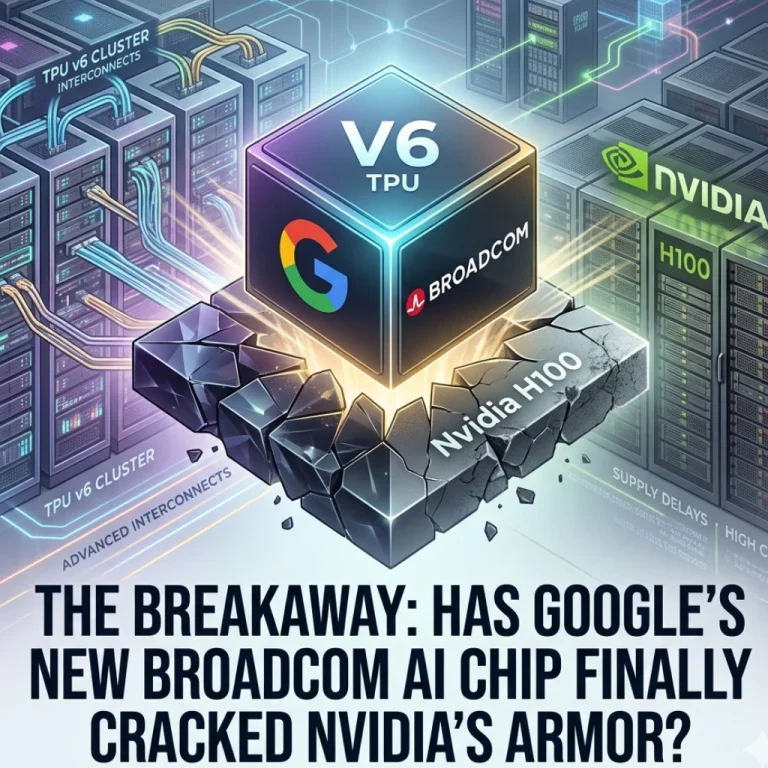
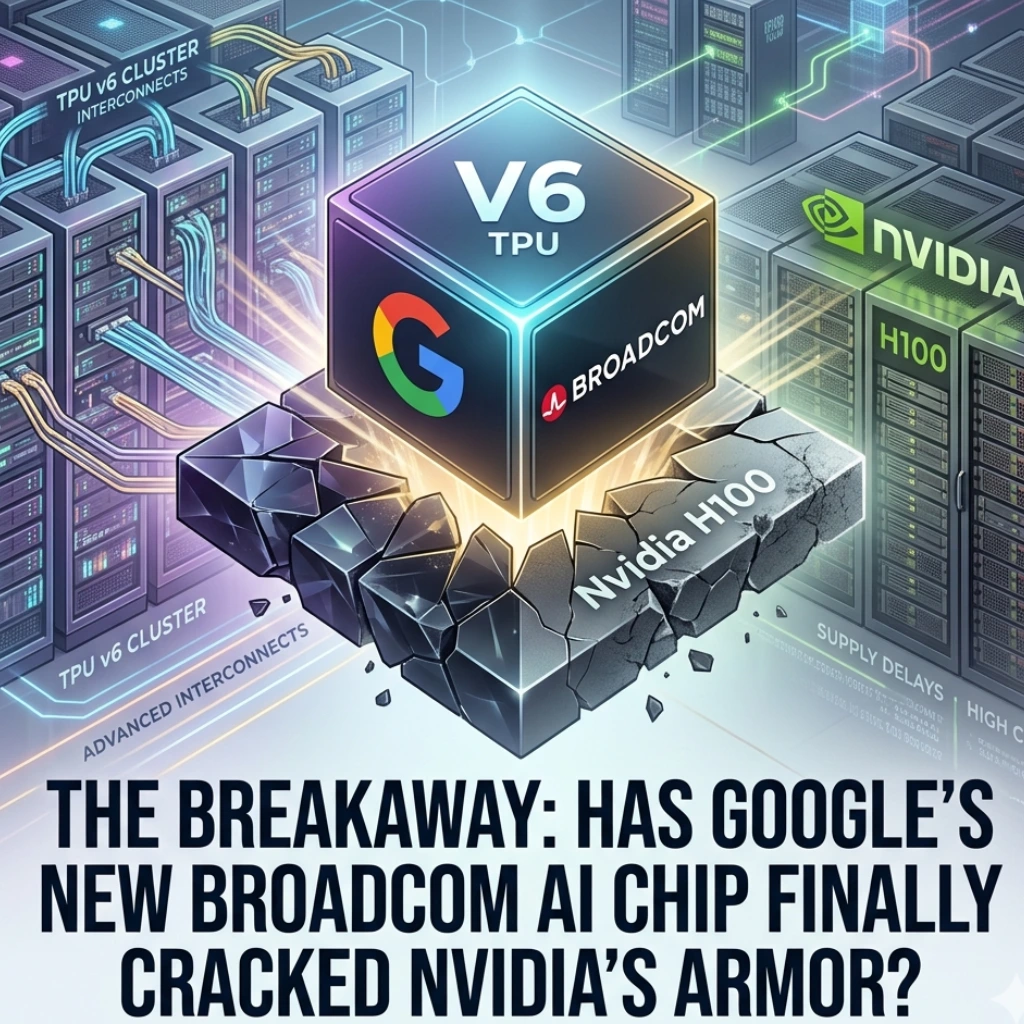
Is the era of Nvidia’s absolute dominance finally seeing a crack in the armor? For the last two years, the tech world has been obsessed with one thing: H100 GPUs. If you had the chips, you had the power. But as lead times stretch and costs skyrocket, the world’s biggest players are tired of waiting in line.
In a move that signals a massive shift in the AI hardware landscape, Google has solidified a long-term partnership with Broadcom to design and develop its next generation of custom AI chips, known as Tensor Processing Units (TPUs).
But why does this matter to anyone outside of a server room? It matters because the “Silicon Wars” are entering a new chapter-one where customization beats off-the-shelf power.
The Custom Silicon Revolution: Why Broadcom?
Google isn’t new to the chip game. They’ve been working on TPUs for years, but this latest Broadcom-Google deal marks a significant escalation. Broadcom acts as the “architectural bridge,” helping Google turn complex AI requirements into physical reality.
Broadcom’s role is pivotal because they provide:
- Advanced Interconnects: AI isn’t just about one chip; it’s about thousands of them talking to each other. Broadcom’s networking IP is the “glue” that holds Google’s massive AI data centers together.
- Cost Efficiency: By co-developing custom silicon, Google can strip away the features they don’t need (which Nvidia includes for general purposes) and focus purely on Large Language Model (LLM) efficiency.
- Supply Chain Stability: In a volatile market, having a dedicated partner like Broadcom ensures Google isn’t at the mercy of the “Nvidia tax” or global GPU shortages.
Can Custom TPUs Actually Topple Nvidia’s Dominance?
It’s the multi-billion dollar question: Can anything actually beat a GPU? For general-purpose tasks, Nvidia is still king. But for the specific, heavy-lifting math required for AI training and inference, custom-built TPUs are becoming terrifyingly efficient.
The industry is watching closely as Google moves toward the v6 TPU. These aren’t just incremental upgrades; they are bespoke engines designed specifically to run Gemini and other massive AI frameworks. By tailoring the hardware to the software, Google achieves a “performance-per-watt” ratio that a general-purpose GPU simply can’t match.
Are we looking at a future where the biggest AI breakthroughs happen on proprietary silicon rather than open-market chips? All signs point to yes.
The “Anti-Nvidia” Alliance: A Growing Trend
Google isn’t alone in this pursuit. We are seeing a broader industry trend where “Big Tech” is becoming “Big Chip.”
- Amazon has Trainium and Inferentia.
- Microsoft recently unveiled the Maia 100.
- Meta is aggressively pursuing its MTIA (Meta Training and Inference Accelerator).
The message is clear: Dependence is a risk. By partnering with Broadcom, Google is effectively de-risking its future. They are ensuring that if Nvidia’s prices double or their supply chains freeze, Google’s AI roadmap remains untouched. It’s a strategic pivot from being a customer to being a creator.
What This Means for the AI Economy
This deal is a massive win for Broadcom, which is quickly becoming the “backstage VIP” of the AI boom. Analysts suggest that Broadcom’s AI revenue could see a massive surge as more companies look to replicate Google’s success with custom ASIC (Application-Specific Integrated Circuit) designs.
For the rest of us, this competition is great news. When tech giants stop fighting over the same pile of Nvidia chips and start building their own, innovation accelerates and costs eventually drop.
Final Thoughts: The End of the “One-Size-Fits-All” Era
So, is Nvidia in trouble? Not exactly. They are still the gold standard for researchers and startups globally. However, for the titans like Google, the goal is no longer just to “have AI”-it’s to own the entire stack, from the code down to the transistor.
The Broadcom and Google custom AI deal is a reminder that in the world of high-stakes technology, the best way to predict the future is to build the hardware it runs on.
Will custom silicon become the new status symbol in Silicon Valley? It certainly looks like it. As Google and Broadcom pave the way, the “Nvidia-or-bust” era might finally be coming to a close, replaced by a more diverse, efficient, and competitive AI landscape.
FAQs
Find answers to common questions below.
Why is Google building its own chips instead of just buying from Nvidia?
While Nvidia GPUs are powerful, they are expensive and power-hungry. By co-developing custom TPUs with Broadcom, Google can optimize hardware specifically for its AI models (like Gemini), reducing costs and increasing processing speed.
What role does Broadcom play in this partnership?
Broadcom provides the critical intellectual property (IP) and networking "glue" (interconnects) that allow thousands of chips to work together as a single supercomputer.
Does this deal mean Nvidia is losing its market share?
Not immediately. Nvidia still dominates the general market, but the "Big Tech" trend of moving toward custom ASICs (Application-Specific Integrated Circuits) creates a significant long-term challenge to Nvidia’s absolute control.
What are the benefits of TPUs over GPUs for AI?
TPUs (Tensor Processing Units) are specifically designed for the matrix math required by neural networks, often offering better "performance-per-watt" than general-purpose GPUs.