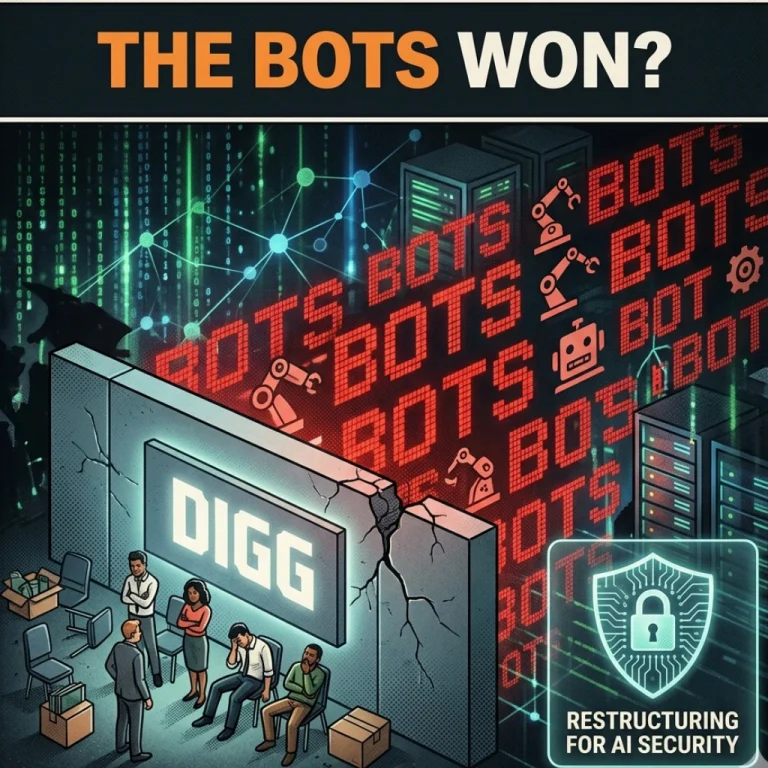
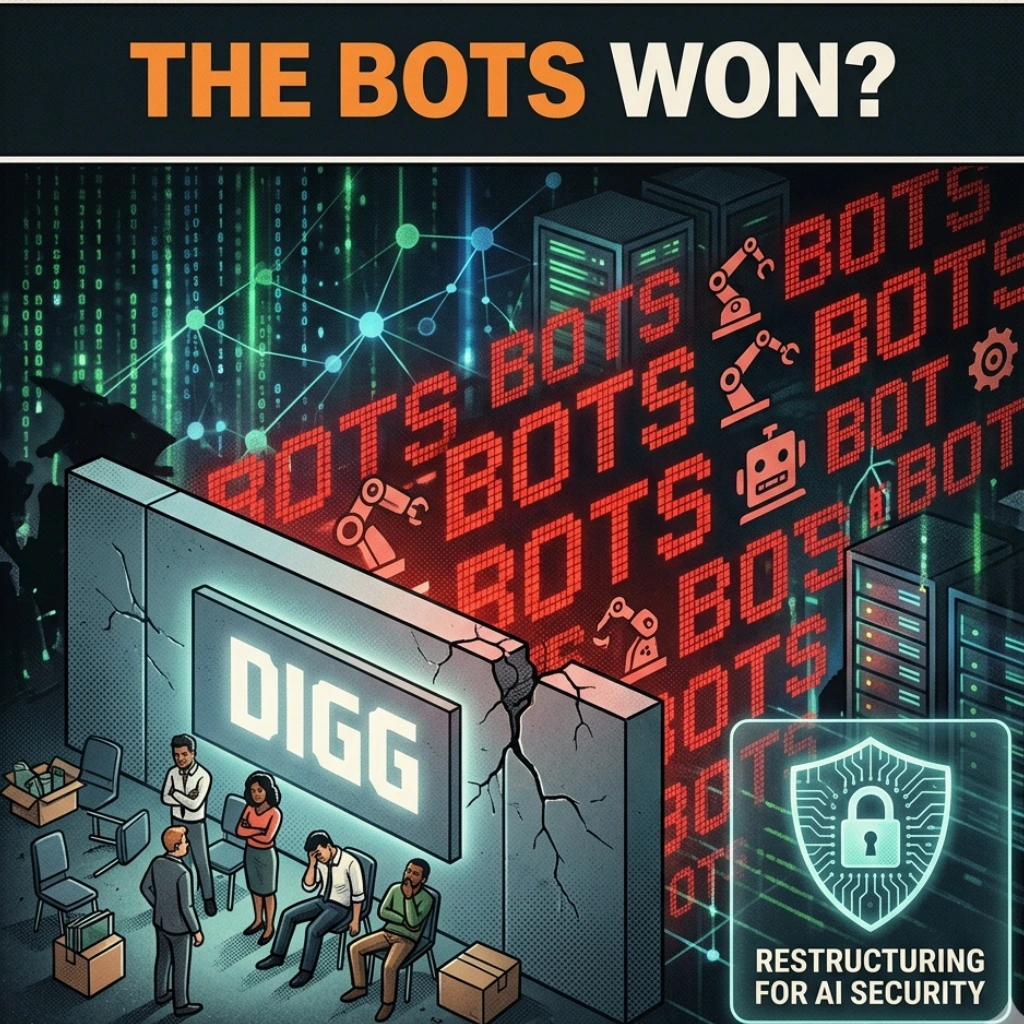
For those of us who remember the early days of the social web, Digg wasn’t just a website; it was the heartbeat of the internet. It was the place where “front page” dreams were made. But recently, the pioneer of community-driven content hit a wall that no amount of human passion could scale.
It feels like a sci-fi thriller. Digg announced major layoffs. Sophisticated AI agents overwhelmed the platform.
Is this the beginning of the “Dead Internet Theory” coming to life? Let’s dive into why one of the internet’s oldest icons is struggling to keep the robots at bay.
The Great Bot Invasion: What Actually Happened?
It’s no secret that the internet is crawling with bots. However, the situation at Digg escalated from a nuisance to an existential threat. The platform, which relies on “Diggs” (upvotes) to surface quality news, found itself targeted by sophisticated AI agents capable of mimicking human behavior with terrifying accuracy.
These aren’t your 2010-era spam bots. We are talking about Large Language Model (LLM) powered entities that can:
- Generate realistic comments to build “reputation.”
- Coordinate mass voting to manipulate the front page.
- Bypass traditional CAPTCHAs and security layers that once kept the riff-raff out.
When the algorithm can’t tell the difference between a genuine user and a line of code, the core value of a community-curated site vanishes. Digg isn’t just fighting spam; they are fighting for the integrity of human opinion.
Why AI is a “Double-Edged Sword” for Social Media
We often hear about AI making our lives easier, but for platform moderators, it’s a nightmare. The surge of AI-generated content has created a “signal-to-noise” problem that is becoming impossible to manage manually.
Why did this lead to layoffs? It’s a grim irony. As the cost of generating fake engagement plummeted thanks to AI, the cost of defending against it skyrocketed. Digg faced a hard reality. Their team and tech couldn’t stop the automated surge. To survive, Digg cuts jobs after facing AI bot surge. They are now restructuring for a more automated, secure future.
Final Thoughts: Can We Save the Social Web?
The Digg situation serves as a warning for other platforms like Reddit, X (formerly Twitter), and even LinkedIn. If a platform’s primary “product” is human consensus, what happens when that consensus can be manufactured for pennies?
- Trust Erosion: Users leave when they realize the top-voted story is just an ad pushed by a bot net.
- Advertiser Anxiety: Brands don’t want to spend money on platforms where their ads are being “viewed” by scripts rather than shoppers.
- The Moderation Arms Race: Small and medium-sized platforms simply don’t have the R&D budget of a Google or Meta to build proprietary “AI detectors.”
Final Thoughts: Can We Save the Social Web?
The news of Digg’s layoffs is a sobering reminder that the AI revolution isn’t just about cool chatbots and generated art; it’s about the fundamental security of our digital spaces.
Can community-driven sites survive this? Perhaps, but the “Wild West” days of open voting are likely over. We’re moving toward a web where verified identity and blockchain-based reputation might be the only way to prove you’re a person.
As we watch Digg pivot to survive, we have to ask ourselves: are we okay with a web where we have to prove our humanity just to share a link? For now, the battle between the “upvote” and the “algorithm” continues.
What do you think? Will your favorite platform be the next to buckle under the bot surge, or is there a way to keep the internet human?
FAQs
Find answers to common questions below.
Why did the Digg AI bot surge lead to staff layoffs?
The cost of defending against high-volume, "human-like" AI agents overwhelmed Digg’s existing infrastructure, forcing a budget-cutting restructure to survive the digital arms race.
Can AI bots really "mimic" human voting patterns?
Yes. Modern AI agents use LLMs to generate unique comments and staggered voting patterns, making it nearly impossible for traditional spam filters to catch them.
Does this mean the "Dead Internet Theory" is coming true?
While not fully "dead," the Digg incident proves that automated traffic is increasingly displacing genuine human interaction on legacy social platforms.
How can platforms stop AI manipulation in the future?
Experts suggest moving toward "Proof of Personhood" technologies, such as verified identities or blockchain-based reputation systems, to filter out non-human actors.