Have you ever felt that for all the “intelligence” of modern AI, we’re still doing most of the heavy lifting? We ask a question, get an answer, and then we have to execute the task. But what if the AI didn’t just tell you what to do, but actually went ahead and did it?
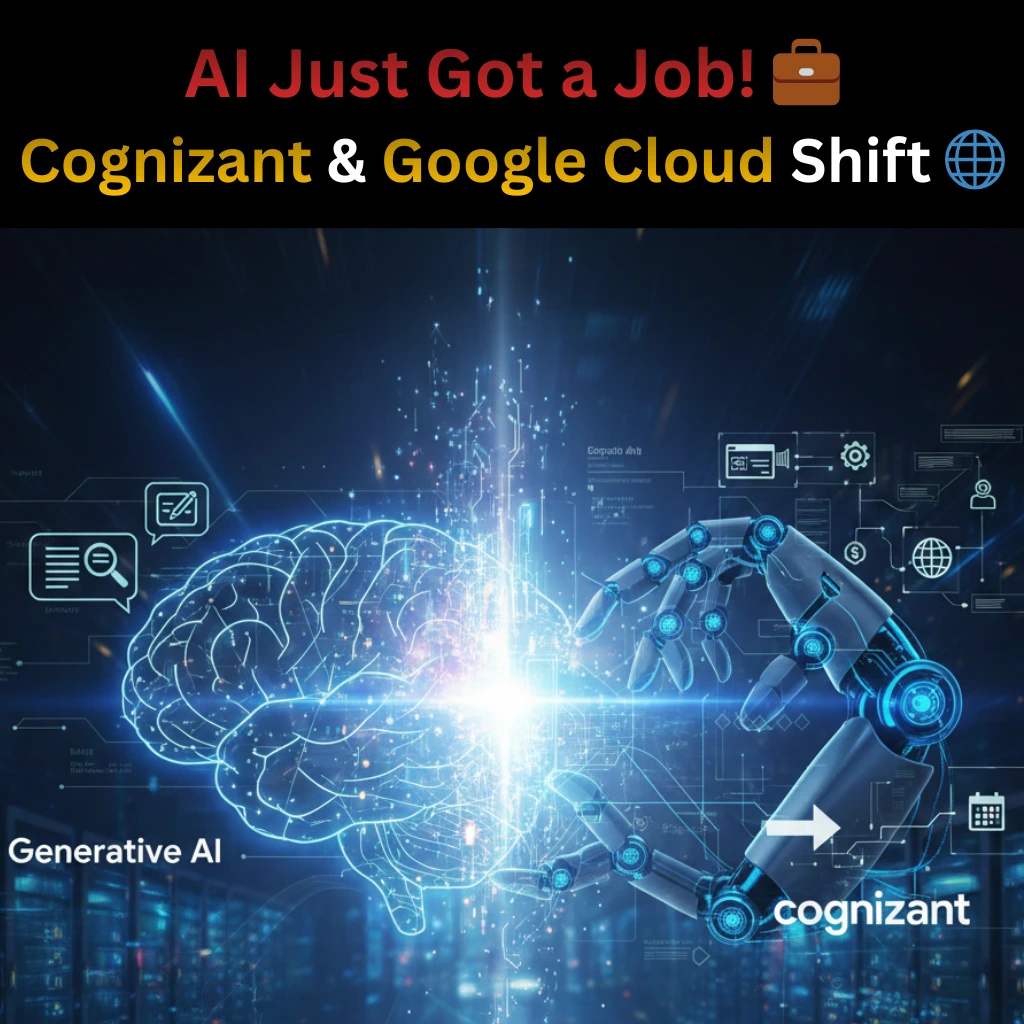
That shift from “Assistant” to “Agent” is exactly why the tech world is buzzing today. In a massive move to redefine enterprise productivity, Cognizant has expanded its strategic partnership with Google Cloud to operationalize Agentic AI at scale. This isn’t just another corporate handshake. It’s a fundamental pivot in how businesses will function in the coming years.
From Answering Questions to Executing Workflows
For the past two years, we’ve lived in the era of Generative AI-wonderful for drafting emails or summarizing long PDFs. But let’s be honest: GenAI can be a bit of a “talker” rather than a “doer.”
Agentic AI changes the script. These are autonomous systems capable of navigating multi-step business workflows. Imagine an AI that doesn’t just flag a supply chain delay but automatically contacts alternative vendors, updates the inventory logs, and notifies the logistics team.
According to the official announcement on Cognizant’s newsroom, this partnership is designed to move these capabilities out of the “cool demo” phase and directly into the heart of global enterprises.
Why the Google Cloud & Cognizant Duo Matters
Why does this specific pairing matter? Because Agentic AI requires three things that are incredibly hard to get right: massive compute power, sophisticated models, and deep industry expertise.
- Google Cloud provides the “brains” and “muscle” via its Vertex AI platform and Gemini models.
- Cognizant provides the “context.” They understand the messy, complex reality of how a healthcare provider or a global bank actually operates.
By combining Google’s tech stack with Cognizant’s specialized industry solutions, they are building autonomous agents tailored for specific sectors. We aren’t talking about generic bots; we’re talking about digital coworkers that understand the nuances of regulatory compliance in finance or clinical trial management in life sciences.
What Does This Look Like in the Real World?
You might be wondering: “Is this just more marketing jargon, or will it actually change my workday?” The impact is likely to be felt in three key areas:
- Software Engineering: Moving beyond code suggestions to autonomous “agents” that can manage entire software development lifecycles, significantly boosting delivery velocity.
- Customer Experience: Moving from chatbots that offer FAQ links to agents that can actually process a refund, rebook a flight, or troubleshoot a complex technical issue without human intervention.
- Operations: Systems that can monitor data patterns and independently trigger business processes-like adjusting marketing spend in real-time based on a sudden shift in consumer sentiment.
The “Human” Side of Autonomous Systems
The word “autonomous” often makes people nervous. Does it mean humans are out of the loop? Not exactly. The goal of this partnership is augmented productivity.
By offloading the repetitive, multi-step “grunt work” to Agentic AI, human employees are freed up to focus on strategy, creativity, and the complex decision-making that AI still can’t touch. It’s about removing the friction that makes modern work feel like a chore.
Final Thoughts: Are We Ready for the Agentic Shift?
The expansion of the Cognizant and Google Cloud partnership signals that the “honeymoon phase” of AI curiosity is over. We are now in the execution phase.
The question for business leaders is no longer “What can AI tell me?” but “What can AI do for me?” As these autonomous agents become more integrated into our digital infrastructure, the companies that thrive will be those that embrace AI not just as a library of information, but as a proactive workforce.
Are you ready to delegate your most complex workflows to an agent? The technology is here-now it’s just a matter of who scales it first.
FAQs
Find answers to common questions below.
What exactly is the difference between Generative AI and Agentic AI?
While Generative AI is great at creating content (text/images), Agentic AI is designed to act. It can plan, use tools, and complete multi-step business processes without needing a human to prompt every single sub-task.
Can Agentic AI really handle complex industries like healthcare or finance?
Yes. By combining Google Cloud’s Vertex AI with Cognizant’s deep industry knowledge, these "agents" are being built with specific regulatory and operational guardrails to handle specialized workflows.
Is this the end of human oversight in business operations?
Not at all. Think of it as "Human-in-the-loop" automation. Agentic AI handles the repetitive execution "grunt work," allowing humans to step into roles as strategic orchestrators and creative problem solvers.