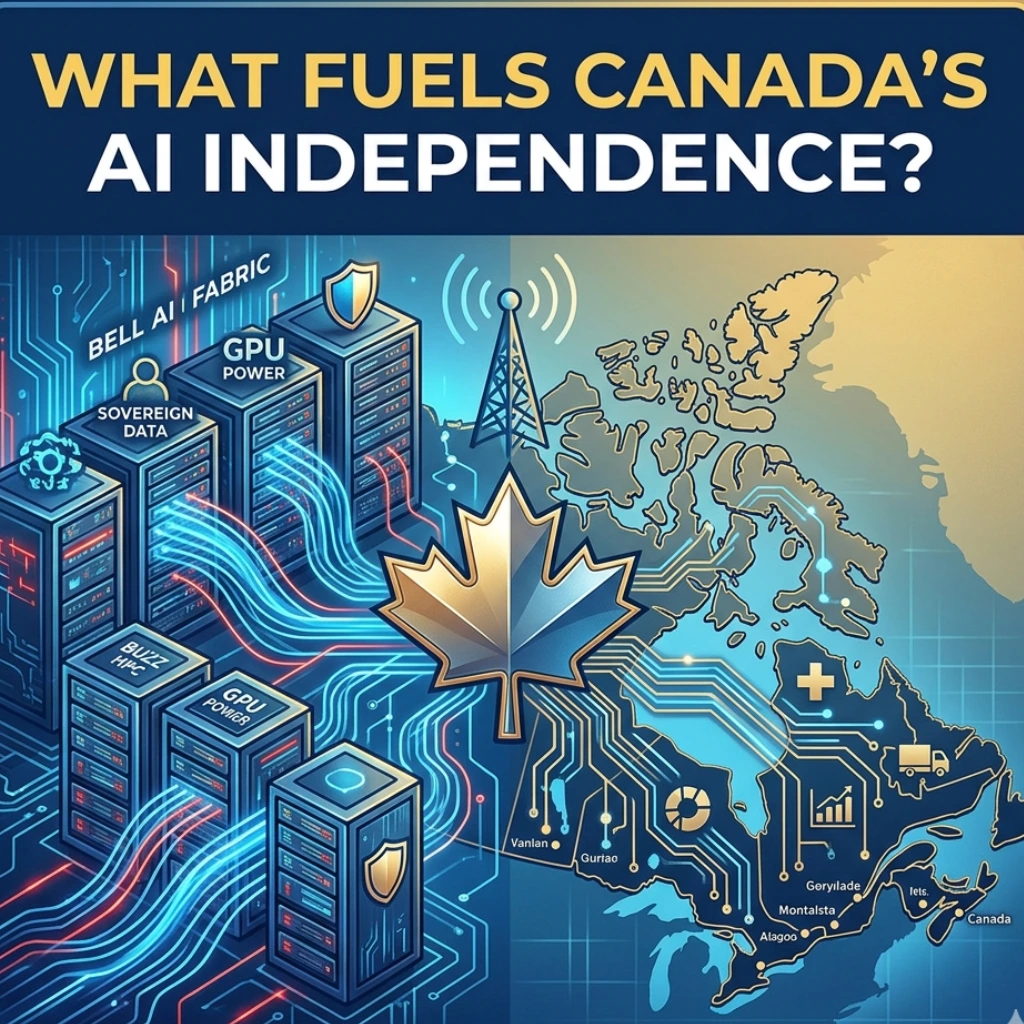
Have you ever wondered where the “brain power” for Canada’s future actually lives? As AI evolves from a flashy party trick into the backbone of our national economy, a critical question has emerged: Who owns the infrastructure, and where is our data going?
In a move that signals a massive shift toward data independence, Bell Canada announced a major expansion of its “Bell AI Fabric“, partnering with BUZZ High Performance Computing to supercharge its GPU capacity. This isn’t just another corporate press release; it’s a foundational play for Sovereign AI.
Why “Sovereign AI” is the New National Security
For a long time, Canadian businesses relied on massive data centers south of the border. But as industries like healthcare, finance, and defense integrate machine learning, “close enough” isn’t good enough anymore.
Sovereign AI is the idea that a nation’s AI capabilities should be built, managed, and housed on its own soil. By partnering with BUZZ HPC, Bell is effectively building a digital fortress. This expansion ensures that sensitive Canadian data stays under Canadian jurisdiction, protected by local laws and powered by world-class hardware.
But what does this mean for the average developer or enterprise leader? It means lower latency, tighter security, and a massive boost in raw horsepower.
The BUZZ Factor: Solving the GPU Scarcity Problem
If you’ve tried to scale an AI model lately, you know the struggle: GPUs are the new oil. There is a global scramble for high-performance chips, and many Canadian firms have found themselves at the back of the line.
The partnership with BUZZ High Performance Computing changes the math. Here’s how this collaboration is moving the needle:
- Massive GPU Density: BUZZ brings high-density liquid cooling and cutting-edge NVIDIA infrastructure to the table, allowing Bell to offer unprecedented compute power.
- Sustainability: AI is power-hungry. By utilizing BUZZ’s optimized HPC environments, Bell can scale capacity without an astronomical carbon footprint.
- Edge Integration: Because Bell owns the network, they can place this compute power closer to the “edge,” making real-time AI applications-like autonomous logistics or remote surgery-actually viable.
Breaking the Bottleneck for Canadian Startups
Why should Silicon Valley have all the fun? One of the most engaging aspects of this expansion is what it does for the local ecosystem. For years, Canadian AI startups have been forced to migrate to US-based cloud providers once they hit a certain scale.
By expanding the Bell AI Fabric, Bell is providing a “homegrown” alternative. We are looking at a future where a startup in Toronto or a research lab in Montreal can access the same level of GPU clusters as a tech giant, all while keeping their IP firmly within the country.
Is this the moment Canada stops “exporting” its best AI ideas and starts scaling them at home? All signs point to yes.
What’s Next for the Bell AI Fabric?
This expansion isn’t a one-off event; it’s a roadmap. As Bell integrates BUZZ’s high-performance clusters, we can expect a ripple effect across the Canadian tech landscape:
- Public Sector Transformation: Government agencies can finally move toward AI-driven efficiency without the red tape of international data transfers.
- AI-as-a-Service: Bell is positioning itself as more than a telco; it’s becoming a compute utility.
- Enhanced Connectivity: Combining 5G speeds with HPC capacity means the “intelligence” of the network is about to skyrocket.
Final Thoughts: A Digital Maple Leaf
We often talk about AI in abstract terms, but it ultimately relies on physical wires, cooling fans, and silicon. The Bell and BUZZ partnership is a bold statement that Canada isn’t content to be a mere consumer of AI technology-we want to be the landlord.
By prioritizing sovereign AI workloads, Bell Canada is ensuring that as the world gets smarter, Canada stays in control of its own intelligence. The “Bell AI Fabric” is no longer just a concept; it’s the engine room of a more secure, more powerful Canadian digital economy.
FAQs
Find answers to common questions below.
What exactly is "Sovereign AI" and why does Canada need it now?
It’s the digital equivalent of border control; it ensures that a nation's AI data and processing power remain on home soil, protected by local laws rather than foreign interests.
How does the Bell and BUZZ HPC partnership affect local startups?
It levels the playing field by providing local access to massive GPU clusters, meaning startups no longer have to "export" their data or innovation to US-based cloud giants.
Will this expansion actually make AI applications faster?
Yes. By combining Bell’s 5G network with BUZZ’s high-density compute power, latency is slashed, making real-time AI like autonomous transit much more viable.
Is this expansion environmentally sustainable?
Surprisingly, yes. Through BUZZ HPC’s specialized liquid cooling and high-density infrastructure, the "Bell AI Fabric" can scale up power without the traditional massive carbon footprint of older data centers.