The tech world just witnessed a shift so seismic it has sent ripples from Silicon Valley to Bengaluru. In less than three years-a timeframe where most startups are still figuring out their product-market fit-Anthropic has vaulted into a league of its own.
With a staggering $380 billion valuation following a fresh $30 billion funding round, the AI lab isn’t just “growing”-it’s rewrite the rules of economic scale. But what does it mean for the established guard of the technology sector?
The Meteoric Rise: From Startup to $14 Billion Powerhouse
How does a company go from inception to a $14 billion annualized revenue run rate in under 36 months? For Anthropic, the answer lies in its “safety-first” approach to Generative AI. While the industry has been obsessed with raw power, Anthropic’s Claude models have won over the enterprise world by focusing on reliability and ethical steering.
Investors aren’t just betting on a chatbot; they are betting on the fundamental infrastructure of the next industrial revolution. This massive surge is fueled by high-stakes partnerships and an insatiable corporate demand for AI that doesn’t “hallucinate” away a company’s reputation.
Overshadowing Giants: The India IT Comparison
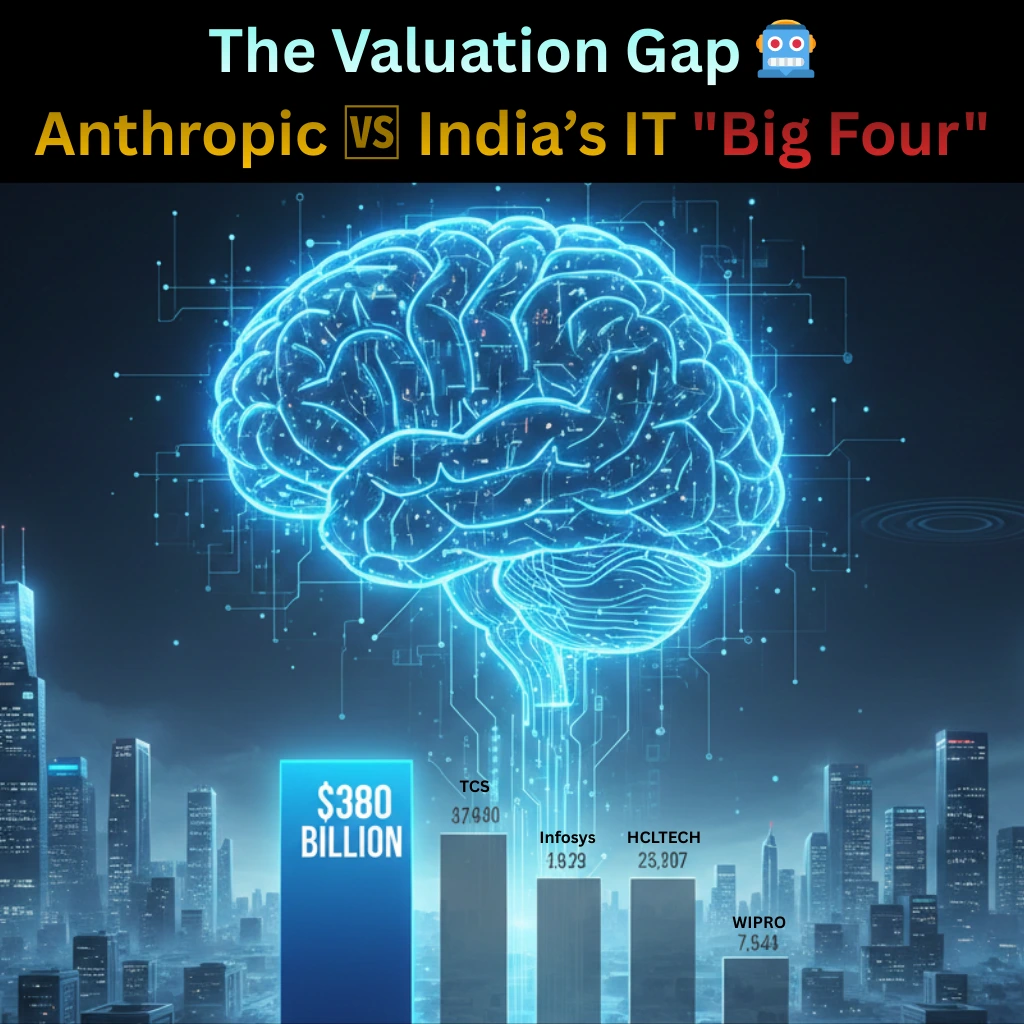
Perhaps the most jarring statistic from this recent surge is how Anthropic’s valuation now stacks up against global stalwarts. According to recent reports, Anthropic at $380 billion surpasses India’s top IT firms combined, a feat that seemed impossible just 24 months ago.
To put this in perspective, consider the “Big Four” of Indian IT: TCS, Infosys, HCLTech, and Wipro. These companies have spent decades building global empires, employing millions, and anchoring the digital backbone of the world’s largest corporations. Yet, a single AI lab with a fraction of the headcount now commands a higher market value.
Why is the market pivoting so aggressively?
- Scalability: AI models can scale infinitely with compute power, whereas traditional IT remains heavily dependent on human talent.
- Margin Potential: Software-as-a-Service (SaaS) fueled by AI offers margins that traditional services-based models simply cannot match.
- FOMO (Fear Of Missing Out): Venture capital is flowing toward “disruptors” rather than “maintainers.”
Are “AI Fears” Rocking Traditional Stocks?
The markets are currently gripped by a peculiar brand of anxiety. As Anthropic’s valuation climbs, traditional IT stocks have faced turbulence. Is this a sign of the “AI displacement” we’ve all been hearing about?
It’s not necessarily that Indian IT is failing; in fact, most of these firms are posting solid profits. However, investors are looking for exponential growth, and they see it in Anthropic’s ability to automate complex cognitive tasks that used to require thousands of billable hours. The question isn’t whether these IT giants will survive, but whether they can pivot fast enough to become “AI-first” before the valuation gap widens further.
Final Thoughts: A New Era of Value
We are no longer living in a world where “big” is defined by how many offices you have or how many employees are on your payroll. In 2025, value is defined by intellectual property and compute efficiency.
Anthropic’s $380 billion milestone is a wake-up call. It challenges the notion of what a “tech company” looks like and how quickly a newcomer can dismantle a decades-old hierarchy. Is this an AI bubble, or are we simply seeing the true price tag of the future? One thing is certain: the race for dominance is no longer about who can code the best—it’s about who can build the most intelligent machine.
FAQs
Find answers to common questions below.
How did Anthropic reach a $380 billion valuation so quickly?
It’s a mix of timing and trust. By positioning themselves as the "safety-first" alternative to other AI labs and hitting a $14 billion revenue run rate, they’ve convinced investors that their enterprise-grade Claude models are the most sustainable bet for long-term corporate integration.
Why is Anthropic being compared to Indian IT firms like TCS and Infosys?
The comparison highlights a massive shift in market sentiment. While Indian IT firms rely on massive human workforces to generate value, Anthropic’s valuation proves that investors now prioritize high-margin, scalable AI software over traditional service-based business models.
Is the current AI market in a bubble, or is Anthropic’s growth real?
While the numbers are eye-watering, Anthropic’s $14 billion annualized revenue suggests there is significant "real-world" demand. Unlike the dot-com bubble, these AI firms are seeing massive, immediate adoption from Fortune 500 companies looking to automate complex workflows.
What does this mean for the future of traditional tech jobs?
It’s a pivot point. The surge in Anthropic's value suggests that the market expects AI to handle more "routine" cognitive tasks, forcing traditional IT professionals to move toward AI management, ethics, and high-level architectural roles.