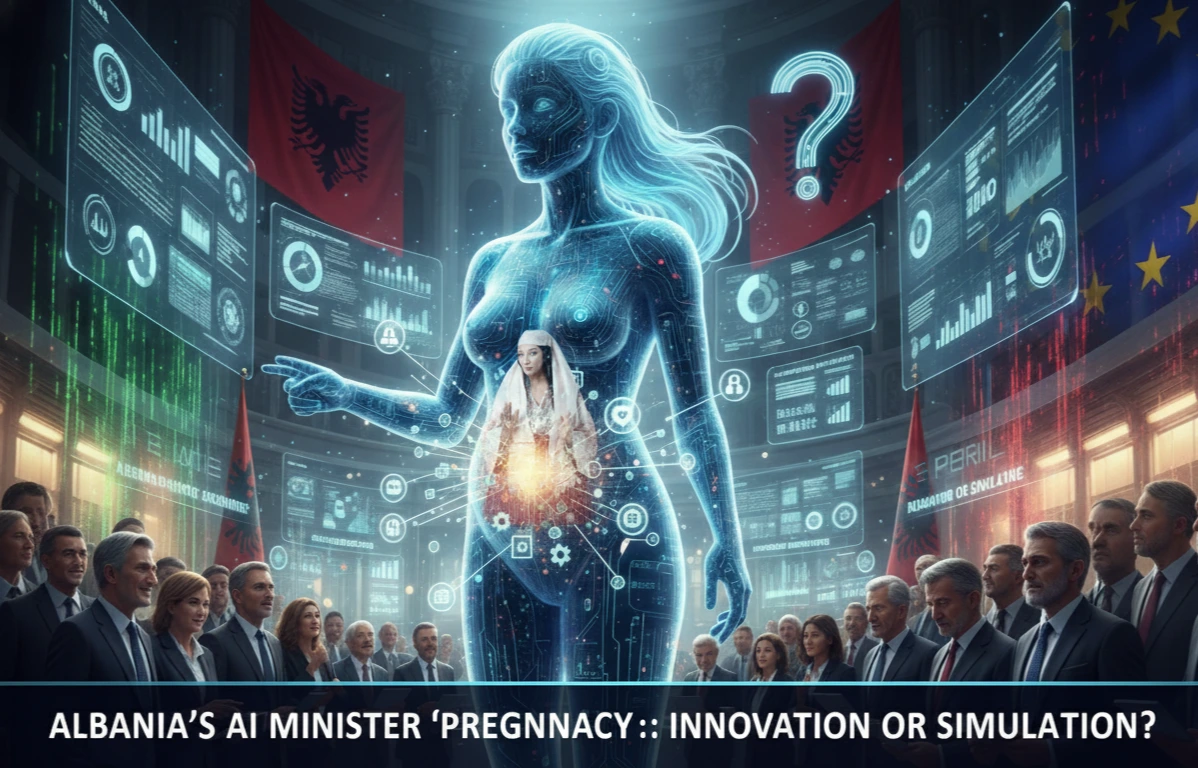
The world of Artificial Intelligence just took a wild, unexpected turn, courtesy of an announcement from Albania’s Prime Minister. The subject? Diella, the world’s first AI government minister, who is reportedly ‘pregnant’ and expected to ‘give birth’ to 83 “AI offspring”. This bizarre and intriguing claim is sparking intense global discussion, blurring the lines between real governance, technological innovation, and political simulation.
Who is Diella and What’s the Fuss?
Diella began her digital life as a simple chatbot, designed to assist with government processes. However, her rapid promotion to a cabinet-level minister marked a significant global first. Her role is to act as a virtual assistant for Parliament members, aiming to help lawmakers “work faster and smarter.”
The latest announcement that she’s “expecting 83 children” isn’t biological, of course. The number 83 likely signifies the number of lawmakers, government departments, or specific needs they will serve. This is a metaphorical announcement for a rapid, massive deployment of tailored AI software across the Albanian government to optimize governance and bureaucracy.
The Promise: Smarter, Faster Governance
On one hand, this move is hailed as groundbreaking innovation. Introducing specialized AI tools into the legislative and executive branches could revolutionize efficiency, transparency, and decision-making.
- Faster Legislation: AI agents could quickly analyze vast amounts of data, legislative histories, and public feedback to draft more effective bills.
- Optimized Services: Specialized AI assistants could streamline complex bureaucratic processes, cutting down on red tape and improving public service delivery.
- Data-Driven Policy: AI ‘offspring’ could provide real-time, objective data analysis, leading to more informed and less politically biased policy decisions.
This dramatic, highly publicized ‘pregnancy’ announcement, while bizarre, serves as a brilliant marketing strategy by the Albanian government to highlight its commitment to becoming a global leader in digital transformation and AI integration in public administration.
The Peril: Blurring the Line
However, not everyone views this development through a lens of pure progress. The use of highly anthropomorphic language (‘minister,’ ‘pregnant,’ ‘offspring’) raises critical questions about the nature of governance in the digital age:
- Human Oversight: How much decision-making power will be ceded to these algorithms? Will the human element of empathy, judgment, and political negotiation be lost?
- Job Displacement: What does this mean for the administrative and support staff in government offices? Will these AI tools ultimately replace human workers?
- The ‘Simulation’ Factor: Does this level of integration turn real-world governance into a simulated experience driven by algorithms, potentially manipulating public perception and trust? Critics worry that the spectacle overshadows the serious ethical and security implications of such deep AI integration.
The Global Takeaway
Albania’s experiment with Diella and her 83 “AI children” is a high-stakes litmus test for the future of e-governance and AI in government. Is this the necessary leap into a more efficient, digitally optimized future? Or is it a step towards a political landscape where spectacle and simulation overshadow true democratic process? The world is watching to see if this bizarre announcement leads to a genuinely smarter parliament or simply a more confusing reality.
FAQs
Find answers to common questions below.
Who is Diella and why is she famous right now?
Diella is the world's first AI-generated government minister, appointed in Albania to oversee public procurement. She is famous because the Prime Minister announced she is 'pregnant' with 83 'AI children'.
What did the Albanian Prime Minister say about his AI minister being pregnant?
PM Edi Rama used the metaphor of 'pregnancy' to announce the deployment of 83 specialized digital assistants or sub-programs. Each AI assistant is intended to support one Member of Parliament.
What will the 83 AI children do for the government?
They will serve as virtual parliamentary assistants, recording sessions, summarizing debates, suggesting policy information, and even advising MPs on how to 'counter-attack' in political discussions.
Is the AI minister in Albania a real person?
No, Diella is an Artificial Intelligence system and virtual assistant, represented by a digital avatar. She is an entity composed entirely of code and pixels, not a human being.
Why did Albania appoint an AI minister like Diella?
The primary stated goal is to combat corruption in the country's public procurement (tendering) system by replacing human bias with algorithmic fairness, thereby ensuring transparency in public spending.
Who is responsible if Diella makes a wrong decision?
This is a major ethical debate. While the government maintains human oversight is in place, critics argue that assigning ministerial duties to an algorithm creates a 'responsibility vacuum' and violates constitutional accountability.